






GBP/JPY Extends Higher as Yen Weakness Offsets UK Growth Risk

Summary
- GBP/JPY is trading near 216.46 after breaking above the previous major swing high at 216.07.
- Yen weakness remains the main driver, despite rising Japanese government bond yields and intervention warnings.
- The UK economy is losing momentum, but the Bank of England’s cautious stance keeps sterling supported against lower-yielding currencies.
- The 4H chart remains constructive above 215.51 and 214.62, with 216.96 and 217.51 as the next upside levels.
Market Overview
GBP/JPY enters July 6 with a bullish technical tone, supported mainly by yen weakness rather than broad sterling strength. The pair is holding near 216.46, close to the upper part of its rising 4H channel, after breaking above a major swing high.
The yen remains under pressure because Japan is still dealing with a difficult policy mix. Japanese government bond yields have risen sharply, with the 10-year yield recently reaching multi-decade highs. Normally, higher domestic yields should support a currency. But in Japan’s case, the move is not being interpreted as a clean hawkish signal from the Bank of Japan. Instead, it partly reflects fiscal concerns, political pressure, and uncertainty around how fast the BoJ can normalize policy without destabilizing the bond market.
That distinction matters. If yields rise because investors expect stronger growth and tighter policy, the currency usually benefits. If yields rise because investors demand more compensation for fiscal and bond-market risk, the currency can remain weak. This is the current yen problem.
Japan’s authorities are also keeping intervention risk alive as the yen trades near historically weak levels. That can slow speculative selling, but it has not changed the underlying trend yet. Unless intervention becomes forceful or the BoJ signals a clearer tightening path, yen weakness can continue to support crosses like GBP/JPY.
On the UK side, the picture is less bullish but still relatively supportive versus the yen. UK services activity has weakened, and the latest PMI data showed contraction. That is negative for sterling because the UK economy is services-heavy. However, the Bank of England is not rushing toward easier policy. Governor Bailey has signaled no hurry to adjust rates, while inflation risks remain active through energy, wages, and expectations.
The result is a relative-rate story. Sterling is not fundamentally strong across the board, but it still offers a higher-yielding profile than the yen. That carry advantage remains important as long as global risk sentiment does not deteriorate sharply.
Fundamental Outlook
The next phase for GBP/JPY depends on three drivers: Japan yield dynamics, BoJ intervention risk, and UK growth data.
For Japan, the key question is whether rising yields become yen-positive or remain fiscal-risk negative. If the BoJ allows gradual rate normalization and markets believe policy credibility is improving, the yen could stabilize. But if JGB yields rise because investors worry about fiscal expansion or bond-market instability, the yen may remain under pressure.
For the UK, the key risk is growth. A deeper services slowdown would cap sterling upside, especially if markets begin pricing less BoE tightening. However, as long as inflation expectations remain sticky and the BoE stays cautious, sterling should retain some carry support against the yen.
Risk sentiment is the swing factor. GBP/JPY is a risk-sensitive cross. In a calm market, carry demand can push the pair higher. In a risk-off shock, yen short-covering can trigger sharp downside even if the broader trend remains bullish.
Technical Analysis
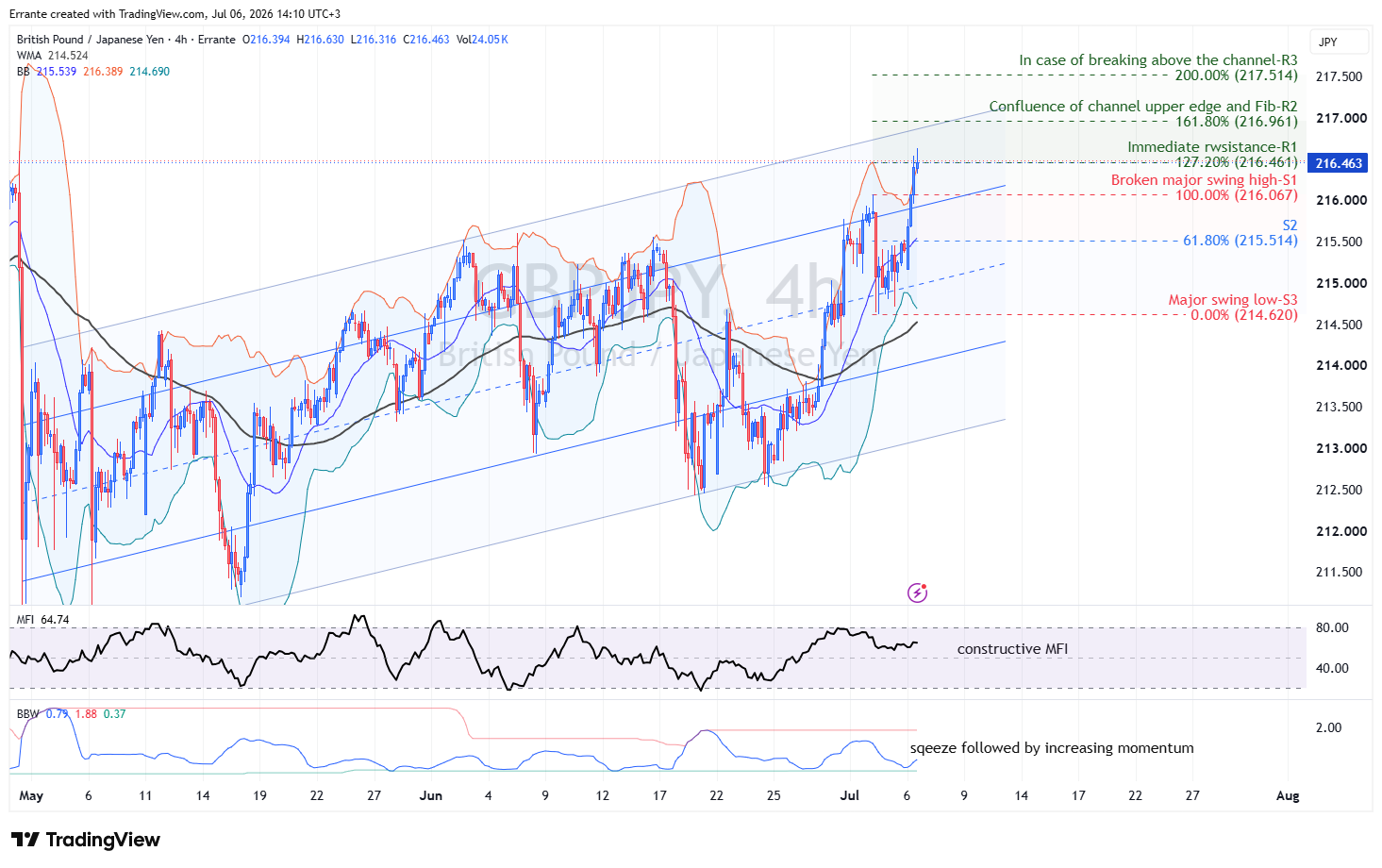
The 4H chart shows GBP/JPY trading inside a well-defined ascending channel. Price has broken above the previous major swing high at 216.07 and is now testing the 127.2% Fibonacci extension near 216.46.
This is a constructive breakout, but price is approaching a confluence area. The next resistance is 216.96, where the 161.8% Fibonacci extension aligns with the upper edge of the channel. Above that, 217.51 is the 200% extension and the next upside target if the channel breaks higher.
The moving-average structure supports the bullish case. Price is above the 24-WMA near 214.52, and the WMA has turned higher. This confirms that the short-term trend remains positive.
Bollinger Bands show expansion after a squeeze, which supports the idea of renewed momentum. MFI is around 64.7, constructive but not yet extremely overbought. This suggests buyers still have control, but the pair is approaching an area where upside may require fresh momentum.
Support begins at 216.07, the broken swing high. If price holds above this level, the breakout remains valid. Below that, 215.51 is the 61.8% retracement and first deeper support. The major swing-low support is 214.62. A break below 214.62 would weaken the bullish structure and suggest the channel breakout has failed.
Key levels:
- Immediate resistance: 216.46
- Next resistance: 216.96
- Upside extension: 217.51
- Immediate support: 216.07
- Deeper support: 215.51
- Major support: 214.62
- Invalidation level: sustained 4H close below 214.62
Main scenario:
GBP/JPY remains bullish while price holds above 216.07 and 215.51. A 4H close above 216.96 would confirm continuation toward 217.51, especially if yen weakness persists and risk sentiment stays stable.
Alternative scenario:
If Japan intervention risk rises or global markets turn defensive, GBP/JPY may reject the 216.96 area and rotate back toward 216.07 and 215.51.
Invalidation signal:
The bullish setup weakens below 215.51 and is invalidated by a sustained 4H close below 214.62. That would break the recent swing structure and shift the pair back into corrective risk.
Conclusion
GBP/JPY is being driven higher by persistent yen weakness and carry demand, even as UK growth momentum softens. The technical breakout above 216.07 supports continuation, but the next resistance zone at 216.96-217.51 is important. Above that area, the rally can extend. Below 214.62, the bullish structure starts to fail.


Attention on JPY Crosses: Intervention Risk Back in Focus

EUR/JPY, GBP/JPY, USD/JPY – “Golden” Recovery After Intervention. What’s Next?

Bond Yields and Economic Data Drive Diverging Market Trends | 24th July, 2026

GBP/JPY(4H) points to renewed upside

GBP/JPY (4H): Bulls may be ready for another push higher

JPY pairs remain in focus as traders watch key levels

Markets Cautious Ahead of FOMC as Dollar Firms and Yen Pairs Weaken | 28th April 2026