




Instant Funding vs Challenge Funding: Pros and Cons

When choosing a prop firm, one of the first decisions traders face is the funding model. Most firms offer either instant funding or challenge-based funding. Both options give access to firm capital, but they work very differently and suit different trader profiles.
What Is Instant Funding?
Instant funding allows traders to access a funded account immediately after purchasing a program. There is no evaluation or challenge phase. You start trading live under real prop firm rules from day one.
Because the firm takes on more upfront risk, instant funding accounts usually come with stricter rules, lower profit splits, or smaller maximum account sizes.
What Is Challenge Funding?
Challenge funding requires traders to pass one or more evaluation phases before receiving a funded account. These challenges test profitability, discipline, and risk management.
Once the challenge is passed, traders gain access to larger capital, higher profit splits, and more long-term scaling opportunities.
Main Differences Between Instant and Challenge Funding
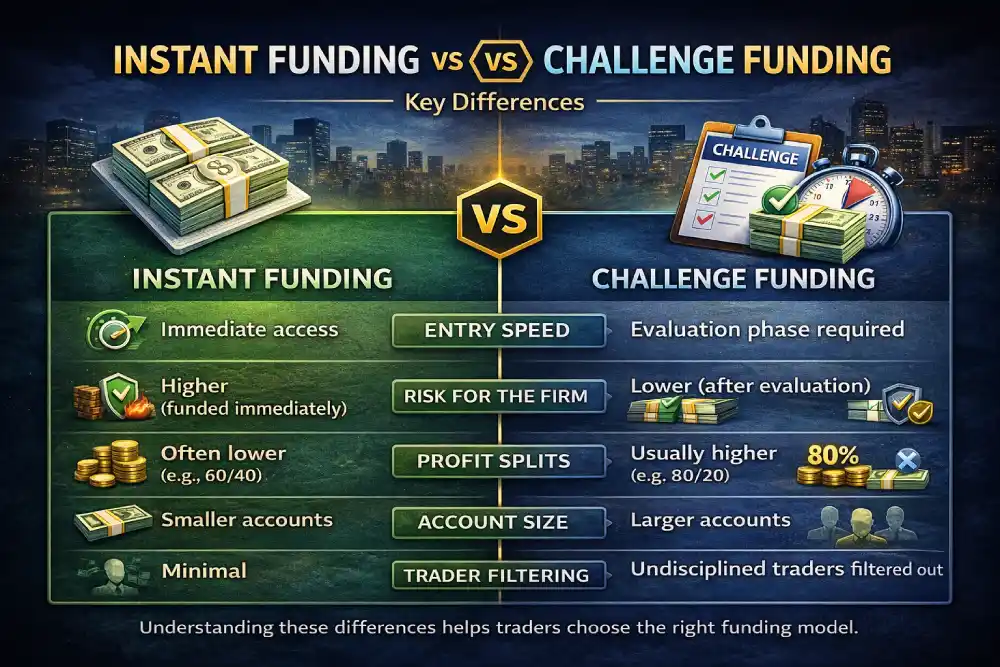
- Entry speed: Instant funding provides immediate access, while challenge funding requires passing an evaluation.
- Risk for the firm: Higher with instant funding, lower with challenge-based models.
- Profit splits: Usually lower for instant funding and higher after passing a challenge.
- Account size: Instant funding accounts tend to be smaller.
- Trader filtering: Challenges filter out undisciplined traders before funding.
Pros and Cons of Instant Funding
Pros
- No evaluation or challenge phase
- Immediate access to a funded account
- Suitable for experienced, disciplined traders
- No pressure to hit profit targets quickly
Cons
- Lower profit splits in many cases
- Stricter drawdown or risk rules
- Limited scaling opportunities
- Higher upfront cost
Pros and Cons of Challenge Funding
Pros
- Higher profit splits after passing
- Access to larger account sizes
- Clear path to scaling capital
- Better long-term earning potential
Cons
- Risk of failing the challenge
- Pressure to meet profit targets
- Evaluation fees may be lost if rules are broken
- Requires patience and discipline
Which Funding Model Is Better for Beginners?
For most beginners, challenge funding is often the better choice. The evaluation phase forces traders to develop discipline, risk control, and consistency before managing large capital.
Instant funding may be attractive, but without strong risk management, beginners can lose accounts quickly under strict drawdown rules.
Which Funding Model Is Better for Experienced Traders?
Experienced traders with proven systems may prefer instant funding, especially if they want to avoid time pressure and trade at their own pace.
However, many professional traders still choose challenge funding because of higher profit splits and better long-term scaling options.
Final Thoughts
Instant funding and challenge funding serve different purposes. Neither option is objectively better—it depends on your experience, mindset, and trading style.
The key is to choose the funding model that aligns with how you trade, not the one that simply looks faster or easier on the surface.