




Prop Trading vs Hedge Funds: Key Differences and Strategies
1. Introduction
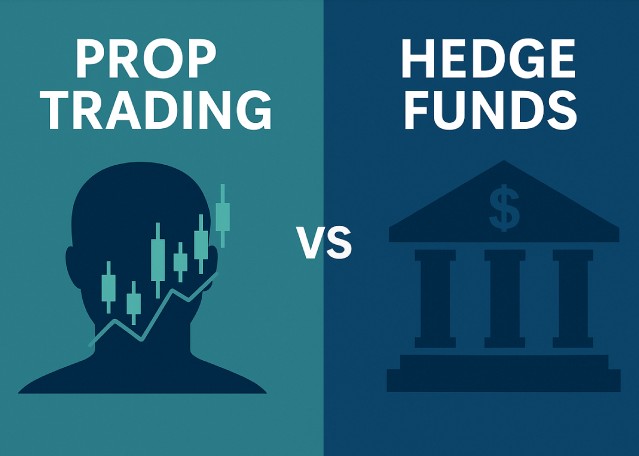
Professional trading is no longer reserved for big banks and institutional desks. Today, proprietary trading (prop trading) firms and hedge funds both offer exciting opportunities to generate market-beating returns through active strategies.
While they share the ultimate goal of finding alpha and managing risk, their business models, regulations, and career paths differ in fundamental ways. Understanding these differences is essential for traders, quants, and developers who want to choose the right environment for their ambitions.
2. Definitions and Core Concepts
What Is Proprietary Trading?
Proprietary trading firms use their own capital to trade financial markets.
- Profits (and losses) belong directly to the firm.
- Common setups include classic prop desks and modern prop firms that allow external traders to trade the firm’s money after passing an evaluation challenge.
What Is a Hedge Fund?
A hedge fund manages investor capital, usually from accredited investors or institutions.
- Managers pursue a wide range of active strategies designed to outperform the market.
- Hedge funds often pool billions of dollars and operate under more formal structures and investor reporting standards.
3. Key Differences Between Prop Trading and Hedge Funds
3.1 Source of Capital and Business Structure
- Prop Trading: Trades exclusively with the firm’s own capital. There are no external investors to satisfy, which allows more flexibility in risk-taking and strategy design.
- Hedge Funds: Raise and manage outside capital from limited partners (LPs). Fundraising, investor relations, and performance reporting are central parts of the business.
3.2 Regulation and Compliance
- Prop Firms: Face lighter regulatory requirements because they don’t manage client money. Many are still registered with major global regulators to ensure trader safety.
- Hedge Funds: Must register and report to regulators (for example, filing SEC forms such as 13F, 13D/13G, PF) and comply with strict anti–money laundering (AML) and know-your-customer (KYC) rules.
3.3 Time Horizons and Trading Styles
- Prop Trading: Focuses on short-term, high-frequency, and quantitative strategies—think market making, statistical arbitrage, and algorithmic trading. Speed and micro-alpha are key. Traders also care about execution costs, including prop firm spreads.
- Hedge Funds: Operate across a wide spectrum—from intraday to multi-year plays. Strategies range from long/short equity and event-driven trades to global macro.
3.4 Compensation Models
- Prop Trading: Traders typically receive a profit split (a percentage of the PnL). Many retail-oriented prop firms require an evaluation challenge fee to access firm capital.
- Hedge Funds: Follow the classic “2 and 20” model (management fee plus performance fee), although pressure has lowered these numbers for some funds. Employees receive a base salary plus bonuses linked to fund performance.
3.5 Risk and Accountability
- Prop Trading: The firm bears the financial risk, but traders’ income is directly tied to their own profits and losses.
- Hedge Funds: Carry fiduciary responsibility toward their investors. Risk management is tightly supervised by compliance teams and investment committees.
4. Career Paths and Workplace Reality
4.1 The Trader’s Role
In prop trading, traders work in fast-moving environments where milliseconds and execution algorithms matter.
In hedge funds, traders and portfolio managers focus on broader research, macro views, or cross-asset strategies that may take weeks or months to play out.
4.2 Quant Developers and Engineers
For quant developers and software engineers, the day-to-day work can be quite similar in both environments—building low-latency systems, modeling risk, and analyzing big data. The main distinction is that high-frequency trading (HFT) is historically more concentrated in prop firms, while hedge funds may incorporate HFT strategies only in specialized teams.
4.3 Moving Between the Two Worlds
It’s possible to transition between prop firms and hedge funds, but starting your own hedge fund is far harder than popular myths suggest. High barriers to entry—capital raising, regulatory filings, and investor trust—mean few traders successfully launch funds from scratch.
5. Pros and Cons for Traders
| Aspect | Prop Trading | Hedge Fund |
|---|---|---|
| Starting Out | Quick onboarding, minimal bureaucracy | Slower entry, requires strong track record and investor network |
| Flexibility | High autonomy, fast decision-making | Lower autonomy, more committees and investor oversight |
| Income Potential | High upside directly tied to PnL | Stable base salary plus performance bonus |
| Risk | Income volatility; firm capital at stake | More stability; fiduciary responsibility for client funds |
6. Which Path Fits You?
Choose Prop Trading if: You thrive on speed, micro-alpha, algorithmic execution, and direct PnL accountability.
Choose a Hedge Fund if: You prefer a wider investment universe, long-term strategies, and working within a structured institutional environment with external capital.
Your personality, risk appetite, and desired lifestyle are key. Someone who enjoys coding low-latency strategies might excel at a prop shop, while someone passionate about global macroeconomics might find a hedge fund more fulfilling.
7. Conclusion
Prop trading and hedge funds both aim to beat the market, but they do so with very different structures, regulations, and cultures.
Neither path is objectively “better.” The right choice depends on your career goals:
- Do you want speed, autonomy, and pure trading focus? Prop trading might be ideal.
- Do you want diverse strategies, institutional scale, and investor relations? A hedge fund could be the better fit.
The key takeaway: know your strengths and long-term objectives. Both worlds reward talent and discipline, but success requires a clear match between your skills and the environment.
FAQ
- 1. What is prop trading?
- Prop trading (proprietary trading) means a firm trades with its own capital to generate profits, rather than executing trades on behalf of clients. Traders typically share in the profits they generate. For a deep dive into how it works, read our detailed guide The Complete Guide to Proprietary Trading.
- 2. What is a hedge fund?
- A hedge fund is an investment partnership that pools capital from accredited investors or institutions to pursue active, often complex trading strategies. Hedge funds aim to generate returns that outperform traditional markets while carefully managing risk and regulatory requirements.
- 3. How do prop firms make money if they don’t manage client funds?
- Prop firms earn revenue directly from trading profits. Many also charge small evaluation or challenge fees for access to capital and advanced infrastructure, and some receive technology or data rebates from exchanges.
- 4. Which path offers better career prospects: prop trading or hedge funds?
- It depends on your goals. Prop trading suits those who thrive on speed, algorithmic execution, and direct PnL accountability. Hedge funds are better for professionals who prefer a broader set of strategies, longer investment horizons, and a structured environment with investor oversight.
- 5. What are the typical risks involved in prop trading and hedge funds?
- In prop trading, traders face income volatility since earnings depend heavily on trading performance, though firm capital absorbs direct losses. Hedge funds must protect investor capital and comply with strict regulatory rules, but professionals enjoy steadier compensation and institutional risk controls.
- 6. Do I need special licenses or certifications to join a prop firm or hedge fund?
- Licensing requirements vary by jurisdiction and role. Some prop firms require no formal licenses because they trade only the firm’s capital, while hedge funds often need regulatory registration and compliance with local securities laws.