Why the Yen Is Falling Despite a BoJ Rate Hike


On Friday, Fed Chair Kevin Warsh made it clear in Jackson Hole that he does not yet consider inflation defeated. The yen subsequently slipped to 159.84 per dollar, its weakest level since July. This is notable because the Bank of Japan is highly likely to raise rates again within the next few weeks. A currency depreciating immediately ahead of its own central bank's rate hike requires an explanation.
The DataLet's start with the Fed. The policy rate has remained unchanged at 3.50 - 3.75% since the July meeting, marking the fifth consecutive meeting without a change, although three dissenting officials had already voted for a hike at that meeting. In Jackson Hole, Warsh argued that underlying inflation was not slowing meaningfully, that the PCE index remained the key indicator, and that financial conditions were currently not restrictive. The data support his view: The PCE price index rose 3.7% year over year in July, while the core rate stood at 3.3%. On a monthly basis, the index rose 0.2%, above the expected 0.1%. Interest-rate futures now price roughly a 50% probability of a September hike, while the probability for December stands above 70%.
On the Japanese side, the direction is broadly similar, but the level is completely different. The Bank of Japan raised rates by 25 basis points to 1.00% in June, the highest level since September 1995, and remained on hold in July. For September, the market is pricing an additional hike to 1.25% with a probability of around 87%; ahead of the July meeting, that figure was still only around 23%. Deputy Governor Ryozo Himino said last week that the central bank remained alert to upside risks to inflation and that timely rate increases could prevent the need for more abrupt moves later. Tokyo's core consumer price index rose to 1.8% in August, the highest level in five months, while the measure excluding energy and fresh food rose to 2.0%. The unemployment rate fell to 2.4% in July, its lowest level in a year. The 10-year Japanese government bond yield stands at 2.88%, a multi-decade high.
Two central banks, therefore, moving in the same direction. And yet the yen is falling.
What Positioning Reveals
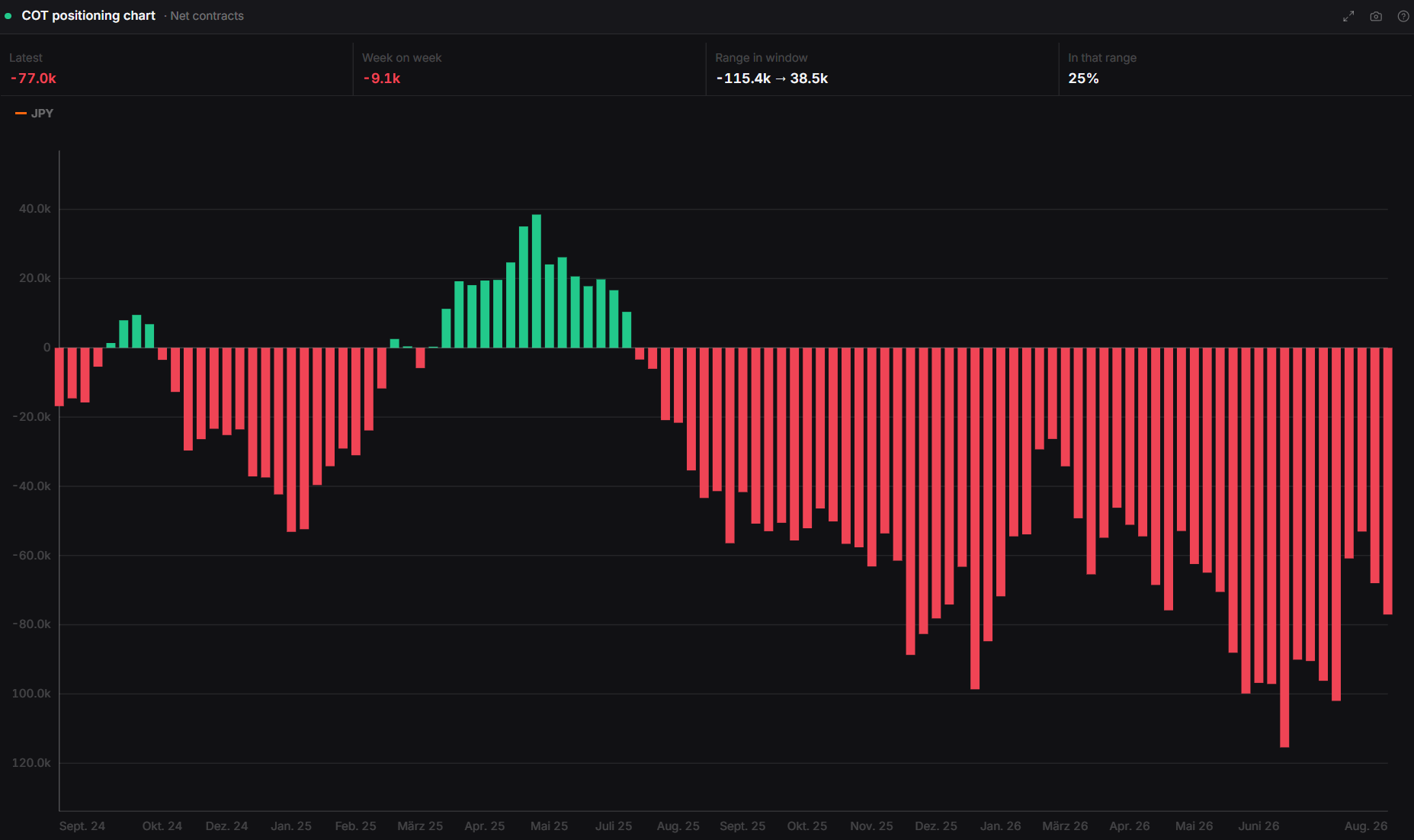 The most revealing part is not found in rate expectations, but in the Commitments of Traders data. As of August 25, leveraged funds held a net short position of 77,042 yen contracts, equivalent to 20.1% of open interest. The 520-week COT index stands at 30.6.
More important than the absolute level is the trajectory. On July 28, the net short position stood at 101,990 contracts. By August 11, it had been nearly cut in half to 53,070. Over the following two weeks, funds rebuilt the position to 77,042, effectively reversing almost half of the previous short-covering. And this happened precisely during the period in which the probability of a BoJ rate hike rose from below one-quarter to nearly nine-tenths.
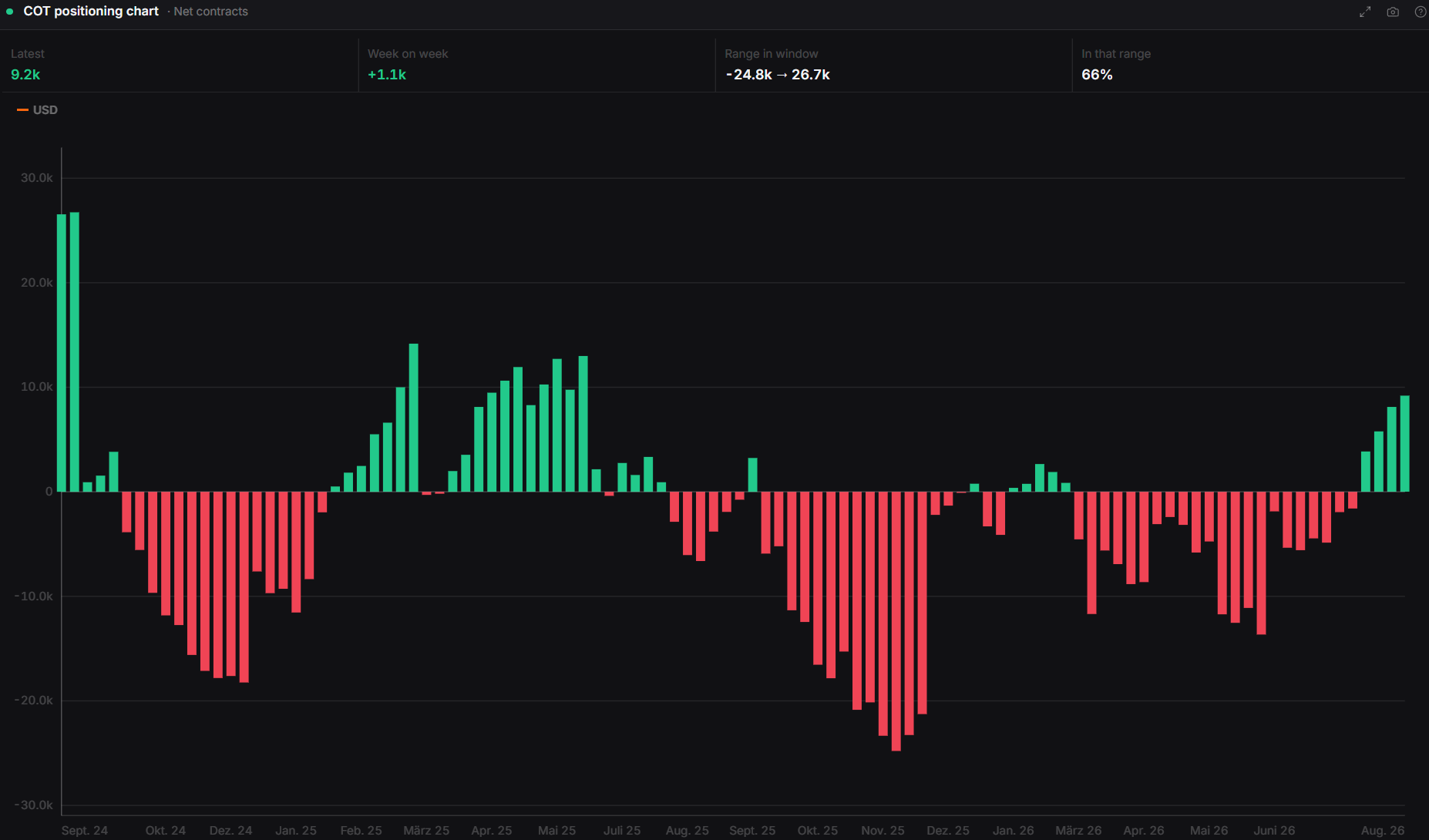
The other side of the trade confirms the picture. The dollar stood at a net long position of 9,189 contracts on the same date, equivalent to 19.2% of open interest, with a COT index of 66.9. At the beginning of June, the position was still net short by 13,656 contracts. Since June 9, it improved for seven consecutive weeks, turning net long on August 4. This is not a one-off reaction to a speech, but a systematic build-up over an entire quarter.
The message is clear: The market does believe the Bank of Japan. It simply considers the expected rate hike insufficient.
Three Reasons Why This Is RationalFirst, the interest-rate differential. Even if both central banks deliver in September, the policy rates would stand at 3.75–4.00% versus 1.25%. The gap would remain around 250 basis points. For the carry trade, borrowing in yen and investing in higher-yielding currencies, a 25-basis-point hike changes very little in the underlying calculation.
Second, the energy bill. Japan imports virtually all of its primary energy. The Japan/Korea Marker price for liquefied natural gas stands above $23 per MMBtu, its highest level since January 2023, as disruptions around the Strait of Hormuz have delayed Qatari shipments for weeks. Japan's current account posted a deficit of ¥923 billion in July. This creates a potentially self-reinforcing mechanism: a weaker yen makes imports more expensive, which puts pressure on the current account, while a weaker current account in turn weighs on the yen.
Third, the fiscal side. The Ministry of Finance is considering raising the assumed interest rate used for debt-service planning for fiscal year 2027 from 3.0% to 3.8%. Higher interest rates are not merely a monetary-policy issue for Japan, but also a fiscal one — and this limits how far the Bank of Japan can realistically go.
What Speaks Against This ViewThis argument has a significant weakness, and it lies not in Japan but in the United States.
The Chicago PMI collapsed to 47.1 points in August, down from 57.6 in July and well below expectations of 58.3. New orders fell by 15.4 points. At the same time, the prices-paid component rose to its highest level since February 2022. The University of Michigan's consumer sentiment index stands at 51.7, roughly 11% below its level a year ago. New home sales fell 10.5% in July. The preliminary annual revision to employment data revised payrolls down by 79,000 jobs.
This is a stagflationary pattern: collapsing order activity alongside rising price pressures. The labor market is holding up for now, initial jobless claims recently stood at 203,000, close to the 60-year low recorded in July. But if the economic slowdown becomes entrenched while inflation remains elevated, the Fed could find itself in a situation where a rate hike becomes increasingly difficult to justify. If the expected Fed hike is priced out, the dollar side of this equation loses one of its key supports.
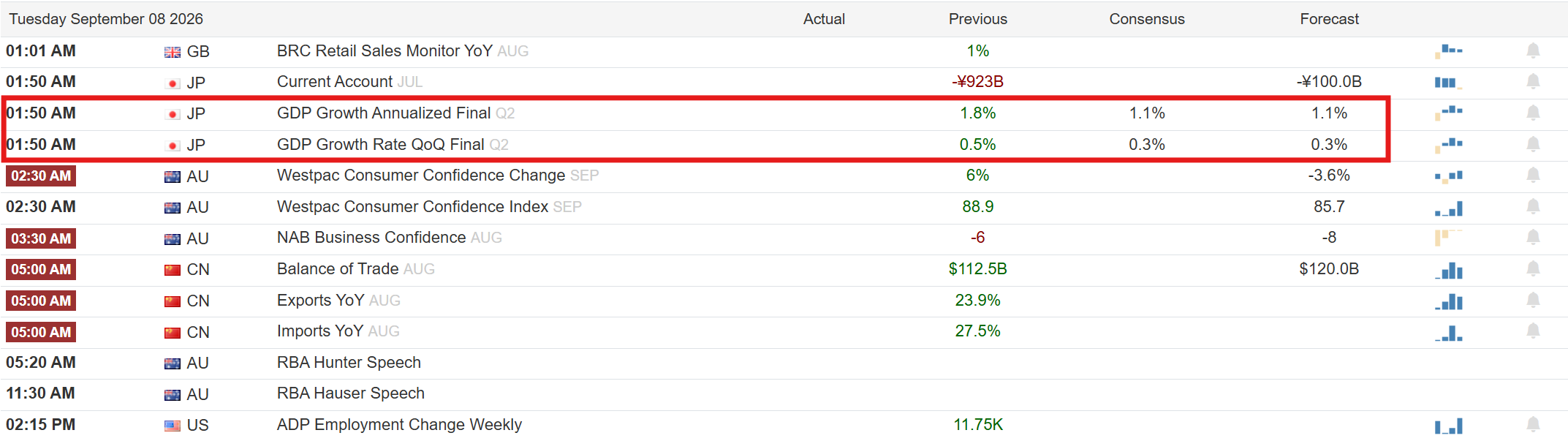
What to Watch NowOn September 8, the final reading of Japanese second-quarter GDP will be released. The previous estimate showed growth of 0.5% quarter over quarter, while consensus expects a downward revision to 0.3%.
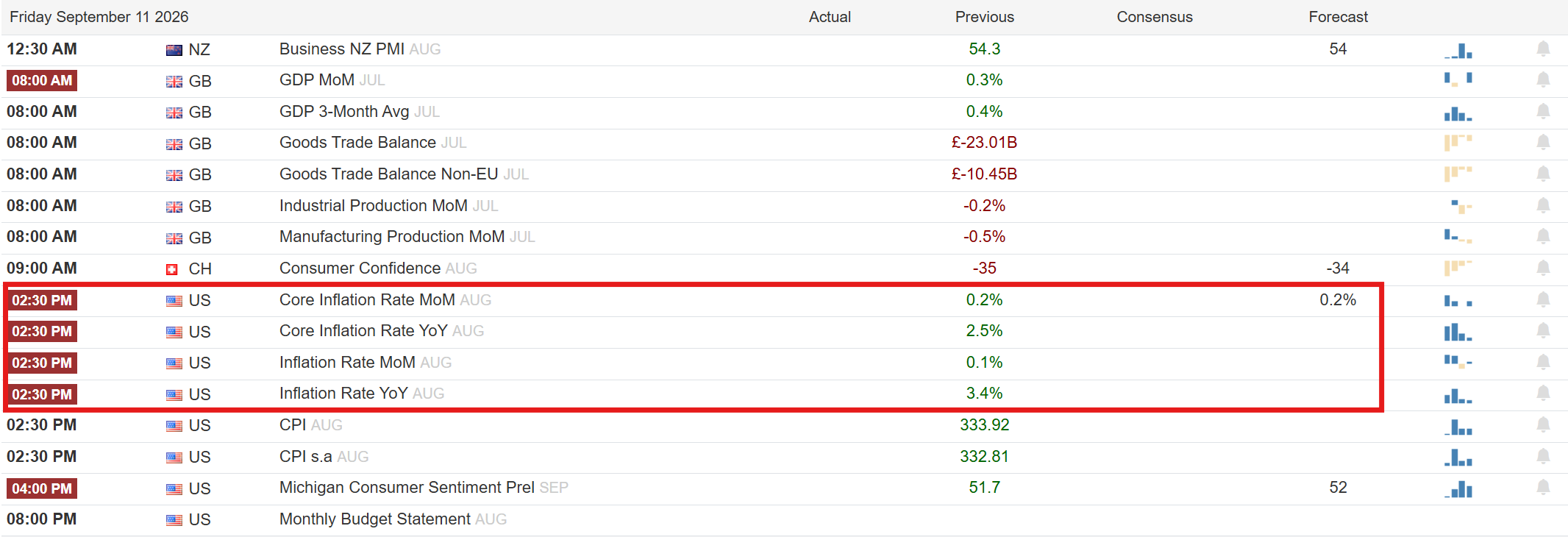
 On September 11, the US CPI report for August will follow, with the core rate expected to rise 0.2% month over month. Both central bank meetings will also take place in September and represent the key decision points.
From a technical perspective, the 160 level is particularly important. The coordinated intervention by Tokyo and Washington took place roughly one month ago and has failed to hold. Another test of this zone could raise the question of whether, and by what means, the Ministry of Finance would intervene again.
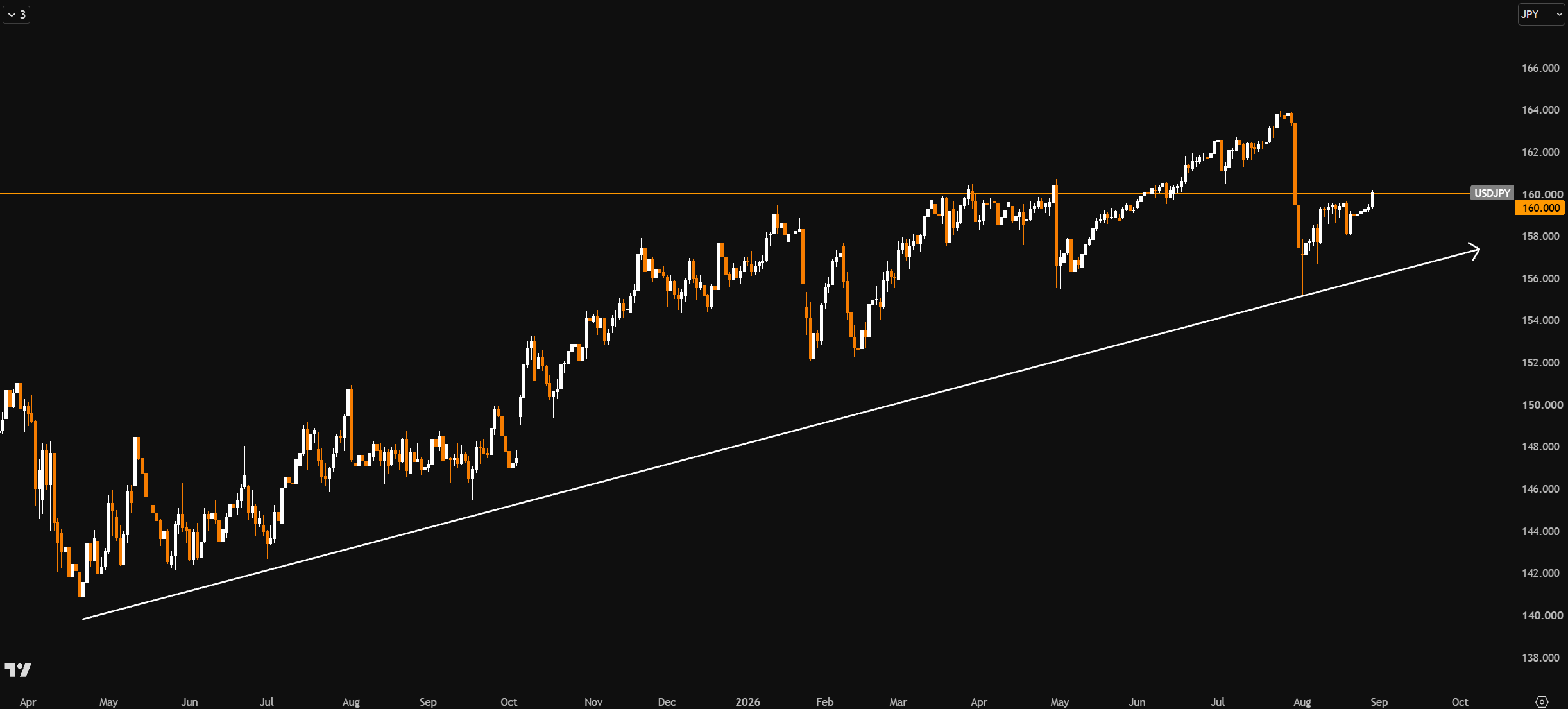
ConclusionThe USD/JPY situation cannot be explained by rate hikes alone. Both central banks are tightening, but the starting levels remain too far apart to end the carry trade. As long as the interest-rate differential remains around 250 basis points and Japan's energy imports continue to weigh on the current account, leveraged-fund positioning points toward continued yen weakness.
The key counterargument is not the Bank of Japan, but the US economy. If the US slowdown becomes pronounced, the rate hike currently priced into the Fed curve could disappear, taking with it one of the major pillars supporting dollar strength.

I think the interest-rate differential is probably the key point here. Even with another BoJ hike, the gap with US rates would still be large enough for the carry trade to remain attractive. It will be interesting to see how positioning changes after the upcoming central-bank decisions and whether the 160 level gets tested again.

Interest rate does not currently favour the yen