






Sterling’s Rebound Faces US Inflation Hurdle

Summary
- The Bank of England’s broadly supported rate increase underpins sterling, but the outlook for further tightening remains conditional.
- Strong US employment data have reinforced expectations for a December Federal Reserve increase, putting Tuesday’s inflation report at the centre of the outlook.
- GBP/USD has recovered from a cluster of technical support, with 1.34463 marking the next important resistance.A sustained break below 1.33386 would undermine the recovery and expose 1.32720.
Market Overview
Sterling’s rebound against the dollar faces an immediate hurdle from US inflation data, as traders weigh the Bank of England’s renewed tightening against evidence that the US economy can withstand higher interest rates.
GBP/USD stood at 1.34210 in the supplied four-hour chart on Monday, recovering from last week’s decline towards its rising trendline and 200-period weighted moving average. The rebound preserves the recovery that began in October, although momentum indicators have yet to confirm renewed upward strength.
The Bank of England raised Bank Rate to 4% on November 5, with a voting pattern that carried more significance than the quarter-point increase itself. Eight policymakers supported the increase, while Catherine Mann preferred a half-point rise. Every member therefore favoured higher borrowing costs, a marked shift from September’s 6–3 vote to leave rates unchanged.
That broader support strengthens sterling’s policy backing. It does not, however, establish a fixed path for further increases.
The BoE expects inflation to approach 5% in mid-2027, with energy costs continuing to feed through to household and business bills. Its projections also show the cost of prolonged restraint: annual GDP growth in the fourth quarter of 2027 is forecast at 1%, down from 1.4% previously.
Those projections are conditioned on market interest rates, rather than a promised policy path. For sterling, the distinction matters. Higher expected rates can support returns on UK assets, while weaker purchasing power and investment can erode confidence in the economy.
The dollar retains substantial support of its own. US payrolls increased by 165,000 in October, while revisions added 84,000 to the previous two months. Average hourly earnings rose 0.4%, and unemployment was 4.1%, according to the Bureau of Labor Statistics.
Interest-rate futures assigned roughly an 81% probability to a December Fed increase in Monday’s trading. The dollar’s retreat as risk appetite improved therefore leaves the underlying rate argument largely intact.
Technical Analysis
GBP/USD is rebounding from structural support and has moved back above 1.34130, but resistance at 1.34463 separates the recovery from a stronger continuation signal.
The four-hour chart shows an improving structure since mid-October. A break below the shaded trading range was quickly reversed, followed by higher swing lows. The price action supports the interpretation of a failed downside breakout. The chart alone cannot establish whether specific stop orders or institutional flows caused the reversal.
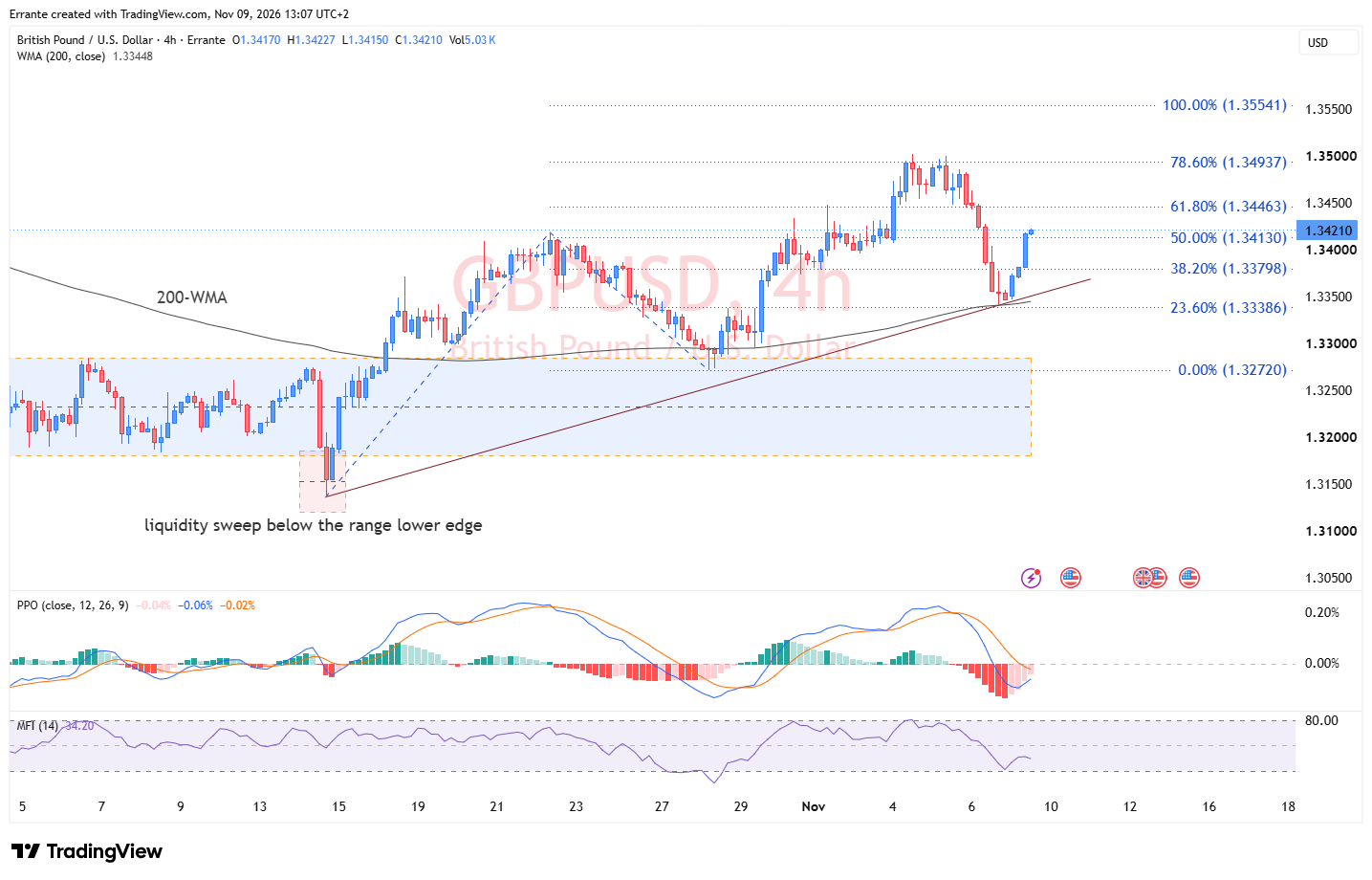
The latest decline from approximately 1.34937–1.35000 found support around 1.33386–1.33448. That area combines a Fibonacci projection, the rising trendline and the 200-period weighted moving average, shown at 1.33448 in the chart snapshot.
The moving average is flattening after its earlier decline. Price holding above it is constructive, although this is still a developing recovery rather than an established, strongly rising trend.
The Fibonacci grid projects the earlier October advance from the late-October corrective low at 1.32720. Its upper levels represent projected objectives. In particular, 1.35541 is an extension target, not a previous swing high.
Price has reclaimed the grid’s 50% level at 1.34130. A sustained four-hour close above the 61.8% level at 1.34463 would strengthen the case for a return towards 1.34937–1.35000.
Momentum remains cautious. The percentage price oscillator, or PPO, is below zero and its signal line. Its shrinking negative histogram indicates that selling pressure is easing, without yet confirming bullish momentum.
The money flow index, or MFI, has recovered to approximately 34.20 from near oversold territory but remains below its midpoint. In spot foreign exchange, the indicator uses the chart feed’s volume proxy and should not be interpreted as a direct measure of global capital flows.
Technical reference
Immediate support - 1.34130Secondary support - 1.33798Structural support cluster - 1.33386–1.33448Deeper support - 1.32720Immediate resistance - 1.34463Previous-high resistance zone - 1.34937–1.35000Higher extension objective - 1.35541
Fundamental Outlook
Tuesday’s US consumer price report is the main near-term catalyst. Softer underlying inflation would challenge expectations for additional Fed tightening and offer sterling a firmer foundation.
A slowdown driven mainly by energy would be less persuasive if services and other underlying price pressures remained strong. The composition of the report, and the response in Treasury yields, will matter alongside the headline number.
UK third-quarter GDP is scheduled for Thursday, November 12. Resilient domestic demand would reinforce the BoE’s assessment that activity can withstand tighter policy. A disappointment would sharpen concerns about the economic cost of higher borrowing costs.
Friday’s US producer price report provides a further inflation signal, particularly through components that feed into the Fed’s preferred personal consumption expenditures price measure.
The key market gauge is the UK–US two-year yield differential. An improvement in sterling’s relative yield position would lend credibility to the price rebound.
Scenario Map
Main scenario: recovery continues
Holding 1.34130, followed by sustained acceptance above 1.34463, would strengthen the outlook towards 1.34937–1.35000. Softer US inflation and improving relative UK yields would support that outcome. A break above the previous highs would bring 1.35541 into view.
Alternative scenario: resistance caps the rebound
Rejection around 1.34463, followed by a loss of 1.34130 and 1.33798, would point towards another test of the 1.33386–1.33448 support cluster. Strong US inflation or disappointing UK growth would reinforce the setback.
Invalidation signal:
A sustained four-hour close below 1.33386, followed by a failed recovery of the support cluster, would undermine the higher-low structure and expose 1.32720.
Trading Takeaways
The rebound has stronger technical foundations than its momentum readings currently suggest. Confirmation would come from a break of resistance accompanied by improving indicators and supportive relative yields.
Recent large candles also argue for treating the marked levels as reaction zones. A brief move above resistance around a data release carries less weight than a sustained close and successful retest.
Conclusion
Sterling has defended an important support area, but extending the recovery requires the interest-rate outlook to move in its favour. Softer US inflation and sustained acceptance above 1.34463 would provide the clearest confirmation.


Gold, GBPUSD, EURUSD

US Payrolls in Focus as Wall Street Rout and Falling Yields Cap the Dollar | 6th November, 2026

The dollar saves the day

Tech Stocks Lead US Selloff Ahead of Payrolls

GBPUSD bull run: Can the pair smash through 1.3565?

Democrats' Midterm Victory Sends Dollar and Oil Lower

US Midterm Elections: Analyzing Fiscal Deficits, Treasury Yields, and the Greenback