






Dollar traders lock gaze on US CPI data

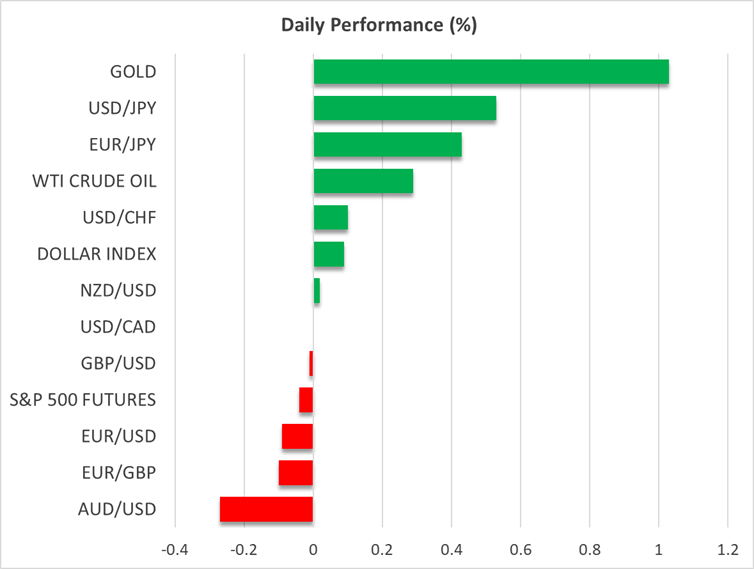
Dollar gains, but investors still expect 60bps Fed rate cuts
The US dollar continued to gain ground against its major counterparts on Thursday, losing ground again only against the yen. Today, it rebounded against the Japanese currency as well, but dollar/yen is set for its worst week in almost 15 months.
It seems that dollar traders continued to add to their long positions on the back of Wednesday’s much-stronger-than-expected jobs report. However, with such a blockbuster report, the dollar gains should have been more if investors were actually convinced that it will drastically impact the Fed’s course of action.
Market participants somewhat scaled back their rate cut bets just after the release to price in 50bps worth of reductions for this year from 60, but today, they are back close to 60bps, which translates into two quarter-point reductions and a 40% chance of a third.
This could mean that more good data is needed to convince investors that there is no need for the Fed to proceed with so many rate cuts. What places the bar even higher is US President Trump’s obsession for aggressive reductions in borrowing costs and the likelihood of the new Fed Chair nominee to fulfill the President’s wishes.
US CPI inflation data enter the spotlight
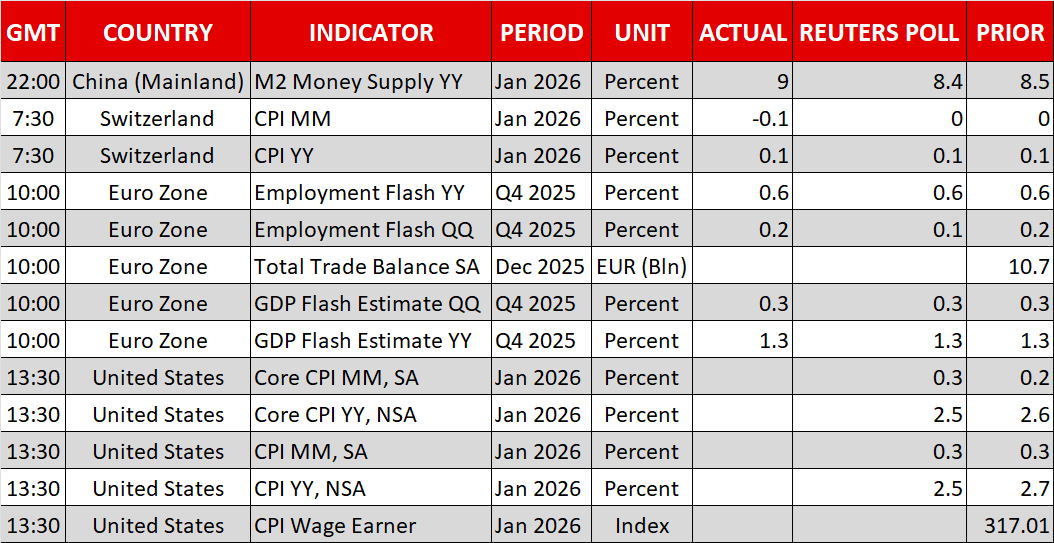
Today, the spotlight is likely to turn to the US CPI data for January. Expectations are for both the headline and core CPI rates to have ticked down to 2.5% y/y from 2.7% and 2.6% respectively. That said, with the prices subindices of both the ISM manufacturing and services PMIs suggesting accelerating inflation, the risks of the CPIs may be tilted to the upside. The fact that the Cleveland CPI Nowcast is projecting a 2.76% y/y core CPI rate for January is also corroborating the notion of higher-than-expected numbers.
Thus, should inflation prove to be stickier than anticipated, market participants could buy some more dollars as they reconsider whether a third rate cut is needed this year. They may decide to scale their bets back closer to 50bps worth of reductions by December.
Yen retreats on PM adviser’s remarks, aussie pulls back
The yen continued to shine on Thursday, but it pulled back today following remarks by a PM Takaichi adviser, who said that the government does not necessarily need to appoint BoJ members committed to aggressive monetary policy easing, but added that a rate hike in March would likely be premature, given the need to assess the impact of the December move.
A Takaichi victory on Sunday’s election means that she will be able to pass through her fiscal spending plans much more easily through parliament, which combined with a BoJ proceeding more slowly with rate hikes, consist of a blend of developments that are negative for the yen. That said, the repetitive intervention warnings by the finance ministry and concerns about a coordinated US-Japan action, are unlikely to allow dollar/yen to rise beyond 160.00 and extend its prevailing uptrend. Maybe a sideways period of volatile swings is lying ahead of us.
The aussie pulled back against its US counterpart, but the broader uptrend of the aussie/dollar pair appears to be in no danger. After all, there is a huge divergence in monetary policy expectations between the RBA and the Fed, with the former already beginning raising interest rates and the latter expected to cut at least two more times this year.
RBA Governor Bullock said yesterday that the Bank will stay in a hiking course if inflation becomes “entrenched”, remarks that added to the likelihood of a back-to-back 25bps rate hike at the March 17 gathering. The probability for such a move now stands at 23%.
Stocks retreat on AI concerns; Gold falls back below $5000
Wall Street’s main indices fell sharply yesterday, with the tech-heavy Nasdaq losing more than 2%, after Cisco Systems announced a quarterly adjusted gross margin below estimates, mainly due to a surge in prices of memory chips. This sent the firm’s stock diving 12% and wiped out around $40bln of its market cap.
This had a spill-over effect, with Apple slumping around 5%, as investors’ concerns about whether massive AI investments will turn into profitability are growing. Transport stocks were also hit hard on worries of AI disruptions, but also as Wednesday’s jobs report revealed weakness in transportation hiring.
Gold pulled back, slipping back below the $5,000 mark, perhaps on a delayed response to the dollar’s recovery. However, the broader fundamental outlook has not changed enough to suggest that gold may be headed for a full-scale bearish reversal. The Fed is expected to reduce interest rates at least twice this year, central banks continue to buy gold for their reserves, and concerns about geopolitical flare ups are never negligible nowadays. Today, the precious metal is rebounding again.


The US Equities Brace for Further Pressure as Short Positioning Reaches Extremes

Brent is heading towards $100 a barrel

Gold Rallies Beyond Fed Expectations as Treasury Policy Shifts Market Focus

Further Middle East hostilities fuel dollar’s engines

Gold Holds Above $4,300 as Yields Limit Upside Momentum

Global Markets Reprice Risk as Oil, Yields and Central Banks Collide | 2nd September, 2026

Dell Shares Drop Despite AI Boom as Investors Look Beyond Earnings