-1162026812.png)
-1162026812.png)





BITCOIN CRASHES BELOW $60,000: MAXIMUM PAIN AND THE THREAT OF MASS LIQUIDATIONS

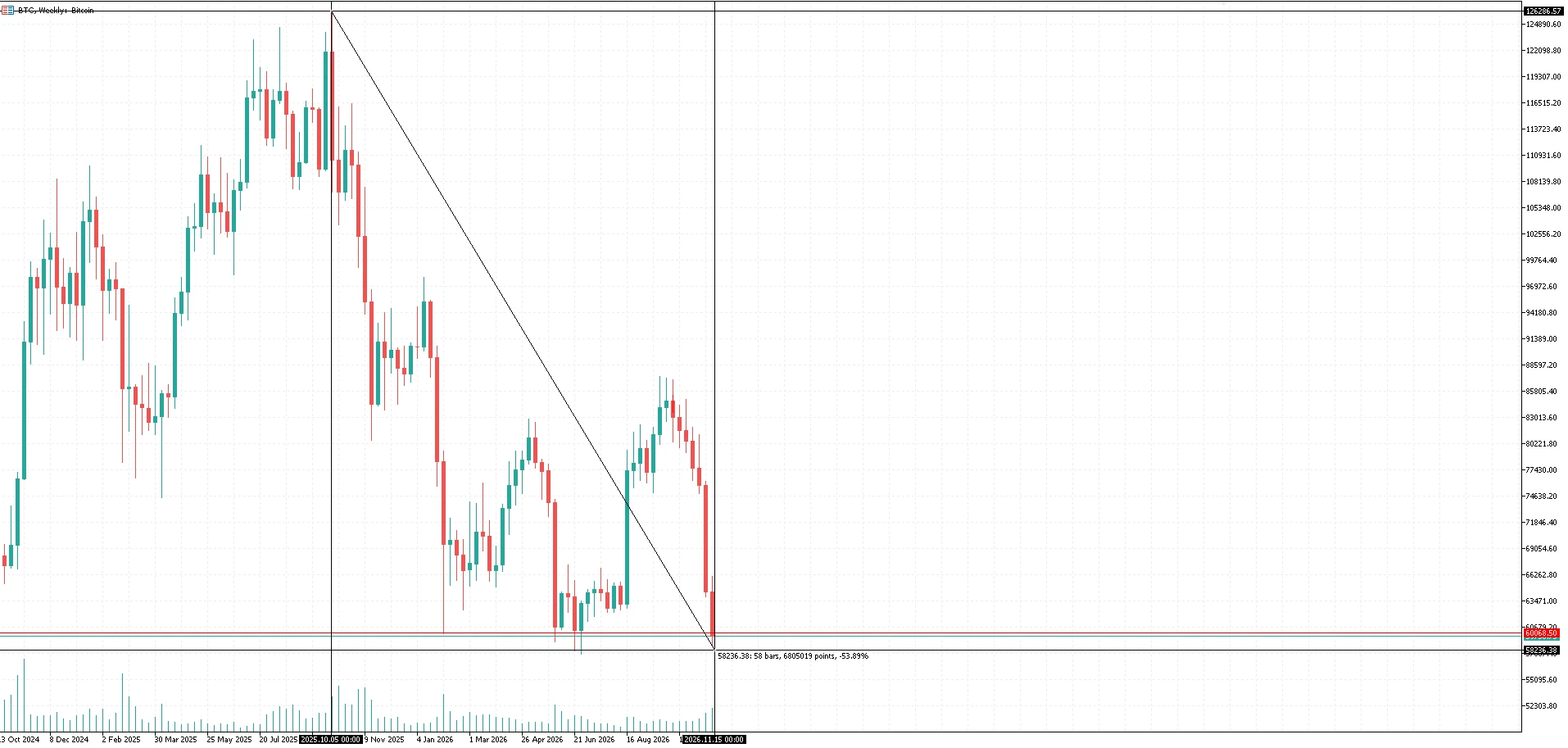
Bitcoin has entered the maximum pain zone. The break below the psychologically important $60,000 level has dealt a severe blow to buyers and placed considerable pressure on traders who had positioned for further gains. According to the positioning data under consideration, a substantial cluster of long positions established by major market participants during the summer was concentrated around $60,000. That level has now shifted from support to potential resistance. The breakdown could trigger a chain reaction of forced liquidations, further selling and an accelerated decline. The market has entered a phase in which price movements may be driven less by fundamentals than by the urgent need to unwind leveraged positions.
The immediate danger is a cascade of long liquidations. In highly leveraged markets, even a relatively modest price decline can force traders out of their positions. These liquidations generate additional selling pressure, potentially triggering another wave of losses. The result is a vicious circle: falling prices force liquidations, whilst liquidations drive prices still lower. Unless Bitcoin quickly reclaims $60,000, sellers could turn their attention to $58,000, followed by $55,000. However, the potential scale of liquidations depends on the actual distribution of open positions and cannot be established from price action alone.
For long-term investors, such sell-offs can present opportunities to accumulate Bitcoin at more attractive valuations. Historically, periods of panic, capitulation amongst short-term traders and widespread deleveraging have sometimes laid the foundations for subsequent recoveries in cryptocurrency markets. Nevertheless, a falling Bitcoin price does not necessarily make Bitcoin cheap. Buying against an established downtrend carries considerable risk, particularly before the market has formed a credible support base. A recovery above $60,000 would provide an initial sign of stabilisation, but a sustainable reversal would require substantially stronger buying interest. For now, sellers retain the upper hand.
Geopolitical developments present another significant risk. Following the US midterm congressional elections and recent discussions between Washington and Beijing, market attention could once again shift towards the Middle East. Reports of an increased US naval presence, including the reported arrival of the aircraft carrier USS Theodore Roosevelt, add to uncertainty, although they do not, in themselves, establish that military action is imminent. Any serious escalation over the weekend could sharply undermine investors' appetite for risk. Bitcoin is particularly exposed because it trades around the clock: during periods of reduced liquidity, abrupt price movements can be accompanied by slippage, wider spreads and another wave of forced liquidations. Under such circumstances, sellers would not need to wait for US equity markets to reopen.
Bitcoin's near-term outlook remains firmly bearish. The break below $60,000 has weakened the technical picture, increased the risk of forced long liquidations and raised doubts about buyers' ability to regain control. The key levels are now $60,000 as immediate resistance, with $58,000 and $55,000 representing potential downside targets. A geopolitical escalation could intensify the sell-off, although the market's initial reaction cannot be predicted with certainty. Long-term investors may begin looking for buying opportunities, but attempting to catch the bottom prematurely remains a high-risk strategy. Bitcoin has entered the maximum pain zone, and there is still little convincing evidence that the worst is over.Trade smart with Headway


Gold Rebounds 2% Towards $3,600 After Steepest Weekly Decline Since March

Nasdaq 100 Rebounds 2% as Tech Stocks Recover After Sharp AI-Led Sell-Off

The yen capitalised on the flight from risk

Crypto market retreats to $2.11T, following stocks

Stocks sink despite record Anthropic IPO, gold dives, dollar shines

Weekly Market Recap and Forecast: Anthropic Makes Nasdaq Debut in Record IPO Despite Tech Sell-off. Gold Falls Toward $3,500 levels

Week Ahead – Flash PMIs and PCE inflation in focus ahead of Thanksgiving