





BoJ Hawkish Hold and a Softer US Dollar Shape Currency Markets | 30th October, 2026

BoJ Hold Lifts Yen
Currency markets on Friday are being shaped by the Bank of Japan's hawkish hold and a softer US Dollar, as easing US-Iran tensions and lower Treasury yields weigh on safe-haven demand while central banks from Tokyo to Frankfurt keep the door open to further rate hikes. The BoJ left its policy rate at 1.25% in an 8-1 vote with one member favoring a hike, hot Tokyo CPI kept December hike bets alive, the ECB's hawkish outlook has helped the Euro rebound from a year-to-date low, and the Dollar Index has slipped for a third straight day despite strong US GDP and sticky PCE inflation. Traders are now watching Governor Ueda's press conference, euro area GDP and inflation data, the RBA meeting on 3 November, and the Bank of England decision on 5 November for fresh direction.
USD/JPY Forecast
Current Price and Context
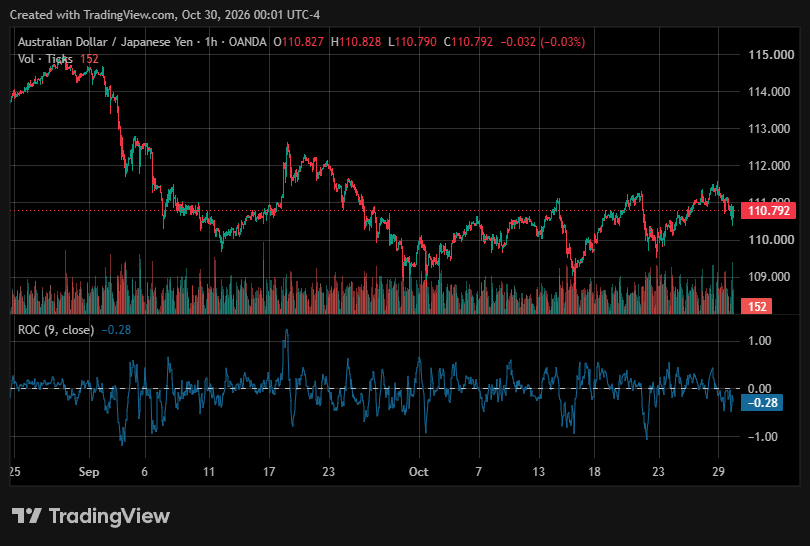
USD/JPY was trading below the 157.50 mark in the Asian session on Friday, 30 October 2026, extending its decline for a third straight day (reported level, not a live quote), after the Bank of Japan held its policy rate at 1.25% in an 8-1 vote with board member Takata dissenting in favor of a hike to 1.50%. The BoJ statement said core inflation is likely to stay near levels consistent with its price target with risks tilted to the upside, while hot Tokyo CPI reaffirmed December hike bets of around 80% and falling US bond yields narrowed the US-Japan yield gap as traders await Governor Ueda's press conference.
Key Drivers
• Geopolitical Risks: Hopes for US-Iran diplomacy are reducing safe-haven demand for the US Dollar and could extend USD/JPY losses, whereas a breakdown in talks could revive Dollar demand and lift the pair.
• US Economic Data: Strong US Q3 GDP growth of 3.4% and core PCE inflation of 3.1% did not stop Treasury yields from falling, and any further decline in yields could keep narrowing the US-Japan yield differential against USD/JPY.
• FOMC Outcome: The Fed's hold with two dissenters favoring a hike and roughly 75% odds of a December increase could still cushion the Dollar and limit USD/JPY downside unless those expectations fade.
• Trade Policy: No specific trade-policy catalyst featured in today's reporting, so changes in global trade conditions would affect USD/JPY only indirectly through Japanese export expectations and risk sentiment.
• Monetary Policy: A hawkish tone from Governor Ueda that brings forward a December hike could extend Yen gains, while a cautious message could trigger renewed Yen selling as seen after September's rate hike.
Technical Outlook
• Trend: USD/JPY has slipped for three straight sessions and keeps a mildly bearish near-term tone while it trades below the 158.00 round number.
• Resistance: Immediate resistance appears near 157.58, a Fibonacci level cited earlier this week, followed by the 158.00 round number and the 200-day average near 158.54.
• Support: Initial support is near 157.00, where the 4-hour 200-period SMA and pivot point cluster, followed by the one-month low near 156.00 and the 155.00 base of the broader support zone.
• Forecast: USD/JPY could test 157.00 and then 156.00 if Governor Ueda sounds hawkish and US yields keep falling, while a cautious message could lift the pair back toward 158.00.
Sentiment and Catalysts
• Market Sentiment: Sentiment toward the Yen has improved because the only BoJ dissent favored a hike and no dovish dissent emerged, although traders could wait for Governor Ueda before placing larger bets.
• Catalysts: Governor Ueda's press conference, US Treasury yields, US-Iran headlines and Fed commentary could determine the pair's next directional move.
GBP/JPY Forecast
Current Price and Context
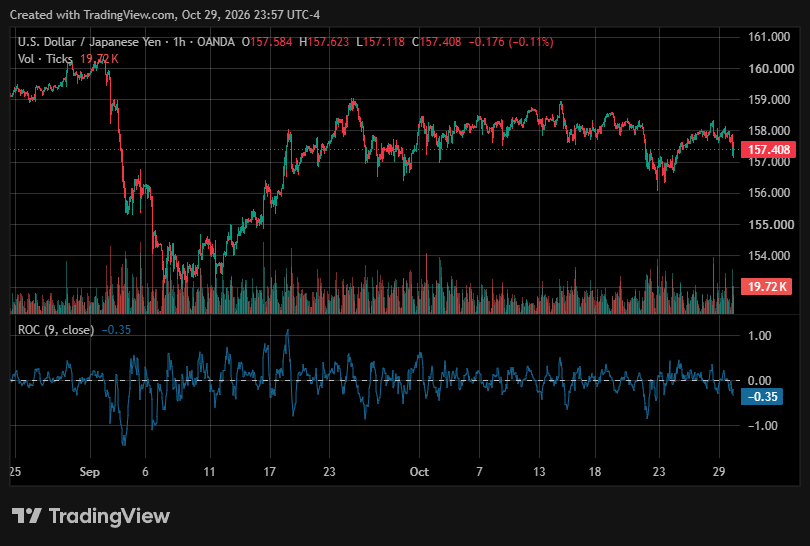
GBP/JPY was trading around 210.80 in the Asian session on Friday, 30 October 2026, almost unchanged after the Bank of Japan's 8-1 decision to hold rates at 1.25% (reported level, not a live quote). The cross showed little reaction as the BoJ decision was described as a dovish hold while analysts at Brown Brothers Harriman expect a hawkish Bank of England response at its 5 November meeting.
Key Drivers
• Geopolitical Risks: Easing US-Iran tensions could reduce safe-haven demand for the Yen and favor risk-sensitive crosses such as GBP/JPY, while renewed tensions could revive Yen buying and pull the cross lower.
• US Economic Data: Strong US GDP and sticky PCE inflation matter for GBP/JPY mainly through global risk sentiment and the Dollar's influence on both currencies, since Treasury yields fell after the release.
• FOMC Outcome: The Fed's hawkish hold affects GBP/JPY only indirectly, although a firmer Dollar on December hike bets could weigh on the Pound while a softer Dollar could support it.
• Trade Policy: No specific trade-policy catalyst featured in today's reporting, so changes in UK trade arrangements or global trade conditions would influence GBP/JPY only indirectly through growth expectations and risk sentiment.
• Monetary Policy: A hawkish Bank of England on 5 November could support the Pound, while a BoJ move toward a December hike could narrow the wide policy-rate gap between the UK and Japan that favors the Pound.
Technical Outlook
• Trend: GBP/JPY remains downward-biased on the daily chart even though it cleared a downsloping trendline in mid-October and reached a one-month high near 211.99.
• Resistance: Resistance appears at 211.10, followed by the 212.00 area and the 200-day SMA near 212.95.
• Support: Support lies at the October 23 low of 209.13 and the 209.00 level, with the September 30 low of 206.89 below.
• Forecast: GBP/JPY could retest 211.10 if the Pound holds up on Bank of England hike expectations and the Yen fails to extend gains, whereas a break below 209.13 would expose 209.00.
Sentiment and Catalysts
• Market Sentiment: Sentiment could remain balanced, as the muted reaction to the BoJ decision suggests Bank of England tightening expectations and BoJ hike hopes are offsetting each other.
• Catalysts: Governor Ueda's press conference, UK data and Bank of England communication ahead of the 5 November meeting, and US-Iran headlines could drive the cross's next move.
AUD/JPY Forecast
Current Price and Context
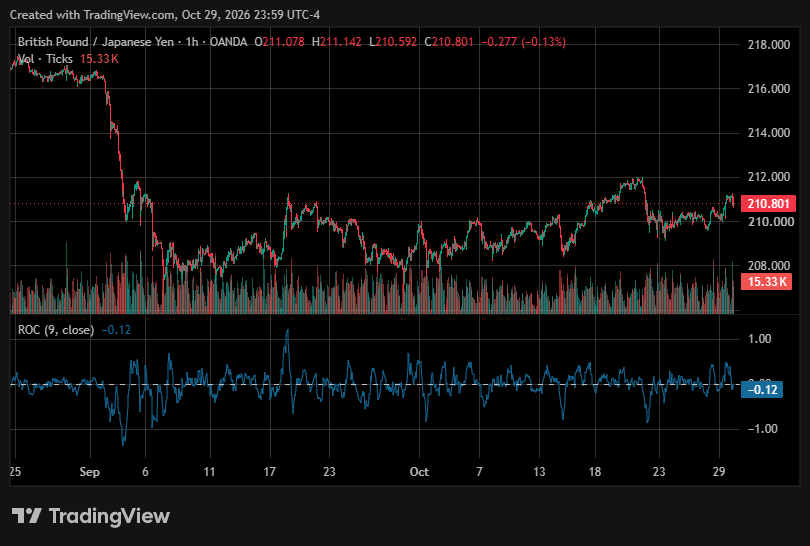
AUD/JPY lost ground for a second straight day, trading around 110.80 in the Asian session on Friday, 30 October 2026 (reported level, not a live quote), as the Yen stayed stronger after the Bank of Japan left its short-term rate unchanged at 1.25%. The Australian Dollar remains supported by hot domestic inflation and expectations of an RBA rate hike at its 3 November meeting, which could limit the downside if the Yen's advance fades.
Key Drivers
• Geopolitical Risks: Easing US-Iran tensions could support the risk-sensitive Australian Dollar against the Yen, while a renewed escalation could lift safe-haven demand and weigh on the cross.
• US Economic Data: Strong US GDP and core PCE inflation matter for AUD/JPY mainly through global risk sentiment and Treasury yields, with falling yields after the release limiting any direct impact on the cross.
• FOMC Outcome: The Fed's hawkish hold influences AUD/JPY only indirectly, although a sharp repricing of December hike odds could shift risk appetite and move both currencies.
• Trade Policy: No specific trade-policy catalyst featured in today's reporting, so changes in trade conditions affecting Australia's major trading partners would influence AUD/JPY only indirectly through sentiment and demand expectations.
• Monetary Policy: A potential RBA hike on 3 November favors the Aussie while a BoJ path toward a December hike favors the Yen, so the relative speed of tightening could decide the cross's direction.
Technical Outlook
• Trend: AUD/JPY keeps a bearish near-term tone on the daily chart while it trades below the 100-day SMA, even after a falling-wedge breakout earlier in October.
• Resistance: Resistance appears around the 111.00-111.20 area, followed by the 111.64-111.71 zone where the 50-day and 200-day SMAs converge.
• Support: Initial support is the indicative 110.20 Bollinger middle band and the 110.00 psychological level, with the 109.00-109.30 zone and the October 15 low of 108.64 below.
• Forecast: AUD/JPY could stabilize above 110.00 if RBA hike expectations hold, whereas a break below 110.00 would expose 109.00 and a move above 111.20 would revive the recovery.
Sentiment and Catalysts
• Market Sentiment: Sentiment toward the Aussie is supported by hawkish RBA pricing, although traders could stay cautious while BoJ hike expectations and intervention risk remain in play.
• Catalysts: Governor Ueda's press conference, the RBA's 3 November decision, Australian data and US-Iran developments could determine the cross's next directional move.
EUR/USD Forecast
Current Price and Context
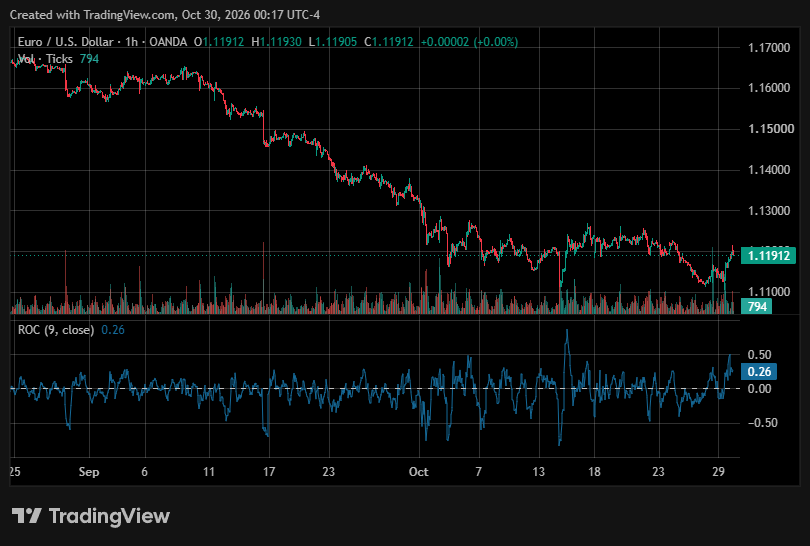
EUR/USD was trading above 1.1200 in the Asian session on Friday, 30 October 2026, gaining for a third straight day after rebounding from the 1.1100 area, a fresh low since May 2025 (reported level, not a live quote). The ECB's hawkish outlook, with President Lagarde saying a December hike remains likely after a unanimous hold, and a weaker US Dollar on Middle East diplomacy hopes and lower US yields are supporting the recovery, although roughly 75% odds of a December Fed hike could cap gains.
Key Drivers
• Geopolitical Risks: Progress in US-Iran diplomacy could keep weighing on safe-haven Dollar demand and support EUR/USD, while renewed tensions or French fiscal concerns could pressure the Euro.
• US Economic Data: Strong US GDP growth of 3.4% and core PCE inflation of 3.1% initially favored the Dollar, but falling Treasury yields afterward allowed EUR/USD to extend its recovery.
• FOMC Outcome: The Fed's hold with two dissenters favoring a hike and roughly 75% odds of a December increase could cap EUR/USD gains if the Dollar finds support from rate expectations.
• Trade Policy: No specific trade-policy catalyst featured in today's reporting, so changes in tariffs or trade restrictions affecting euro area exports would influence EUR/USD only indirectly through growth expectations.
• Monetary Policy: A hawkish ECB path, with another hike seen as likely in December, could narrow policy divergence with the Fed and support the Euro.
Technical Outlook
• Trend: EUR/USD keeps a bearish tone on the daily chart below the 100-day SMA, although the pair has rebounded for three straight days from the 1.1100 area.
• Resistance: The recovery stalled near the 100-period EMA on the 4-hour chart, with resistance at 1.1270, the October 16 high, and the upper Bollinger band near 1.1315.
• Support: Initial support is the October 23 low at 1.1185, followed by the lower Bollinger band near 1.1138 and the October 14 low at 1.1114, with the 1.1100 psychological level below.
• Forecast: EUR/USD could extend toward 1.1270 if the Dollar stays soft and euro area data supports ECB hike expectations, whereas a failure to clear the 4-hour 100-period EMA could send it back toward 1.1185.
Sentiment and Catalysts
• Market Sentiment: Sentiment toward the Euro is recovering on ECB hike expectations, although French fiscal concerns and the pair's failure to reclaim the 4-hour moving average could keep traders cautious.
• Catalysts: The euro area's first Q3 GDP estimate and inflation figures, ECB commentary, US Treasury yields and US-Iran headlines could determine the pair's next move.
US Dollar Index (DXY) Forecast
Current Price and Context
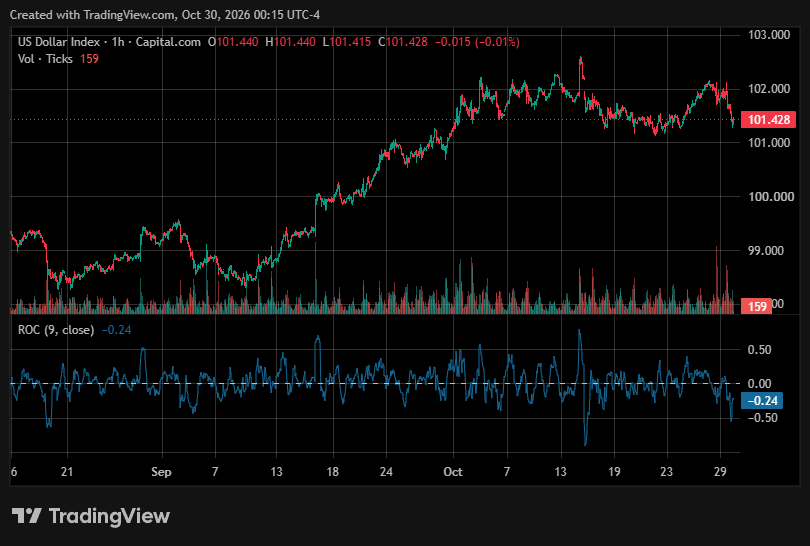
The US Dollar Index (DXY) was losing ground for a third successive day and trading near 101.70 in the Asian session on Friday, 30 October 2026 (reported level, not a live quote), as easing US-Iran tensions reduced safe-haven demand and lowered December Fed hike probabilities. US Q3 GDP grew 3.4% and core PCE inflation held at 3.1%, but Treasury yields fell after the data, leaving the Dollar vulnerable even as the Fed's hawkish hold keeps some support in place.
Key Drivers
• Geopolitical Risks: Hopes for US-led diplomacy with Iran, which have steadied crude oil prices, are reducing safe-haven Dollar demand, but a breakdown in talks could quickly restore the safe-haven premium.
• US Economic Data: Q3 GDP growth of 3.4% and core PCE inflation of 3.1% support the case for a December Fed move, yet lower Treasury yields after the release limited Dollar gains.
• FOMC Outcome: The Fed's hold at 3.75%-4.00% with two dissenters favoring a hike keeps a December increase in play, which could limit DXY losses unless officials turn less hawkish.
• Trade Policy: No specific trade-policy catalyst featured in today's reporting, so changes in tariff expectations would act as an indirect risk for the DXY by shifting US growth and inflation expectations.
• Monetary Policy: Tightening signals from the ECB and hike expectations at other central banks could reduce the Dollar's relative yield advantage and weigh on the index.
Technical Outlook
• Trend: The index holds above the 50-day EMA but remains capped by the nine-day EMA, which keeps the near-term tone neutral after the pullback from recent highs.
• Resistance: Immediate resistance is the nine-day EMA at 101.93, with a break above it opening the way toward the 102.49 cycle high and the October 14 high near 102.94.
• Support: Initial support is the 50-day EMA at 101.21, and a daily close below it would shift the bias back toward a more bearish configuration.
• Forecast: The DXY could test the 50-day EMA at 101.21 if US-Iran hopes persist and yields keep falling, whereas a break above 101.93 would revive a retest of recent peaks.
Sentiment and Catalysts
• Market Sentiment: Sentiment is cautious, as easing Middle East tensions weigh on safe-haven demand while Fed hike expectations could prevent a deeper selloff.
• Catalysts: US-Iran diplomacy, Treasury yield moves, Fed commentary and upcoming euro area and Japanese data could determine the index's next directional move.
Wrap Up
The BoJ's hawkish hold and a softer US Dollar are the main themes, with lower Treasury yields and US-Iran diplomacy hopes weighing on the Dollar while the Yen, Euro and Aussie draw support from tightening expectations at the BoJ, ECB and RBA. Governor Ueda's press conference, euro area GDP and inflation data, the RBA decision on 3 November, the Bank of England decision on 5 November and any change in December Fed hike pricing are the principal catalysts. Traders should monitor whether Governor Ueda's tone brings forward a December BoJ move and whether the Dollar holds key support levels, keeping in mind that every scenario in this report is conditional on upcoming data and geopolitical developments.
Ready to trade global markets with confidence? Join Moneta Markets today and unlock 1000+ instruments, ultra-fast execution, ECN spreads from 0.0 pips, and more! Start now with Moneta Markets!


EURUSD recouped its losses

The ECB, the Bank of Japan and the Fed prefer to wait until December

Fed Holds Rates; PCE and ECB Take Center Stage

Federal Reserve Holds Rates, Leaving Policy Outlook Unclear

Rate-Hike Bets and a Hawkish Fed Hold Shape Currency Markets | 29th October, 2026

EURUSD Steadies Near 1.1150 as Traders Await ECB Decision After Hawkish Fed Hold

The Fed will set the course for the markets