2276-682026843.jpg)
2216-682026843.jpg)





France’s Political Turmoil and Trump’s Grip on the Fed Increase FX Volatility

The EUR/USD, which is up more than 13.80% since the beginning of the year, is now facing a tough week, as the political turmoil in France is pressuring the Euro, while worries over the Fed’s independence is weakening the US Dollar. The Forex pair is currently trading around 1.1626 (already down around 0.81% since the beginning of the week), after failing to break through recent resistance levels. The weekly chart reflects a phase of consolidation following a strong rally that began earlier this year, with momentum now potentially showing early signs of exhaustion.
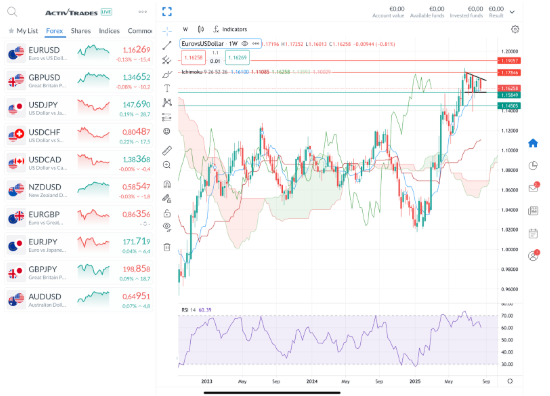
Weekly EUR/USD Chart - Source: ActivTrades
The pair is still in an overall uptrend from the lows near 1.02, with higher highs and higher lows intact (and prices remaining above the Ichimoku cloud). However, recent candles reveal hesitation around the 1.1780 resistance zone, where repeated rejections have formed a short-term descending trendline (visible from recent swing highs). This suggests a potential bullish pause or corrective phase within the broader uptrend.
The RSI (14) on the weekly timeframe stands at around 60, down from recent overbought levels above 70. This usually indicates momentum has cooled but is not yet bearish. An RSI above 50 generally favors bulls, but the downward slope reflects loss of strength and potential risk of a deeper correction.
Potential Market Outlook
- Bullish Scenario: If EUR/USD holds above 1.1585 and breaks through the 1.1780 resistance area, buyers may regain control, targeting 1.1905, then the 1.2000–1.2100 zone.
- Bearish Scenario: Failure to remain above the 1.1585 level would expose FX traders to a fall towards 1.1450 and possibly towards the next key level at around 1.1200.
- Neutral View: The pair is consolidating after a sharp rally. Until a decisive breakout occurs, EUR/USD is likely to remain rangebound between 1.1585 and 1.1780.
France’s Political Storm: A French Problem or a Eurozone Crisis?Is the euro at risk? That is the question many forex traders are asking after French Prime Minister François Bayrou unexpectedly announced he would put his government’s austerity programme to a confidence vote on 8 September. The move has brought political uncertainty in the eurozone’s second-largest economy back into sharp focus, and investors are now reassessing the risks.
France could lose its prime minister — for the third time in just over a year, as opposition parties from both extremes have united in their opposition to Bayrou’s €44 billion budget savings plan. His proposal aims to trim the deficit from 5.4% of GDP in 2025 to 4.6% in 2026 — still well above EU targets.
The credibility of French fiscal consolidation is now in question, and with it, investor confidence in the country’s financial assets. Markets have already delivered their verdict.
French equities extended their selloff on Tuesday, with the CAC 40 dropping more than 3% in two days, retreating to its lowest level in three weeks. Financial stocks were hit hardest, reflecting concerns that banks would face higher funding costs and deteriorating investor sentiment if political instability persists.
Simultaneously, the bond market fell sharply. The yield on France’s ten-year government bonds briefly surged to 3.53%, a level not seen since March, before ending the day at 3.50%. This was underscored by a widening of the spread over Germany’s 10-year Bunds, which hit 79 basis points — its largest gap since April and a key indicator of investor anxiety. This widening reflects the higher risk premium investors now demand to hold French bonds relative to the eurozone’s benchmark safe haven.
In contrast, the spread between French and Italian bonds, which two years ago stood at a hefty 150 basis points, has narrowed to around just 10 basis points. The irony is striking: investors are now pricing French debt risk closer to Italy’s, reversing a long-standing perception of France as a safer borrower.
These developments matter well beyond the Parisian exchange. Currency markets have been quick to reassess whether France’s political turmoil is a localised issue or something that could spill over into broader euro sentiment.
The euro has held relatively steady for now, suggesting investors are still treating this as a French story. Yet, France’s political instability has the potential to undermine confidence in the euro, especially at a time when Europe is trying to present itself as a counterweight to U.S. policy uncertainty and leverage German-led initiatives to boost growth. If French politics continue to unravel, the “Make Europe Great Again” narrative — which has supported European assets in recent months — could come under strain.
Cook’s Dismissal: Will the Fed’s Independence Withstand This New Challenge?The U.S. dollar came under renewed pressure earlier this week as President Donald Trump escalated his long-running confrontation with the Federal Reserve, this time attempting to dismiss Governor Lisa Cook. What may look like a personnel dispute is, in reality, a direct challenge to the central bank’s independence — a cornerstone of U.S. monetary credibility for more than a century. If the White House is able to bend the Fed to its will, the greenback’s status as the world’s reserve currency could face its most serious test in decades.
Trump accused Cook of improprieties in obtaining mortgage loans and on Monday declared that she should be removed from her post. Cook’s attorney swiftly rebutted the claim, insisting that the president has “no authority” and “lacks any factual or legal basis” to fire a sitting governor.
To shield them from political interference, Federal Reserve governors serve fixed 14-year terms and can only be removed by law "for cause." Cook, appointed in 2022 by President Joe Biden and the first Black woman ever to serve on the Fed’s Board of Governors, is scheduled to hold her seat until 2038.
If Trump were to succeed in pushing her out, it would not only undermine the Fed’s credibility but also set a precedent that its members can be removed at the discretion of the White House. The dollar kept weakening on Wednesday as traders factored in the possibility that the Fed could become more politicised and less independent in its decision-making.
For decades, the Fed’s autonomy has been one of the key pillars underpinning the dollar’s global dominance. Investors buy U.S. assets not just because of the country’s size and liquidity, but also because they trust that monetary policy is shielded from short-term political pressures. Trump’s attempt to remake the Fed in his image calls that assumption into question.
The immediate market concern is the September meeting, where the Fed is expected to weigh further rate cuts in response to slowing growth and easing inflation. If Cook is dismissed and replaced with someone more dovish, Trump could accelerate his push for lower rates — a policy mix that may provide short-term political benefits but risks stoking inflationary pressures and further eroding international confidence in U.S. institutions. Cook’s continued presence on the Board, on the other hand, would ensure a steady influence on monetary policy for years to come.
But the stakes go beyond a single meeting. Cook’s removal would allow Trump to appoint yet another Fed governor, giving him control of a majority on the seven-member Board, including his pending nomination of White House economist Stephen Miran. That would mark a historic power shift: the Federal Reserve, long seen as the guardian of monetary stability, could be perceived as an extension of the executive branch. For foreign investors and central banks holding trillions in U.S. reserves, the notion of a politically captured Fed threatens the very foundation of their trust in the dollar.
Sources: ING, CNBC, CNN, Reuters, The Wall Street Journal, Investir Les Echos, The Guardian


Tech Stocks Lead US Selloff Ahead of Payrolls

The euro has spread its wings
US Midterm Elections: Analyzing Fiscal Deficits, Treasury Yields, and the Greenback

US Midterm Results Weigh on the Dollar as Central Bank Policy Divergence Builds | 4th November, 2026

The dollar concedes the Democrats’ victory

US Midterms: Early Democratic Senate Wins Sink Dollar and Drag Futures Lower

EURUSD depends on the stock market