-1162026812.png)
-1162026812.png)





Gold: Is 2026 the New 1978?

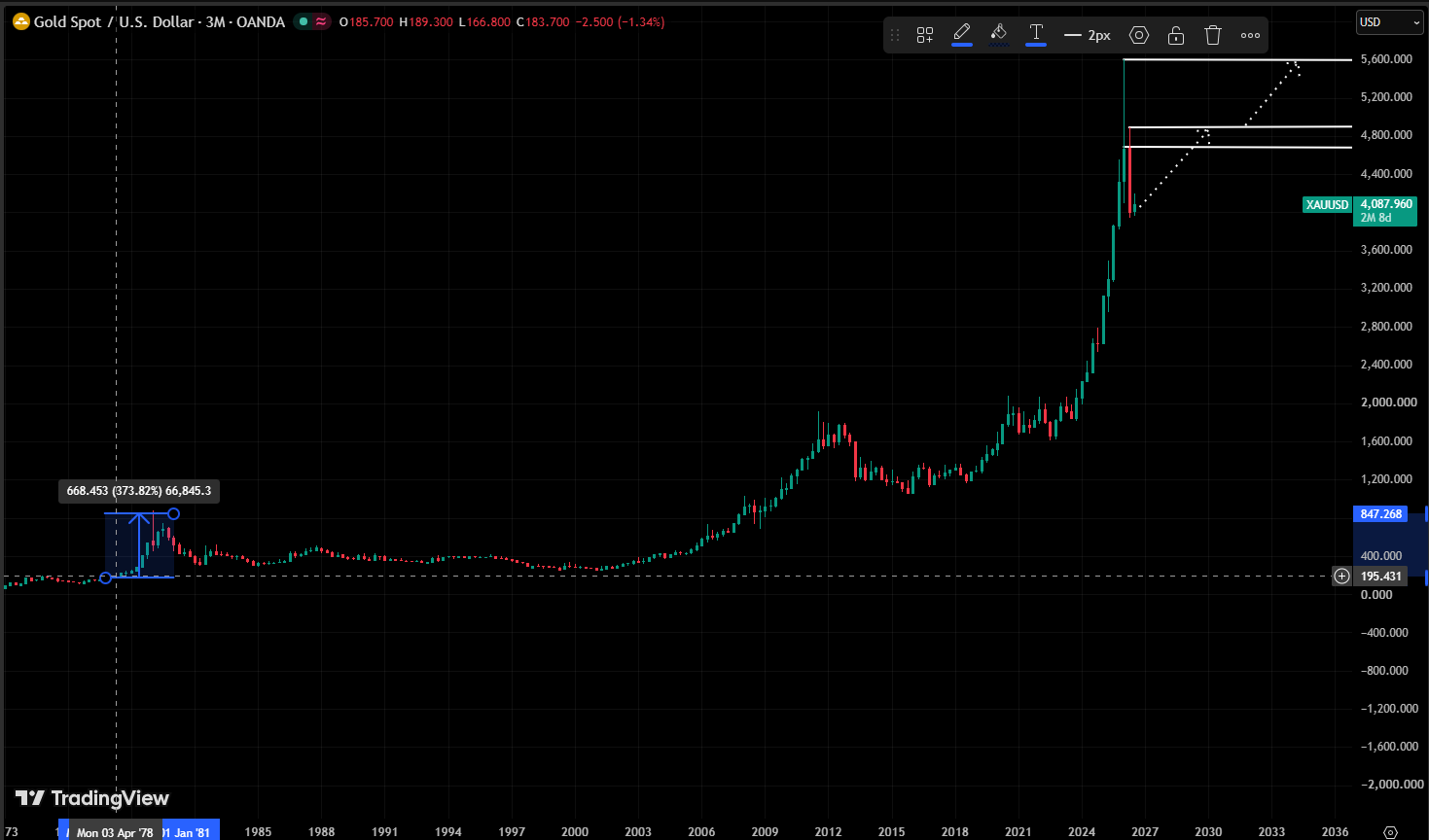
Despite the recent price correction, gold's medium-term outlook remains constructive, with the risk-reward profile becoming increasingly attractive for investors. Analysts project XAUUSD to reach ~$5,000 by the end of 2026, followed by ~$5,600 towards the end of 2027. In many respects, 2026 may prove to be for the metal what 1978 was — a period of consolidation before the market's strongest advance.
The comparison with 1978 reflects the fact that, in both cases, the market underwent a correction before entering the final and most powerful phase of a long-term bull cycle.
Gold's performance between 1978 and 1980 remains one of the most significant bull markets in modern financial history. Against a backdrop of persistent stagflation, the second oil shock and heightened geopolitical tensions following the Iranian Revolution, the price of gold rose from approximately $200 per troy ounce to a record $850 by January 1980.
Several fundamental factors combined in 1979 to trigger a broad-based global commodities bull market:
- the second oil shock. Following the Iranian Revolution, oil production declined sharply, crude prices almost doubled, and inflationary pressures intensified worldwide;- persistently high inflation. Inflation accelerated into double digits across the United States and much of the developed world, undermining confidence in fiat currencies;- the US dollar's weakness. Investors increasingly sought alternative stores of value, including gold, silver and other commodities;- elevated geopolitical risk. The Iranian Revolution, the Tehran hostage crisis and the Soviet invasion of Afghanistan reinforced demand for safe-haven assets;- the start of a global commodities bull cycle. Strong gains extended beyond gold to oil, silver, industrial metals and agricultural commodities.As a result, gold advanced from around $200 per ounce in mid-1978 to an all-time high of approximately $850 in January 1980, representing one of the fastest and most significant rallies on record.
This historical episode underpins comparisons with the current market. According to a number of analysts, the recent correction is more likely to represent a consolidation within an ongoing bull market than its conclusion. The macroeconomic backdrop shares several notable characteristics with the late 1970s, including elevated geopolitical uncertainty, rising sovereign debt, widening fiscal deficits, sustained central bank gold purchases and a gradual erosion of confidence in fiat currencies. While these similarities are noteworthy, historical analogies should be viewed with caution, as today's macroeconomic environment differs materially from that of the late 1970s.


Yen Hits 6-Month High, Volatility Returns After North American Holiday.

Gold Slides Below $4,500 as Strong NFP Revives Fed Hike Bets

US Payrolls Hit 5-Month High as Markets Await CPI This Week.

The dollar is in no hurry to gain ground

Dollar Strength Meets Geopolitical Risk | 7th September, 2026

Week Ahead: US Jobs Strengthen Fed Hike Bets as CPI Looms

The Great Gold Reallocation: Central Banks Rethink Reserve Security 💥