-1162026812.png)
-1162026812.png)





The Great Gold Reallocation: Central Banks Rethink Reserve Security 💥

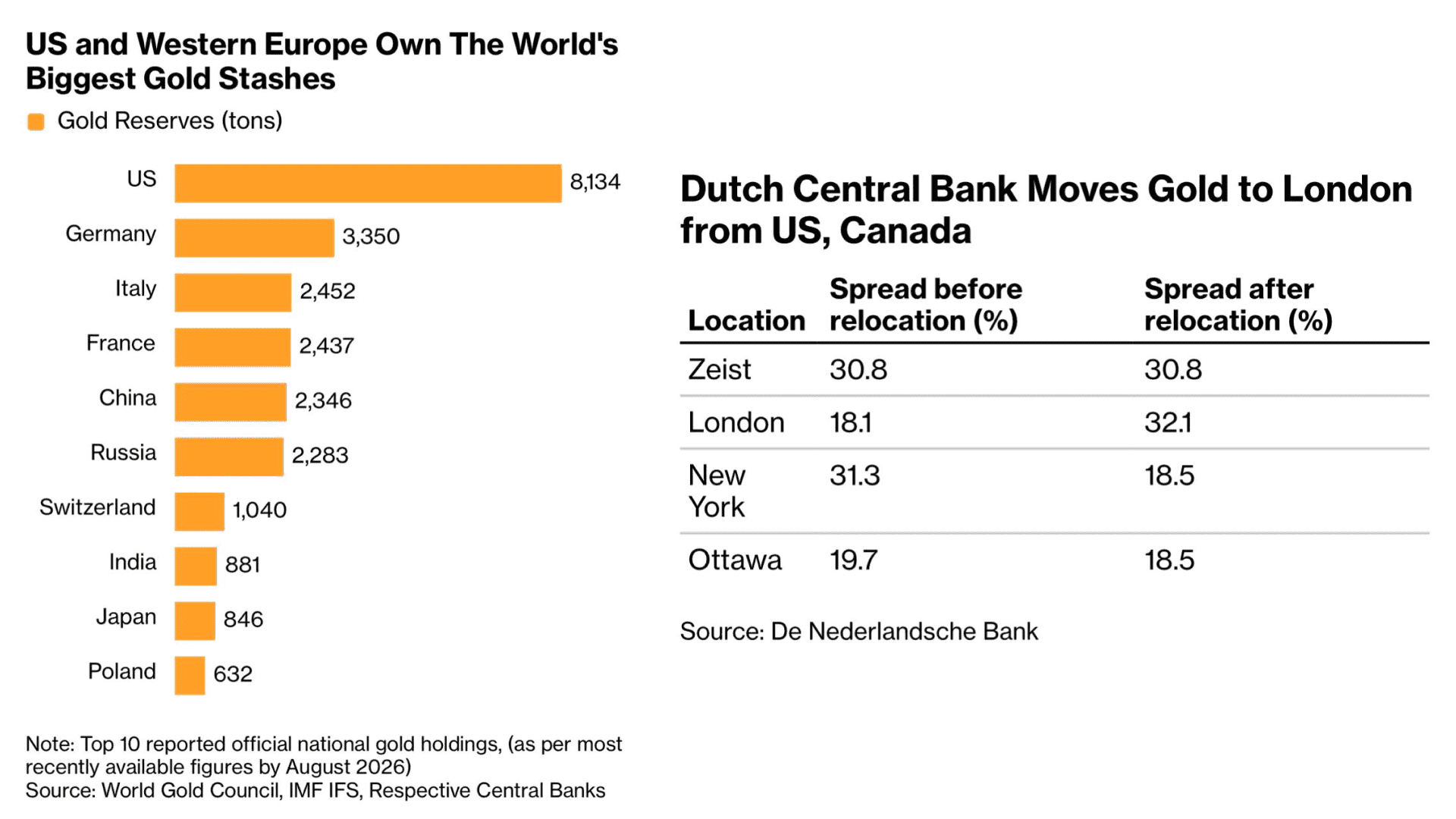
Gold is becoming more than a reserve asset for governments; it is emerging as an instrument of financial sovereignty. As relations between the world’s largest economies become less predictable, monetary authorities are paying greater attention to their ability to maintain direct access to strategic assets. Against this backdrop, the geography of official gold holdings is gradually changing, with bullion historically stored in North America increasingly being moved to European financial centers.
The Netherlands provides a notable example of this shift. Around 86 tonnes of gold, valued at approximately $12 billion, has reportedly been transferred from storage facilities in the United States and Canada to the United Kingdom. The scale of the operation is considerable, representing more than a quarter of the relevant Dutch holdings. Following the reallocation, a significant share of the country’s bullion is now held in London, where the Bank of England and one of the world’s deepest precious-metals markets provide access to extensive trading and settlement infrastructure.
What makes the development particularly significant is that reassessing the location of sovereign gold is no longer confined to countries seeking to reduce their reliance on Western financial infrastructure. Similar considerations are becoming increasingly visible across Europe. France has strengthened domestic control over its bullion, while Germany has seen renewed political debate over whether part of its national gold holdings should continue to remain in New York. The underlying argument is straightforward: a strategic sovereign asset should ideally be held where the authorities can guarantee access regardless of changes in the international political environment.
Historically, the logic was almost the reverse. In the decades following the Second World War, the United States was widely regarded by European governments as one of the safest locations for substantial portions of their gold reserves. The possibility of another major conflict on the continent made North America a natural destination for sovereign bullion. The system reached its height in the early 1970s: by 1973, the Federal Reserve Bank of New York held more than 12,000 tonnes of foreign official gold.
Half a century later, the assumptions underpinning that arrangement have changed. European governments no longer necessarily regard geographical distance from domestic territory as an advantage in itself. The growing use of sanctions, restrictions on capital and the possibility of sovereign assets becoming inaccessible have altered the definition of reserve security. Safety is increasingly assessed not only through the value of an asset or the creditworthiness of a counterparty, but also through the owner’s ability to retain effective control under adverse political circumstances.
This is where physical gold possesses a distinctive strategic advantage. Government bonds represent the liabilities of an issuer, bank deposits depend upon financial intermediaries, and foreign-currency reserves operate within specific legal and payment infrastructures. Bullion held under the direct control of a sovereign authority is fundamentally different: it does not depend on another party meeting a financial obligation. During periods of political stability this distinction may appear secondary, but its importance increases considerably when relations between states become more fragmented.
The Dutch decision should not, however, be interpreted as a retreat from the Western financial system. London remains one of its principal financial centres and one of the world’s most important hubs for bullion trading. The development is better understood as a change in sovereign risk management: rather than concentrating strategic assets within a single jurisdiction, governments appear increasingly willing to spread them across several highly liquid and trusted locations.
What It Means for GoldFor investors, it is important to distinguish between the relocation of existing bullion and fresh central-bank purchases. Moving gold from New York or Canada to London does not, by itself, create additional global demand and should not automatically be treated as a bullish catalyst for XAUUSD. The more important signal lies behind these decisions: monetary authorities are increasingly assessing gold in terms of independence from external financial infrastructure. Over time, that shift in perception could reinforce structural official-sector demand.
The second implication concerns the broader international monetary system. Dollar dominance will not be displaced by a series of gold transfers. The US currency retains an exceptional role in international trade, reserves and global financing, while the US Treasury market remains unmatched in scale and liquidity. Nevertheless, the traditional model in which sovereign assets were heavily concentrated within the American financial system is gradually giving way to a more diversified approach. Gold, multiple currencies and several custody locations are increasingly being used together to reduce dependence on any single component of the global financial architecture.
Investment ViewFor gold, these developments contribute to a constructive long-term structural backdrop, although their influence on daily price action remains limited. In the near term, XAUUSD will continue to be driven primarily by real interest rates, Federal Reserve policy, the dollar, inflation expectations and demand for defensive assets. Over longer horizons, however, another source of support is becoming increasingly relevant: governments want reserve assets that can exist outside conventional credit relationships and do not require continuous reliance on a foreign issuer.
The broader shift therefore concerns more than the physical location of individual bars. It reflects a changing definition of security in sovereign reserve management. Several decades ago, safety often meant placing assets at the heart of the world’s dominant financial system. Today, maintaining direct and dependable control is becoming increasingly important. For long-term investors, that strategic reassessment may ultimately prove more significant than any individual movement of bullion between vaults.


US Yields Rise Despite Buybacks; Eyes on ECB Hike

Yen Hits 6-Month High, Volatility Returns After North American Holiday.

Gold Slides Below $4,500 as Strong NFP Revives Fed Hike Bets

US Payrolls Hit 5-Month High as Markets Await CPI This Week.

The dollar is in no hurry to gain ground

Dollar Strength Meets Geopolitical Risk | 7th September, 2026

Week Ahead: US Jobs Strengthen Fed Hike Bets as CPI Looms