-1162026812.png)
-1162026812.png)





Is the Euro Heading Back Towards Parity? Storm Clouds Gather Over the Eurozone

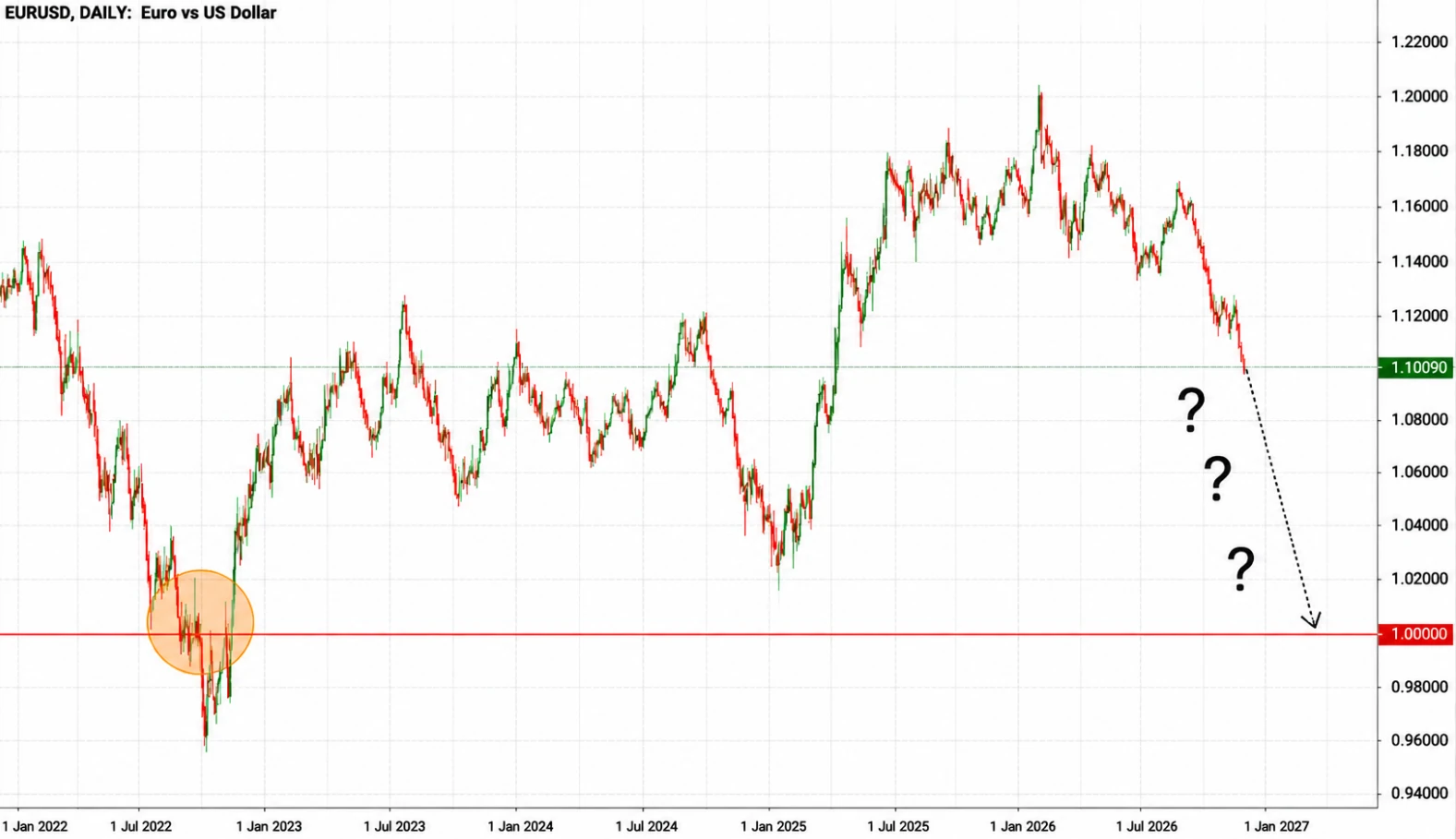
The foreign exchange market is showing signs of a developing situation that could remind investors of the second half of 2022, when the euro fell below parity with the US dollar for the first time in two decades. The daily EUR/USD chart points to renewed weakness in the single currency, with persistent selling pressure prompting market participants to reconsider the possibility of a decline towards 1.0000. While it is too early to suggest that such a move is inevitable, a combination of technical and fundamental factors makes the risk increasingly difficult to ignore. Should the euro continue to break through key support levels, the likelihood of a deeper decline could rise significantly.
One of the biggest threats facing the European economy is stagflation — a combination of weak economic growth and persistent inflationary pressure. This presents a particularly difficult challenge for the European Central Bank (ECB). Keeping monetary policy restrictive helps contain inflation but also weighs on lending, investment and consumer spending. Cutting interest rates, on the other hand, could provide much-needed support for economic activity, although it might also weaken the euro and increase imported inflation. High energy costs, structural weaknesses in European industry and economic disparities between eurozone member states add to these challenges. Nevertheless, stagflation remains a significant risk rather than an inevitable outcome.
The divergence between the economic outlooks for the United States and the eurozone adds another layer of pressure. If the US economy continues to demonstrate greater resilience while the Federal Reserve maintains a more hawkish stance on interest rates, the dollar could strengthen further. Higher yields on US assets may attract international capital, supporting demand for the dollar and putting additional downward pressure on EUR/USD. This would be a particularly unfavourable combination for the euro: sluggish domestic growth would constrain the ECB's policy options, while the relative attractiveness of US financial assets could encourage capital to move away from European markets. As a result, currency traders may increasingly price in the prospect of a more substantial depreciation of the single currency.
From a technical perspective, 1.1000 remains a key psychological threshold, and a sustained break below it could reinforce bearish sentiment. The next important support level lies around 1.0900, with a move beneath this area potentially opening the way for further losses. However, a return to parity would require a much more significant shift in market expectations than an ordinary short-term correction. Such a scenario would probably depend on an extended period of economic weakness in Europe, sustained demand for the US dollar and a lack of convincing signs of recovery across the eurozone. Conversely, a recovery above nearby resistance levels could undermine the bearish outlook and provide scope for the euro to regain ground.
But would a return to parity necessarily signal the potential break-up of the eurozone? Not necessarily. A weaker euro primarily reflects changes in the relative attractiveness of two currencies rather than an imminent threat to the monetary union itself. Nevertheless, prolonged economic stagnation, rising sovereign debt burdens and differences in fiscal policy could bring underlying tensions between member states back into focus. As for the United States, a weaker euro may benefit American buyers of European goods and assets, but the collapse of the eurozone would be unlikely to serve Washington's long-term interests. A major European financial crisis would have serious consequences for US banks, investment funds, international trade and global financial stability. Suggesting that the United States is actively seeking the disintegration of the eurozone would therefore be an oversimplification.
Ultimately, the greatest threat to the euro may not be the hypothetical collapse of the monetary union, but the prospect of Europe falling further behind the United States economically. If the European economy becomes trapped between weak growth, persistent inflation and limited scope for monetary stimulus, the single currency could face another substantial wave of selling. In that scenario, a return to parity would be a symptom of deeper economic imbalances rather than a crisis in itself. Over the coming months, the main drivers of EUR/USD will remain Federal Reserve and ECB policy decisions, inflation trends, the performance of European industry and international capital flows. For now, parity remains a downside risk rather than the central forecast, but the warning signs of renewed euro weakness should not be overlooked.Trade smart with Headway


Weekly Market Recap and Forecast: Anthropic Makes Nasdaq Debut in Record IPO Despite Tech Sell-off. Gold Falls Toward $3,500 levels

AI Selloff Deepens Despite Anthropic’s Record Debut

EURUSD is clutching at straws

Brent is being dragged down by the surplus

Tech Tremors and Hawkish Fed Pressures Trigger Broad Risk-Off Reset

A perfect storm for the dollar

Gold Tests Key Support as Fed Hike Bets Keep Dollar Firm