






RBA Rate Dilemma: Will Sticky Energy Inflation Break AUD/USD Out of Its Range?

Executive Summary
| Key Factor | Overview & Market Implications |
| Upcoming CPI Release (28 Oct 2026) | The Australian Bureau of Statistics (ABS) will release September CPI data, marking the final major inflation reading before the Reserve Bank of Australia's (RBA) 2–3 November meeting. |
| Energy & Cost Pressures | Persistent energy and fuel costs threaten to pass through into broader goods and services, risking a prolonged deviation from the RBA's 2–3% target band. |
| RBA Policy Stance | Following the 25 bps hike to 4.60% on 29 September, policymakers remain sensitive to sticky inflation, keeping open the prospect of higher-for-longer restrictive rates. |
| AUD/USD Market Drivers | Currency valuation will hinge on relative yield spreads against the Federal Reserve, Chinese industrial/commodity demand, and broad global risk appetite. |
Inflation remains an important consideration for Australia’s monetary policy outlook as markets prepare for the release of September consumer price data on 28 October 2026. Developments in energy prices, domestic costs and household demand may influence how the Reserve Bank of Australia (RBA) assesses the persistence of inflationary pressures.
The upcoming release may also provide additional context for the RBA’s monetary policy meeting on 2–3 November. For currency markets, the data could influence expectations for Australian interest rates and contribute to movements in the Australian dollar (AUD), including the AUD/USD pair. However, the market response will also depend on US economic data, Federal Reserve expectations, commodity prices and broader risk sentiment.
Australia’s Inflation Outlook Ahead of the September CPI Release
The latest available data from the Australian Bureau of Statistics (ABS) showed annual CPI inflation at 4.0% in August 2026, up from 3.5% in July. The trimmed mean inflation rate, which helps assess underlying price pressures, stood at 3.6%.
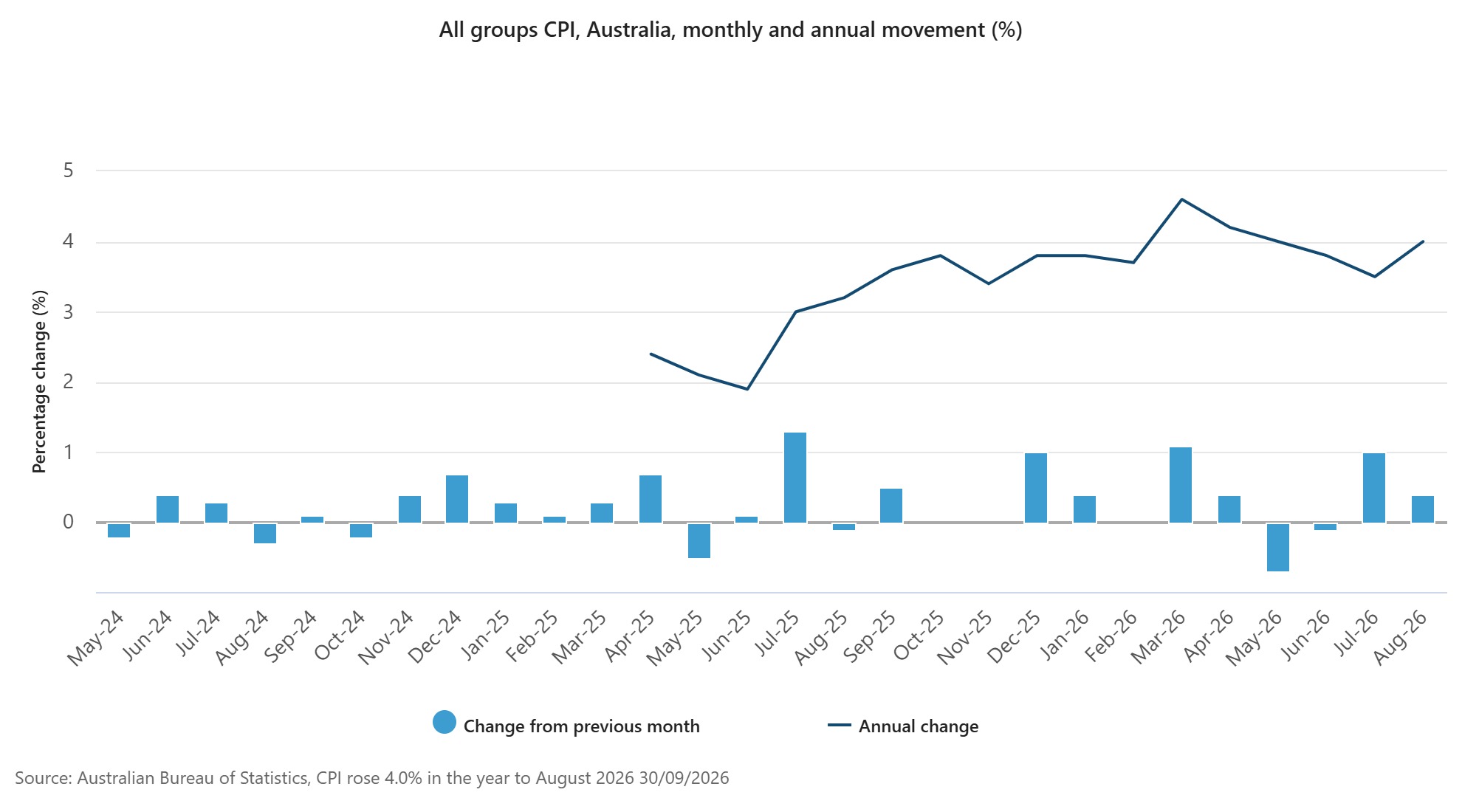
These figures remain relevant because the RBA targets inflation of 2–3% over the medium term. Inflation above that range may complicate the outlook for monetary policy, although the implications depend on the composition of price increases and the broader economic environment.
The September CPI release, scheduled for 28 October, will provide an updated assessment of price developments. Market attention may focus on whether inflationary pressures are broadening, easing or remaining concentrated in particular categories.
The figures should be assessed alongside previous readings and available market expectations. A result above or below expectations may affect interest-rate pricing, but one release alone is unlikely to determine the RBA’s policy decision.
How Energy Prices Could Influence Inflation
Energy costs can affect inflation through several channels. Higher fuel prices may increase transportation, distribution and operating costs. If these pressures persist, businesses may pass some of the additional costs on to consumers through higher prices for goods and services.
The extent of the impact depends on how long energy prices remain elevated, whether businesses absorb or pass on higher costs, and how consumers respond to changing prices. Government measures, supply conditions and movements in other cost components may also influence the overall effect.
For the RBA, an important consideration is whether energy-related price increases remain temporary or contribute to broader and more persistent inflation. If higher costs begin to affect prices across multiple sectors or influence inflation expectations, the implications for monetary policy could become more significant.
However, higher energy prices do not automatically mean that interest rates must rise. The RBA also considers employment, household spending, economic growth and the balance of risks to inflation.
RBA Policy Outlook: What Could the September CPI Reveal?
On 29 September 2026, the RBA raised its cash rate by 25 basis points to 4.60%. The decision reflected concerns about elevated inflation and the risks surrounding the economic outlook.
The September CPI release will arrive shortly before the RBA’s next monetary policy meeting, scheduled for 2–3 November. It will therefore be one of the latest inflation indicators available to policymakers ahead of that decision.
If inflation remains stronger than expected, market participants may reassess the possibility that monetary policy will need to remain restrictive for longer. If inflation shows a broader moderation, expectations for the future policy path could shift in the other direction.
Neither outcome would guarantee a particular RBA decision. Policymakers will assess the CPI alongside other economic indicators and their implications for the inflation outlook.
It is also important to distinguish between market expectations and the RBA’s actual decision. Interest-rate expectations can change before a policy announcement as investors interpret new information.
China and Commodity Demand: Another Factor for the Australian Dollar
Australia’s economic outlook is also influenced by developments in China, one of its major trading partners. Changes in Chinese industrial activity, investment and demand for commodities can affect Australia’s export outlook.
Iron ore and other commodities are relevant to Australia’s external trade, but their prices also depend on global supply, production conditions and demand from other economies. As a result, stronger or weaker Chinese economic data do not necessarily translate directly into a corresponding movement in the Australian dollar.
For AUD/USD, these external factors interact with domestic inflation and interest-rate expectations. A comprehensive assessment therefore requires attention to both Australia’s economic conditions and developments in the global economy.
Three Possible Scenarios for AUD/USD
The September CPI release may shape market expectations through several possible scenarios. These are conditional frameworks for understanding potential market responses, not forecasts of the exchange rate.
1. Inflation exceeds expectationsIf the data indicate stronger-than-expected price pressures, market participants may consider the possibility that Australian interest rates will remain elevated for longer.
This could support the AUD under certain conditions, particularly if Australian interest-rate expectations strengthen relative to those for the United States. However, the response would also depend on the US dollar, commodity prices and broader market sentiment.
2. Inflation comes in below expectationsIf the data indicate a broader moderation in inflation, expectations for further monetary tightening may ease. This could influence Australian bond yields and the relative attractiveness of AUD-denominated assets.
Nevertheless, the implications would depend on the source of the slowdown. Moderating inflation accompanied by resilient economic activity may be interpreted differently from falling inflation associated with weaker demand.
Developments in US inflation and Federal Reserve expectations would also influence the response of AUD/USD.
3. Inflation remains elevated while growth slowsA more complex scenario could emerge if inflation remains high while household spending or economic activity weakens. Such a combination would present a policy challenge for the RBA, as price stability would need to be considered alongside growth risks.
Under these conditions, AUD/USD could become more sensitive to changes in interest-rate expectations, commodity prices and global risk sentiment. The direction of the response would depend on how markets assess the relative outlooks for Australia and the United States.
Summary of Three AUD/USD Scenarios
| Scenario | Inflation Outcome | RBA Policy Implication | Potential AUD/USD Reaction |
Scenario 1: Inflation exceeds expectations |
Headline or underlying inflation comes in above market expectations, particularly if quarterly trimmed mean inflation is stronger than anticipated. | Reinforces concerns about persistent inflation and may increase expectations of another rate hike or a longer period of restrictive policy. | Potentially bullish for AUD, if Australian rate expectations rise relative to US rate expectations and global risk sentiment remains supportive. |
Scenario 2: Inflation comes in below expectations |
Headline and underlying inflation are softer than expected, with evidence that price pressures are moderating. | May reduce pressure for further tightening and strengthen expectations that the cash rate could remain at 4.60%. | Potentially bearish for AUD, if Australian yields decline relative to US yields.
|
Scenario 3: Inflation remains elevated while growth slows |
Underlying inflation remains persistent while household spending or economic activity weakens. | Creates a policy dilemma between containing inflation and limiting risks to economic growth. | Potentially higher volatility, with direction dependent on relative interest-rate expectations, commodity prices and global risk sentiment.
|
Key Indicators to Watch Before the RBA Meeting
Several indicators may help explain how markets interpret the September CPI release:
- Australian CPI: Headline inflation and underlying measures can provide information about the breadth and persistence of price pressures.
- RBA communication: Previous policy statements and subsequent comments can offer context on how policymakers assess inflation and economic risks.
- US economic data and Federal Reserve expectations: Changes in the expected US interest-rate path may influence the USD side of AUD/USD.
- Chinese economic activity: Industrial activity and commodity demand can affect Australia’s export outlook.
- Energy and commodity prices: These may influence Australian inflation, business costs and export revenues through different channels.
These indicators should be considered together rather than interpreted as independent signals of currency direction.
Conclusion
Australia’s September CPI release on 28 October will provide an important update on inflation ahead of the RBA’s November policy meeting. The figures may influence market expectations for Australian interest rates, particularly if inflation differs meaningfully from expectations.
However, the implications for AUD/USD will depend on more than the Australian inflation data alone. Relative interest-rate expectations in Australia and the United States, China’s economic outlook, commodity prices and global risk sentiment may all contribute to the market response.
The release therefore offers an opportunity to reassess Australia’s inflation outlook, while the eventual policy implications will depend on the wider set of economic evidence available to the RBA.
Note: CFDs are complex instruments and come with a high risk of losing money rapidly due to leverage. 76% of retail investor accounts lose money when trading CFDs with this provider. You should consider whether you understand how CFDs work and whether you can afford to take the high risk of losing your money. This marketing publication is for informational and educational purposes only. It is not an investment recommendation. We do not suggest any investment strategy in this material, nor do we provide investment advice. The material does not take into account your individual financial situation, needs, or investment objectives. It does not constitute a solicitation or invitation to buy, sell, or engage with any product or service of IUX. We have prepared this marketing publication carefully and objectively. We present the facts known to the authors at the time of its creation. We do not include any judgmental elements. Information and research based on historical data or results, as well as forecasts, are not a reliable indicator of the future. We are not responsible for your actions or omissions, especially if you decide to purchase or sell financial instruments based on the information in this marketing publication. We are also not liable for any damages that may result from the direct or indirect use of this information. Investing is risky. Invest responsibly.


Federal Reserve Decision Looms as Dollar Strength Challenges Major Currencies | 27th October, 2026

AUDUSD Holds Above 0.7000 as Traders Await Australian CPI

Weak Tech Earnings Pressure the US Dollar as Central Bank Divergence Shapes Forex Markets | 23rd October, 2026

US Dollar Outlook Shifts as Treasury Yields Fall and Central Bank Divergence Shapes Forex | 22nd October, 2026

Gold Edges Lower as Fed Rate Outlook Clouds Markets

UK Inflation Risks and Central Bank Expectations Shape Forex as Oil | 21st October, 2026

Dollar Weakens as Oil Rallies and Asian Currencies Navigate PBOC Policy | 20th October, 2026