





Risk appetite faces crucial tests ahead

Back-and-forth continues in Middle East talks
Two months after the celebrated April 8 ceasefire between the US and Iran, with Israel halting its own military operations shortly afterwards, the progress in the negotiations can be branded as questionable, with the Strait of Hormuz remaining mostly shut. US President Trump continues to advertise that an agreement will be reached soon, sometimes acting as the adult in the room as Iran and Israel momentarily resume their hostilities. Market participants remain mostly convinced that a peace deal will eventually materialize but treat Trump’s bullish rhetoric as unreliable.
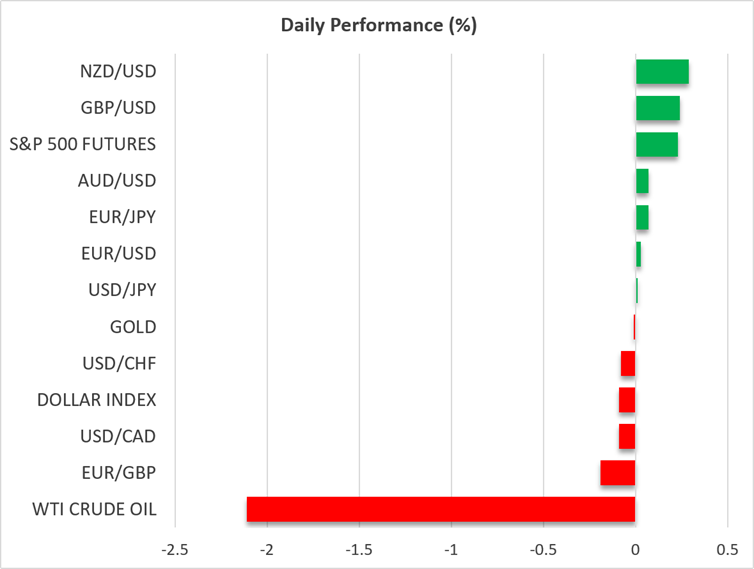
Hence, excluding oil prices that continue to whipsaw upon headlines, although the December WTI future is showing remarkable stability and trading around $80, market reactions to Middle East headlines have been tempered as other developments – predominantly AI and Fed expectations – have been the main market drivers.
That could change, though, over the next few weeks as the temporary buffers, such as the Russian floating stocks and the US SPR releases, are removed from the equation and the world is forced to finally face the Strait of Hormuz supply disruption. One of the dates touted is July 9, potentially adding a real sense of urgency to the Middle East negotiations for both Asian and European countries.
All eyes are on equity markets
While the dollar is tentatively giving back a small chunk of last week’s gains, with euro/dollar hovering around 1.1545 at the time of writing, US equity indices are in the spotlight. Part of the reason for the underperformance of other assets, such as gold and bitcoin, is the AI frenzy and the unrelenting rally in technology stocks. That said, last Friday’s move highlighted the importance of monetary policy in the recent upward move, somewhat shaking investor confidence.
While calls from investment houses about US stock markets showing bearish signals are multiplying, the focus this week is firmly on the SpaceX IPO, which is touted to raise around $75bn. Investors will look at the oversubscription, the pricing of the IPO, with strong demand potentially pushing it towards the top of the price range, but the real test will come during the first trading sessions. The direction of travel could confirm the current appetite for technology stocks, opening the door to other mammoths like OpenAI to go public.
That said, this week’s key US data, predominantly Wednesday’s CPI and Thursday’s PPI and, to a lesser extent, the ECB meeting can really upset risk appetite. Investors believe that the new Fed Chair will copy a page from Powell’s guidebook and avoid upsetting equity markets but, at the same time, he will be inclined to avoid disappointing President Trump. However, with inflation potentially accelerating and the Fed hawks most likely being less accommodative than under the previous Fed Chair, next week’s Fed meeting might surprise with its hawkish tone, potentially triggering a sell-off in equity markets.
Yen stuck in the 160 region; bitcoin climbs to $63k
Despite the current dollar-negative sentiment, dollar/yen continues to trade above 160. The upcoming BoJ rate hike and the balanced rhetoric are not sufficient to reverse the yen’s fate, with Japanese government officials hoping for a miracle in the form of an agreement in the Middle East or weaker US CPI data, both of which would prompt a dollar decline. Comments such as those from Japan's Economy Minister Kiuchi that “rising rates could affect the economy through multiple channels” are definitely not helping the yen at this juncture.
Finally, while gold is failing to react to Friday’s sizeable sell-off, bitcoin is showing some signs of life. It has bounced off the February low of $60k, but a sustained move towards the $75k area is necessary to invalidate the current bearish sentiment. With risk appetite being positive but not benefiting cryptos, it appears difficult to envisage a scenario in which bitcoin jumps higher that does not involve a significant dollar depreciation.


The yen is strengthening before our very eyes

The Inflation Measure Keeping the Fed Cautious

US Yields Rise Despite Buybacks; Eyes on ECB Hike

Bitcoin edges lower for a 4th day, capped by the 50-week MA

GBPUSD (4H) recovery holds above 1.3550, 100-SMA remains key hurdle

Apple Stock Slips After iPhone 18 Launch as AI Growth Expectations Remain in Focus

US Treasury Triples Long-Term Bond Buyback Size