





Tech rout and Fed hike bets fuel global risk aversion

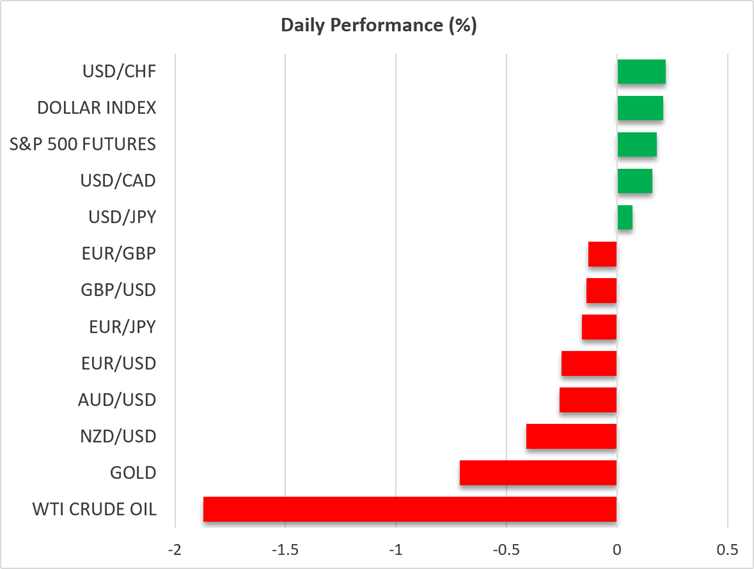
Dollar flexes its muscles
The US dollar continued flexing its muscles against the other major currencies, with the only currency somewhat resisting its strength being the yen. However, the Japanese currency is failing to hold resilient today, resuming its prevailing slide.
It seems that the Fed’s hawkish stance continues to add fuel to the dollar’s engines, but yesterday’s rally may not have been driven solely by Fed bets. After all, according to Fed funds futures, market expectations have not changed much since yesterday. A quarter-point hike remains fully priced in for September, while another one is nearly fully penciled in for March 2027. The probability of a July move stands at around 37%.
Another source of fuel for the greenback may have been safe-haven flows after investors massively sold AI and semiconductor stocks due to concerns of extremely debt-funded spending and stretched valuations, especially amidst expectations of higher interest rates in the months to come.
Indeed, the notion of a risk-off appetite and safe-haven inflows into the dollar is also supported by the pullback in Treasury yields, which confirms that yesterday’s strength did not stem from increasing rate hike bets.
Following yesterday’s better-than-expected flash US PMIs for June and the acceleration of the services price subindex to an 11-month high, dollar traders will now shift their attention to Thursday’s PCE inflation numbers. A hotter-than-expected set of numbers could increase the probability of a Fed hike being delivered in July.
Yen keeps flirting with intervention levels
The Japanese yen resumed its slide against the US dollar today, even after the summary of opinions from the latest Bank of Japan meeting revealed that policymakers have been concerned about inflation spiraling out of control, with some arguing about faster rate hikes towards levels considered neutral for the economy.
On top of that, despite the repeated warnings from Finance Minister Katayama, Japanese authorities have yet to intervene, allowing dollar/yen to get close to the 162.00 zone. That said, they may feel comfortable allowing the pair to move a little bit higher, as the rally has been mainly driven by dollar strength rather than yen weakness. Indeed, looking at other yen crosses, the yen appears to have held relatively strong lately.
Pound surrenders to dollar’s strength
The British pound gave back nearly all of Monday’s gains, surrendering to the broader dollar strength, which seems to have outweighed the diminishing political uncertainty after UK PM Keir Starmer decided to resign.
The pound rebounded on Monday on speculation of an orderly leadership transition, but the dollar’s strength and the weak flash PMIs for June did not allow further advances. The UK composite index fell to a 14-month low of 49.4 from 49.7 in May, accelerating the contraction, and prompting investors to push back the timing of when they expect the Bank of England to press the rate-hike button.
Wall Street falls on AI and chip selloff
On Wall Street, all three of its major indices closed in negative territory, with the tech-heavy Nasdaq tumbling more than 2% as investors continued to abandon AI and semiconductor stocks.
The trigger for the global selloff may have been the tumble in South Korea’s KOSPI, which has become one of the most AI crowded indices in the world. Volume was heavily concentrated in Samsung and SK Hynix, with retailers accumulating exposure through leveraged products. Thus, once the index opened sharply lower, with Samsung and SK Hynix falling more than 10% on Tuesday, the selling spread into the rest of Asia, and then, Europe and the US, with investors questioning even more the sustainability of tech firms' spending on AI projects.
Having said all that, today, the KOSPI index recovered 3.26%, with US stock futures pointing to a modest recovery as well.


The yen is strengthening before our very eyes

The Inflation Measure Keeping the Fed Cautious

US Yields Rise Despite Buybacks; Eyes on ECB Hike

Bitcoin edges lower for a 4th day, capped by the 50-week MA

GBPUSD (4H) recovery holds above 1.3550, 100-SMA remains key hurdle

Apple Stock Slips After iPhone 18 Launch as AI Growth Expectations Remain in Focus

US Treasury Triples Long-Term Bond Buyback Size