






USD/JPY: The Dollar Still Owns the Carry, but Japan Is Starting to Push Back

- The interest-rate differential still favors USD, but rising Japanese yields and growing expectations of another BoJ hike are reducing the asymmetry.
- The Fed is likely to pause this week, making forward guidance and Thursday’s GDP/PCE data more important than the decision itself.
- The daily chart remains capped below major resistance, while the H1 chart shows a tactical bullish recovery approaching supply.
- The key near-term battleground is 157.39-157.68; above it, 158.00 and 158.41 come into focus, while failure returns attention to 156.83 and 156.31.
Fundamental Analysis
USD/JPY is becoming a more sophisticated rates trade. For most of the past several years, the logic was straightforward: U.S. yields were dramatically higher than Japanese yields, making the dollar attractive both for outright carry and as the funding destination for global capital.
That advantage still exists. The Federal Reserve’s target range stands at 3.75%-4.00%, while the Bank of Japan’s policy rate is only 1.25%. U.S. Treasury yields also remain substantially above comparable JGB yields.
But the direction of travel has changed. U.S. front-end yields have eased over recent weeks as markets increasingly expect the Fed to pause in October. At the same time, Japanese yields have risen sharply this year as inflation becomes more persistent and the BoJ moves gradually toward policy normalization.
That means USD/JPY now depends less on the absolute yield gap and more on whether that gap continues widening.
Fed: A Pause Is Priced, December Is Not
The Fed is widely expected to leave rates unchanged this week after September’s 25-basis-point hike. The more important question is whether Chair Kevin Warsh validates market expectations for another increase in December. U.S. inflation remains uncomfortable. August PCE inflation stood at 3.4%, while consumer inflation expectations have also risen as high energy costs continue to pressure household budgets. At the same time, parts of the economy are softening. Housing activity has deteriorated under mortgage rates above 7%, while consumer sentiment remains close to historical lows. The Fed therefore faces a classic late-cycle problem: inflation is still too high, but the economy is increasingly sensitive to restrictive financial conditions.
Thursday’s data will sharpen that debate. Q3 GDP is expected to show strong growth, while September PCE will reveal whether inflation is broadening beyond the energy shock. A combination of strong GDP and firm core PCE would keep December tightening alive and support USD/JPY.
BoJ: Inflation Is Becoming Harder to Ignore
Japan is moving in the opposite direction. September core CPI rose above the BoJ’s 2% target, while the measure excluding both fresh food and energy accelerated further. Wholesale inflation also remains elevated. This matters because Japanese inflation is no longer purely imported. Higher wages, tighter labor markets, stronger AI-related investment and corporate price-setting behavior are increasingly contributing to domestic inflation.
The BoJ is still expected to hold rates this week following September’s hike, but the communication could become more important than the rate itself. If the Bank upgrades its inflation outlook and indicates that policy remains accommodative, markets may bring forward expectations for the next hike. That would support the yen even without an immediate policy move.
Japanese Bonds Are Becoming Competitive Again
The bond market provides another reason why USD/JPY may become harder to push sustainably higher. Japanese government bond yields have climbed dramatically. The 10-year JGB is trading close to 2.8%, while shorter maturities have also repriced higher.
For Japanese insurers, banks and pension funds, domestic bonds are becoming more attractive relative to foreign securities once FX hedging costs are considered.
Recent data already show Japanese investors selling foreign bonds for several consecutive weeks. This creates a potential repatriation channel. As money returns to Japan, demand for yen rises, reducing one of the structural forces that previously supported USD/JPY.
Oil Creates a Two-Sided Yen Risk
Energy remains the complication. Japan imports most of its fuel, so Brent above $100 deteriorates its terms of trade and increases the yen cost of imports. That is fundamentally negative for JPY. But higher oil also pushes Japanese inflation higher, strengthening the case for BoJ tightening.
The result is unusual because the same energy shock can weaken the yen through trade flows while strengthening it through monetary-policy expectations. This is why the BoJ’s reaction function now matters more than oil alone.
Macro Dashboard
| Driver | Current signal | USD/JPY impact |
| Fed policy | Hold likely; December hike still possible | USD supportive |
| BoJ policy | Hold likely; December hike risk rising | JPY supportive |
| U.S. yields | Still historically high | USD supportive |
| JGB yields | Rising materially | JPY supportive |
| Japan inflation | Back above BoJ target | JPY supportive |
| Oil | Elevated despite recent pullback | Mixed |
| Japanese capital flows | Foreign-bond selling / repatriation | JPY supportive |
| Intervention risk | Still relevant near upper-150s/160 | Caps USD upside |
Multi-Timeframe Technical Analysis
Daily Chart: Strategic Bias Remains Capped Below 160.39
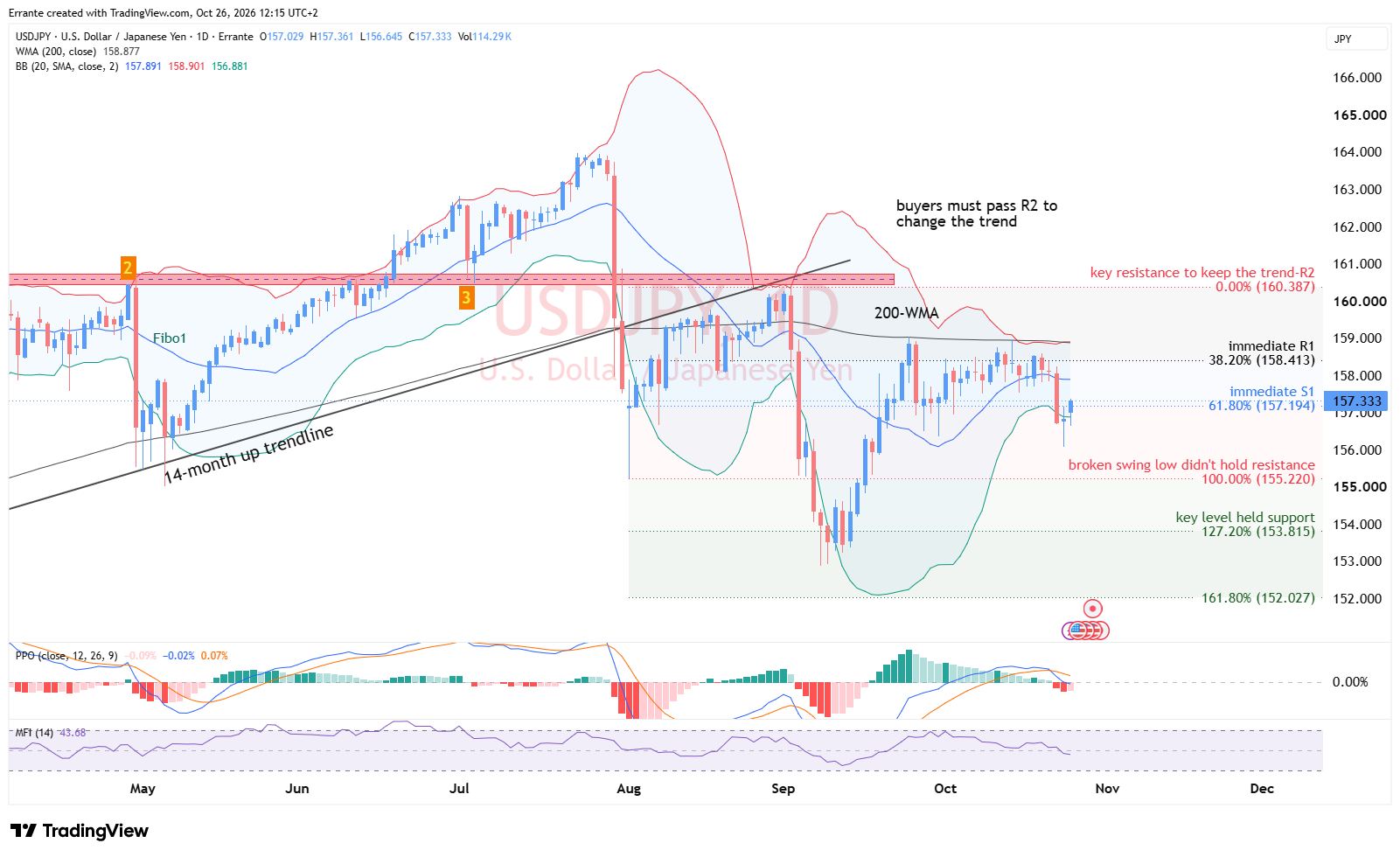
The daily chart remains structurally neutral-to-bearish despite the recovery from September’s low. USD/JPY broke its 14-month rising trendline earlier in the year and is still trading below the 200-period WMA near 158.88. That makes the long-term mean an important resistance rather than support.
The larger barrier sits at 160.39, a former structural level that now defines the threshold between a corrective recovery and a genuine trend reversal.
Price is currently near 157.33, slightly above immediate support around 157.19 but below resistance at 158.41.
Daily PPO has drifted back below neutral and MFI near 44 shows no strong accumulation signal.
The strategic message is therefore clear. Buyers can recover ground, but the broader structure does not turn convincingly bullish until 158.88 and ultimately 160.39 are reclaimed.
1-Hour Chart: Bullish Recovery Runs into Supply
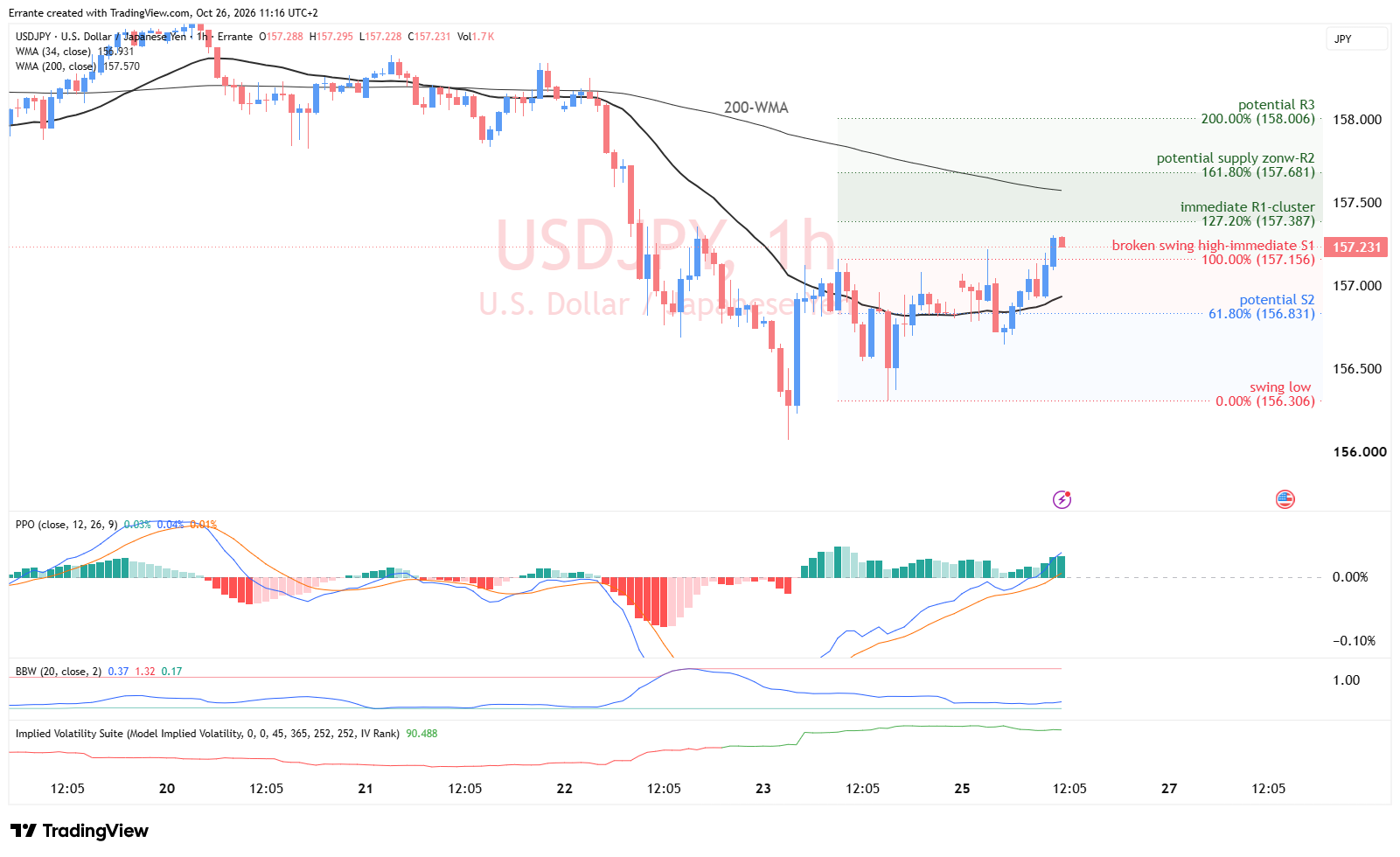
The H1 chart is more constructive. Price has broken above the prior swing high at 157.16, while the 34-period WMA has turned upward. PPO has also moved into positive territory, confirming improving short-term momentum.
However, the recovery is entering resistance. The 200-period WMA sits near 157.57, directly inside the supply zone extending toward 157.68.
That makes the current move a tactical bullish recovery inside a more cautious daily structure. A clean break through 157.68 would open 158.01, followed by the daily resistance around 158.41. Failure to hold above 157.16 would instead return attention toward 156.83, with 156.31 representing the more important structural swing low.
Bollinger Band Width remains relatively compressed, while implied-volatility readings are elevated. That is consistent with a market waiting for policy catalysts rather than already committing to a directional trend.
Key Levels to Watch
Resistance
- 157.39 - Immediate H1 resistance
- 157.57-157.68 - H1 200-WMA and supply cluster
- 158.01 - H1 extension target
- 158.41 - Daily resistance
- 158.88 - Daily 200-WMA
- 160.39 - Major trend-change threshold
Support
- 157.16 - Broken H1 swing high / polarity support
- 156.83 - Tactical H1 support
- 156.31 - H1 swing low
- 155.22 - Major daily support
- 153.82 - Deeper daily structural level
Scenario Outlook
Bullish USD Scenario
The strongest upside scenario would combine a hawkish Fed pause with resilient U.S. GDP and sticky core PCE. If U.S. yields rise while the BoJ remains cautious, USD/JPY could clear 157.68 and extend toward 158.01-158.41. A break through the daily 200-WMA would then expose 160.39.
Neutral Scenario
Both central banks may hold while keeping future tightening optional. That would leave USD/JPY trapped between roughly 156.83 and 158.41 as markets wait for clearer December policy signals. Given elevated implied volatility, this scenario could still produce large intraday swings without a durable trend.
Bearish USD Scenario
The more interesting asymmetric risk is a narrowing yield differential. Softer U.S. GDP or PCE, combined with a BoJ inflation upgrade and stronger signals of another Japanese hike, would pressure USD/JPY. A break below 156.83 would expose 156.31, while loss of that level would reopen the daily support near 155.22.
Trading Considerations
The H1 chart favors confirmation trades rather than chasing price into resistance. Bullish traders need acceptance above 157.68 before the recovery gains technical credibility. Bearish traders should watch for rejection from the 157.57-157.68 supply zone, particularly if U.S. yields fall relative to JGB yields. Elevated implied volatility argues for reduced leverage around the Fed, GDP/PCE and BoJ events.
Final Conclusion
USD/JPY still has one powerful argument in favor of the dollar: carry. But carry is no longer enough by itself.
Japanese inflation is rising, the BoJ is normalizing policy, JGB yields are becoming more competitive and Japanese investors are beginning to reconsider foreign-bond exposure.
Technically, that leaves USD/JPY caught between a short-term H1 recovery and a daily structure still capped below major resistance.
Above 157.68, the market can challenge 158.01 and 158.41.
Below 156.83, the recovery begins to fail.
The larger trend only turns convincingly bullish above 160.39.
For this week, the pair is therefore less a simple dollar-strength trade and more a contest over which central bank forces the market to reprice December first.


Central Bank Divergence and Easing Iran Tensions Reshape Currency Markets | 26th October, 2026

USDJPY Holds Above 157.00 as Traders Weigh Falling Yields and Fed-BOJ Outlook

EURUSD failed to break through the French barrier

Daily Fundamental Analysis: Nasdaq adds 1% as Tesla reports strong earnings

Oil Holds Near Highs as Gold Slips Ahead of Fed Decision

Oil Surge Powers a Risk Check; Gold Touches $4,100 Ground

The pound is capitalising on expectations