-1162026812.png)
-1162026812.png)





🇺🇸 US Midterm Elections: Political Gridlock Raises Fiscal and Debt Risks

 The US midterm elections have delivered a substantial political setback for the Republican Party. Having lost control of both chambers of Congress, the Republicans have effectively surrendered legislative power to the Democrats. President Donald Trump has emerged as the principal casualty of the result, which suggests that a significant proportion of the American electorate has grown increasingly dissatisfied with his unpredictable political approach, confrontational decisions and persistent controversies over the past two years.
Trump acknowledged that the election outcome had taken him by surprise. He has nevertheless made clear that he intends to exercise his presidential veto where necessary, while also expressing a willingness to work with the newly elected Congress. In practice, meaningful cooperation is likely to prove difficult, given the considerable differences between the White House and the Democratic majority over public spending, taxation, fiscal priorities and federal borrowing.
However, Democratic control of Congress does not automatically mean that Trump's economic agenda will be dismantled. The President retains considerable executive authority, including the power to veto legislation. Furthermore, substantial elements of trade, immigration and foreign policy can still be implemented through executive orders without requiring direct congressional approval.
The implications for fiscal policy are potentially more significant. Divided government has historically produced prolonged legislative disputes, particularly when the two parties hold fundamentally different views on taxation and public expenditure. Republicans are likely to resist increases in the tax burden, while Democrats will oppose substantial reductions in government programmes. Under these circumstances, achieving a meaningful reduction in the federal deficit becomes considerably more challenging. A continuation of expenditure exceeding revenue, accompanied by further debt accumulation, appears the more plausible outcome.
This is where the situation becomes particularly sensitive.
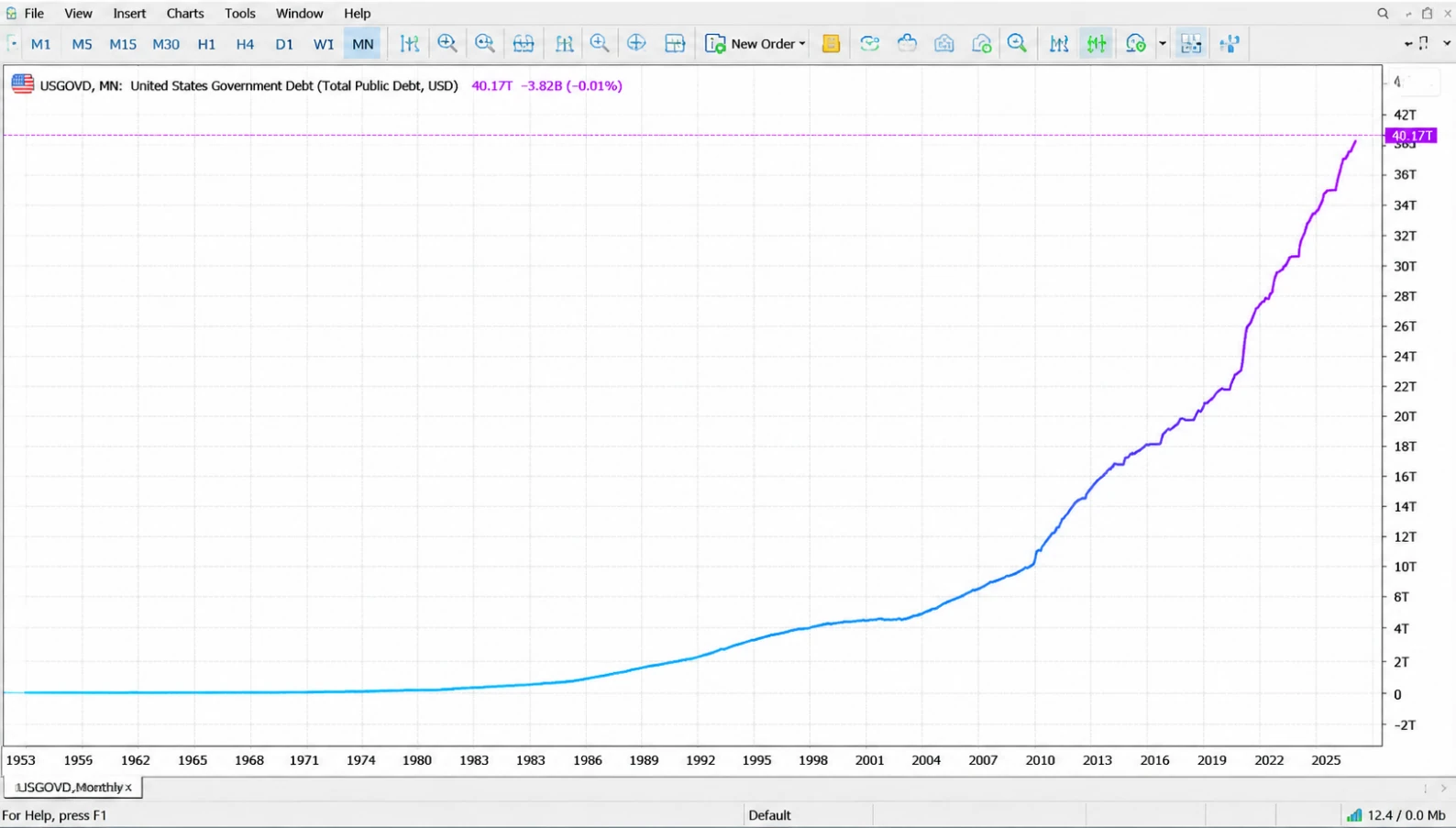
Total US government debt has already approached $40.5 trillion, while the annual federal budget deficit stands at approximately $2 trillion. Debt subject to the statutory borrowing limit is estimated at around $40.3 trillion, against a debt ceiling of $41.1 trillion. This leaves a formal borrowing headroom of just $800 billion.
In the context of US public finances, that is a relatively limited margin. Historically, the period between November and March has generated substantial cumulative budget deficits, typically amounting to approximately $900 billion–$1 trillion. Consequently, the question of how the federal government will continue financing its obligations could return to the forefront of political negotiations as early as spring 2027.
Reaching the statutory debt ceiling, however, would not necessarily result in an immediate suspension of government payments or a technical default.
The US Treasury retains several mechanisms for managing its liquidity requirements. These include cash balances held in its account at the Federal Reserve, estimated at approximately $900 billion, alongside extraordinary measures that could potentially provide an additional $400–500 billion of temporary financial flexibility.
Depending on the pace of expenditure, revenue collection and borrowing requirements, these resources could allow the dispute over the debt ceiling to continue for an extended period, potentially until November or December 2027.
Such a scenario would also have important implications for financial markets. Drawing down the Treasury General Account at the Federal Reserve would release liquidity into the banking system, while restrictions on additional borrowing could temporarily reduce the supply of newly issued US government securities.
In other words, a political confrontation over the debt ceiling could, under certain circumstances, coincide with an improvement in short-term market liquidity, even as the broader fiscal outlook deteriorates.
The initial response across financial markets has already highlighted the complexity of the changing political environment.
Oil prices have fallen sharply, reflecting growing expectations of a possible resolution to the conflict involving Iran and a corresponding reduction in the geopolitical risk premium. Nevertheless, the outlook remains highly uncertain. The Trump administration faces a strategic choice between pursuing a negotiated settlement and adopting a more confrontational approach that could trigger another escalation.
The US dollar has also weakened, while gold has benefited from renewed buying interest. Meanwhile, selling pressure has affected shares of companies exposed to artificial intelligence, as investors reassess the possibility of tighter regulation of the technology sector under a Congress controlled by Democrats.
The market response therefore reflects more than a straightforward judgement on the election result. Investors are reassessing the likely direction of US fiscal policy, international trade relations, regulatory priorities and geopolitical strategy.
For now, a prolonged period of political deadlock appears to be the most likely scenario. The White House and Congress may increasingly seek to constrain each other's initiatives, making significant legislative progress dependent on difficult negotiations, reciprocal concessions and sustained political bargaining.
Major decisions, ranging from federal spending authorisations to adjustments to the debt ceiling, could become sources of recurring confrontation. Even routine fiscal measures may prove difficult to approve if either party believes that withholding support offers a political advantage.
The first substantial test of this new balance of power will come in early December, when federal government funding is due to become a central issue. The outcome should provide an early indication of whether the administration and congressional leadership are prepared to reach workable compromises or intend to pursue a more confrontational strategy.
Looking further ahead, the election result could also encourage a reassessment of political leadership within the Republican Party.
Some moderate Republicans may be tempted to distance themselves from Trump and consider whether supporting efforts to remove him from office could improve the party's prospects ahead of the 2028 presidential election.
Under such circumstances, Vice President JD Vance could potentially assume the presidency. However, this would require a significant political rupture within the Republican Party, while the strategic benefits for Democrats are far from certain. At present, therefore, this remains a speculative possibility rather than a credible near-term political strategy.
Key TakeawayThe United States is entering a period in which political confrontation could have direct consequences for fiscal policy, government borrowing, dollar liquidity and global investor sentiment.
With the structural budget deficit remaining substantial and federal debt continuing to expand, the scope for compromise is becoming increasingly constrained. Prolonged disagreements over public expenditure and the debt ceiling could create recurring uncertainty for financial markets, even where short-term liquidity conditions remain supportive.
The central issue is no longer simply which party controls Congress, but whether the American political system can deliver credible fiscal decisions in an environment of deepening polarisation. For global markets, the consequences of that challenge may ultimately prove more significant than the election result itself.Trade smart with Headway


Dollar extends election-related slide, stocks rebound

The euro has spread its wings

Midweek Technical Look – US100, OIL, BTCUSD

Democratic Sweep Weakens the US Dollar and Lifts Precious Metals | 5th November, 2026

Dow Holds Near 53,578 After 3% Election Rally as Democrats Win Congress

Gold Extends Rally Above $4,100 as Democratic Wins Weigh on Dollar and Yields
EBC Markets Briefing | Oil prices continue to fall after Vance questioned Iran war