-1162026812.png)
-1162026812.png)





China's Gold Strategy: A Structural Tailwind for Bullion

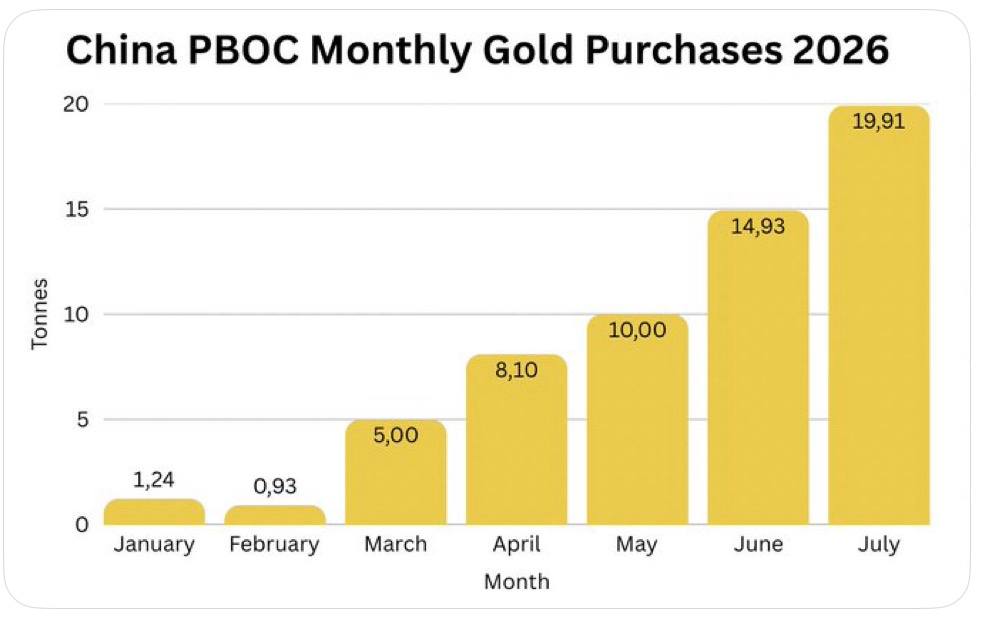
One of the most important long-term drivers of gold remains sustained demand from central banks, particularly the People's Bank of China.
The chart above illustrates China's gold purchases since the beginning of the year. The scale of these acquisitions speaks for itself and clearly demonstrates that the world's major reserve managers continue to increase the proportion of gold within their official reserves.
At the same time, China has spent recent years expanding its natural gas storage capacity and became the global leader in new gas storage infrastructure additions during 2025. At the time, many eurozone observers questioned why Beijing was purchasing gas that much when prices had fallen sharply following the events of 2022.
Today, those decisions appear in a very different light. As the saying goes, "Dig the well before you are thirsty." The proverb perfectly captures the value of long-term strategic preparation. Following the sharp escalation in the Middle East and one of the most significant global energy crises in recent history, China's substantial gas reserves proved to be a major strategic advantage.
For that reason, the Chinese leadership can reasonably be regarded as having adopted a highly forward-looking geopolitical strategy. The decision to accumulate natural gas proved both timely and economically beneficial. China is now pursuing a similarly consistent strategy of expanding its gold reserves, leading many investors to believe that these purchases also reflect a carefully considered long-term policy rather than a short-term response to current market conditions.
Over recent years, central banks have evolved from being secondary participants in the gold market into one of its principal sources of structural demand. Unlike speculative investors, reserve managers typically acquire gold with a multi-year investment horizon, viewing it as a means of diversifying reserves and reducing dependence on individual reserve currencies. Consequently, their purchases tend to exert a more durable influence on long-term price trends.
Provided current conditions remain broadly unchanged—including continued central bank buying, expectations of a more accommodative Federal Reserve and persistent geopolitical uncertainty—the fundamental backdrop for gold remains supportive. The market has repeatedly demonstrated that even after periods of correction, buying interest returns relatively quickly, suggesting that the longer-term upward trend remains intact.
Should these underlying drivers persist through the remainder of the year, gold is likely to remain well positioned to challenge fresh record highs. That said, a repeat of the exceptionally rapid appreciation seen during the first half of the year should not be taken for granted. Periods of consolidation and profit-taking are likely along the way. Under a favorable macroeconomic environment, a year-end range of approximately US$4,700 appears achievable, provided there is no material recovery in the US dollar or an unexpected shift towards tighter Federal Reserve policy.


Dollar struggles to gain ahead of US inflation data, yen extends rally

EBC Markets Briefing | Crude prices on solid footing amid deep supply concerns

The yen is strengthening before our very eyes

The Inflation Measure Keeping the Fed Cautious

US Yields Rise Despite Buybacks; Eyes on ECB Hike

Bitcoin edges lower for a 4th day, capped by the 50-week MA

GBPUSD (4H) recovery holds above 1.3550, 100-SMA remains key hurdle