-482026738.png)





Crypto Security Mistakes That Could Cost You Your Entire Account

Key Takeaways
- Crypto transactions cannot be reversed, so a single mistake can permanently lose your funds.
- The most common attacks on crypto traders are phishing, address-swapping malware, and account takeovers.
- A secure wallet should combine two-factor authentication, address whitelisting, activity monitoring, and identity checks.
- Simple habits such as using an authenticator app and double-checking wallet addresses prevent most losses.
Crypto has changed how traders fund their accounts. Transfers move in minutes, work around the clock, and reach trading platforms without waiting for banks to open. For active traders, that kind of speed can make a real difference when markets move quickly.
But the same speed that makes crypto so useful is also what makes security so important. Unlike a bank transfer, a crypto transaction is final once it is sent. There is no support line to call, no refund to request, and no insurance to claim. A single mistake can drain an account in seconds.
That is why, for traders, security cannot be treated as a one-time setup. It is an ongoing habit, and it needs to keep up with how attackers operate.
The Most Common Security Risks in Crypto Trading
Most attacks on crypto users fall into three main types. The good news is that all of them can usually be prevented when the right tools and habits work together.
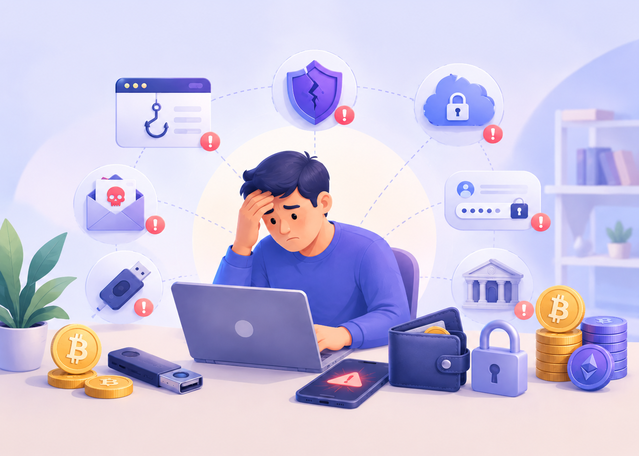
The most common is phishing. This is when an attacker tricks you into entering your details on a fake website, a fake support message, or a fake wallet app. The goal is to steal your login, password, or recovery phrase. These attacks tend to increase during volatile markets, when traders are rushing and more likely to click without checking the link.
Closely related but more technical is address-swapping malware, sometimes called clipboard hijacking. This type of malware quietly replaces the wallet address you copied with one controlled by the attacker. If you paste and send without checking, the funds go straight to them. The attack happens silently and gets around password protection completely.
The third risk is account takeover. This happens when someone gains access to your account using a stolen or reused password. Many cases start on smaller, less secure websites where you used the same password, and attackers then test those credentials across major crypto platforms.Once you know what the most common threats look like, the next step is choosing a wallet that is built to defend against them.
What to Look for in a Secure Wallet
A good wallet does not depend on just one form of protection. It uses several layers, so that if one fails, others still hold.
The strongest wallets usually include:
- Two-factor authentication (2FA): for both login and withdrawals, ideally through an app like Google Authenticator instead of SMS, which can be intercepted.
- Address whitelisting: lets you pre-approve trusted wallet addresses for withdrawals.
- Activity monitoring: flags unusual logins or large withdrawals before they go through.
- Blacklist screening: blocks transactions linked to known scams or fraud.
- Identity verification: adds an extra check beyond just a password.
These features are no longer extras. They are the standard you should expect from any platform that holds your trading capital.
A good example of this layered approach is VT Wallet, which combines two-factor authentication through OTP and Google 2FA, withdrawal address verification, risk-based monitoring, and continuous blacklist screening. Wallets built this way are better suited to active trading capital than to casual storage, where security demands are usually lower.
Habits Every Crypto Trader Should Maintain
Even the best wallet cannot protect a user who skips the basics. That is why strong security depends just as much on personal habits as it does on platform features.
The most effective habits are also the easiest to follow:
- Turn on two-factor authentication for every account, including the email connected to your wallet
- Check your withdrawal address whitelist regularly and remove any you no longer use
- Verify wallet addresses carefully before sending, especially the first and last few characters
- Stay alert during volatile sessions, when phishing attempts increase
- Never share your recovery phrase, 2FA codes, or password, even with someone claiming to be from support
These should be treated as ongoing checks, not one-time tasks. Threats change, and the traders who avoid serious losses are usually the ones who stick to good habits.
Ready to Manage Crypto and Fiat the Smarter Way?
If you are exploring how to manage digital assets more efficiently and want to see how security fits into the bigger picture, read our complete guide: How to Manage Your Fiat and Crypto Assets Seamlessly.
You'll learn how integrated wallets work, what to look for in a trading-ready platform, and how to avoid the most common mistakes when moving between fiat and crypto.

USDCAD extends rally towards June high

Gold Rebounds Slightly but Remains Under Pressure as Hawkish Fed Outlook Supports Dollar

Yen Recovery Builds as Intervention Risk Rises While Dollar Strength Pressures FX | 25th September, 2026

The Hidden Crypto Trap: Choosing the Wrong Blockchain Network

Nikkei225 Rallies Above 66,000 as Yen Weakness and Bank Stocks Support Momentum

America’s Diesel Boom Hits a Political Ceiling

The dollar's strengthening calls for a strong hand