





Dollar gains as yields surge ahead of US jobs report

Dollar supported by bond market rout
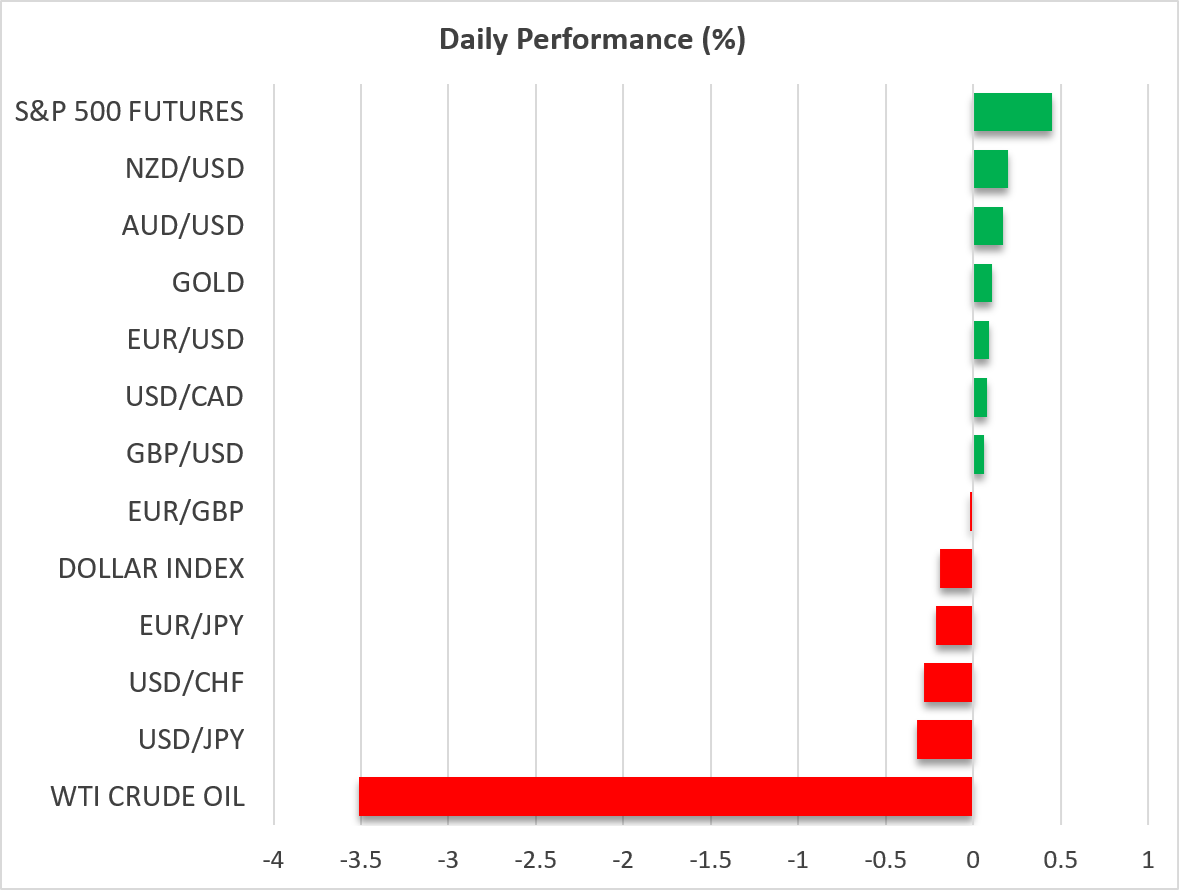
The US dollar outperformed most of its major peers on Thursday, gaining the most ground against the euro, and staying on the back foot versus the Swiss franc and the Canadian dollar.
It seems that the driver behind the dollar’s strength was once again the ongoing bond market rout that sent Treasury yields higher, with the 10-year yield hitting 5.344%, its highest since 2002. That said, borrowing costs eased later in the day ahead of today’s extra-important NFP report.
Having said that though, despite the rising yields and the strength in the US dollar, expectations for an October rate hike by the Fed remained low, at around 25%. At the beginning of the week, the chance of a back-to-back hike was hovering at around 70%, but remarks by New York Fed President John Williams that another hike may be appropriate “later this year”, as well as comments from Vice Chair Philip Jefferson that reaching a judgment about future policy adjustments “may take more time”, prompted investors to scale back their Fed hike expectations.
The next hike is now expected in December, while by the end of 2027, a total of 80bps worth of rate hikes is baked into the cake. This means that investors did not just push back the October hike to December, they also took one quarter-point increase out of the equation.
Will a strong NFP release further fuel the dollar?
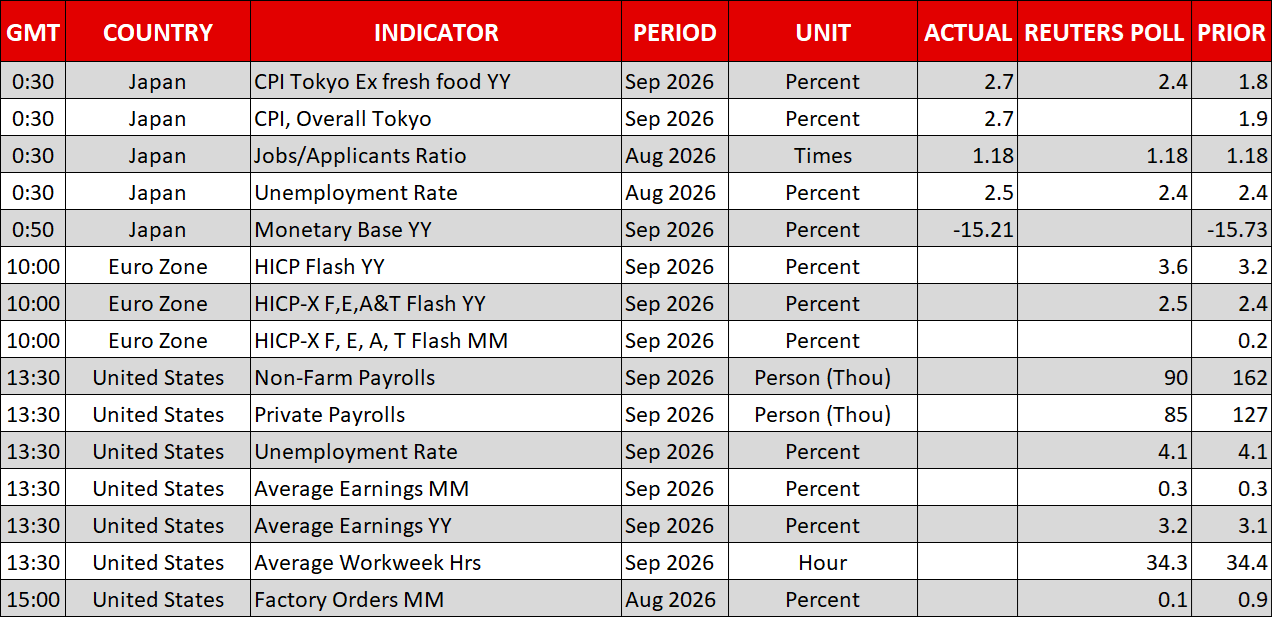
With all that in mind, today’s nonfarm payrolls for September may attract special attention. Expectations are for a slowdown to 89k from a strong 162k in August, with the unemployment rate expected to hold steady at 4.1% and average hourly earnings to accelerate somewhat to 3.2% year-on-year from 3.1%.
According to the S&P Global PMIs, September saw the fastest job creation since June 2022, with the pace rarely being exceeded since the series began in 2009. This means that the risks surrounding the NFP print may be tilted to the upside.
A strong report could add more fuel to the dollar’s engines, even if it doesn’t significantly boost the probability of an October hike. Following William’s and Jefferson’s remarks, investors could maintain the view that December may be more appropriate for the next move. However, they could add more basis points worth of rate hikes by the end of 2027.
French fiscal worries deepen euro pressure
The euro was the biggest loser, with euro/dollar traders having more to deal with than just US Treasury yields, Fed bets and today’s NFP release. France’s fiscal strains seem to have become a direct market risk for the common currency.
The French government is preparing a 2027 budget aimed at 54 billion euros in savings, but political fragmentation makes the plan’s approval and implementation uncertain. French government bond yields skyrocketed on the concern, taking the French – German yield spread to around 133bps, the widest since the Eurozone crisis.
Euro/dollar found support near the key zone of $1.1205 before rebounding somewhat, but a strong US jobs report later today could encourage the bears to dive below that hurdle, taking the pair into territories last seen in May 2025. The next key support may be at $1.1130, marked by the low of May 16.
Wall Street remains hostage to yields ahead of jobs data
On Wall Street, all three indices finished the first day of the new quarter in positive territory, but gains were modest, with the S&P 500 gaining 0.19% and the Nasdaq only 0.04%. This underscores how heavily equities remain hostage to Treasuries, despite the latest flattening of the implied Fed rate path.
Perhaps equity traders are not so convinced that the Fed will skip the October hike as oil moved higher on Thursday amid headlines that the US is deploying more military in the Middle East, while the prices-paid subindex of the ISM manufacturing PMI surged to 77.9. This is challenging for growth and high-duration technology shares, even as Micron’s stronger earnings and guidance supported semiconductors.
A strong NFP report later today could weigh on Wall Street as expectations of higher borrowing costs result in lower present values of high-growth tech stocks. The opposite may be true in case the data miss expectations.


The dollar has lost momentum but not strength

Weekly Recap and Forecast: Wall Street Opens October Higher Even as Oil Climbs above $100 and Bond Yields Hit a 23-Year High

NFP Release and Nasdaq 100 Close to All-Time High — Make or Break?

Dollar Strength Rises as NFP Risks Approach | 2nd October, 2026

Week Ahead – Fed minutes in the spotlight amid bond market rout

Bitcoin has rallied ahead of the news

Dollar’s On Fire; NFP’s Coming—Markets Brace!