2276-682026843.jpg)
2216-682026843.jpg)





ECB vs BoC: Central Bank Divergence Takes Centre Stage

This week could highlight strong policy divergences among major developed economies. While the Bank of Canada (BoC) is widely expected to keep interest rates unchanged, the European Central Bank (ECB) appears poised to raise borrowing costs again as policymakers confront a renewed inflation shock linked to rising energy prices.
The differing policy outlooks reflect contrasting economic realities on either side of the Atlantic. Canada is grappling with weak domestic demand, recessionary conditions and trade uncertainty, despite a recent improvement in labour market data. Meanwhile, the euro area faces a more immediate inflation challenge as the conflict involving Iran has driven up energy costs, forcing the ECB to prioritise price stability even as economic growth slows.
Bank of Canada: Growth Concerns Likely to Outweigh Inflation Risks
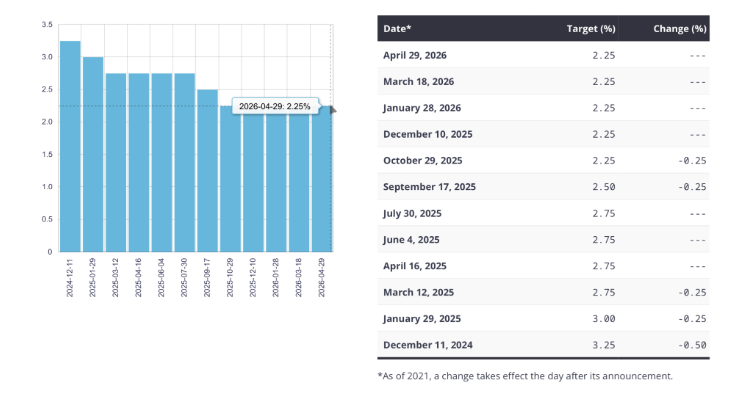
The Bank of Canada is expected to leave its overnight rate unchanged at 2.25% on June 10, with economists increasingly convinced that the central bank will remain on hold for the rest of the year.
Source: Bank of Canada
According to a Reuters survey conducted between June 2 and June 5, all 34 economists polled expect policymakers to maintain current borrowing costs this week. More than 80% of respondents also believe rates will remain unchanged throughout 2026, underscoring the view that the easing cycle that began in 2024 has come to an end with rates at 2.25% since October 2025.
The BoC has already delivered important monetary easing, cutting rates by a cumulative 275 basis points between June 2024 and October 2025. Those reductions were intended to support an economy that has struggled to generate sustained momentum and is now facing renewed headwinds.
Inflation has moved higher in recent months, largely because of rising energy prices linked to geopolitical tensions in the Middle East. Consumer price growth accelerated to 2.8% in April from 2.4% in March. However, inflation remains within the Bank of Canada’s target range of 1% to 3%, and the decline in core inflation measures suggests underlying demand pressures remain relatively subdued.
That distinction is important. Policymakers generally view energy-driven inflation differently from broad-based domestic inflation because higher oil prices can simultaneously weaken economic activity while lifting headline consumer prices. As a result, the Bank of Canada may be reluctant to tighten policy in response to what could prove to be an externally driven inflation shock.
Still, Canada entered a technical recession after the economy contracted for a second consecutive quarter. Statistics Canada reported that gross domestic product shrank by 0.1% on an annualised basis during the first quarter of 2026, significantly weaker than expectations for growth of 1.4% (FactSet). The contraction followed a 1% decline in the final quarter of 2025, highlighting persistent weakness in business investment and domestic demand.
While some indicators point to a possible rebound during the second quarter of 2026, supported by higher energy prices and increased government spending, the broader growth outlook remains uncertain and business surveys continue to reflect that uncertainty.
The S&P Global Canada Services PMI improved to 50.6 in May from 49.2 in April, returning to expansion territory for the first time since October. Nevertheless, companies reported weak demand, falling new business orders and ongoing concerns about the economic impact of geopolitical tensions and trade disruptions.
One bright spot has emerged from the labour market. Canada added 88,000 jobs in May, dramatically outperforming expectations and reversing the loss of 18,000 positions recorded in April. Employment gains were concentrated in full-time work, with 154,000 full-time jobs created during the month. The unemployment rate also declined to 6.6% from 6.9%, marking one of the lowest readings seen this year.
The stronger employment figures have reduced immediate concerns about a deeper recession and provided policymakers with additional justification to keep rates unchanged. A resilient labour market allows the Bank of Canada to assess incoming inflation and growth data without feeling pressure to either cut or raise rates in the near term.
Trade-related risks also remain an important consideration. Canada continues to face uncertainty surrounding its economic relationship with the United States, its largest trading partner. Investors are closely monitoring the upcoming review of the USMCA trade agreement scheduled for July, as any disruption to North American trade flows could further weigh on business confidence and investment decisions.
Taken together, the combination of moderate inflation, weak economic growth and improving employment conditions suggests that the Bank of Canada is likely to remain patient, preferring to wait for greater clarity before considering any policy adjustment.
European Central Bank: Inflation Concerns Take Center Stage
The ECB is expected to raise interest rates next week, potentially becoming the first major central bank to tighten monetary policy since the energy shock triggered by the conflict involving Iran began to affect global markets, as well as growth and inflation outlook.
Unlike Canada, the euro area is experiencing signs that inflationary pressures are broadening beyond energy prices alone. Eurozone inflation accelerated to 3.2% in May, moving further above the ECB’s 2% target and raising concerns that higher energy costs are starting to spread through the wider economy.
Particularly worrying for policymakers is the behaviour of underlying inflation measures. Services inflation and core inflation, which exclude volatile food and energy components, both increased for the first time since the conflict began. Although seasonal factors may have contributed to part of the increase, the data have strengthened concerns that second-round inflation effects may be emerging.
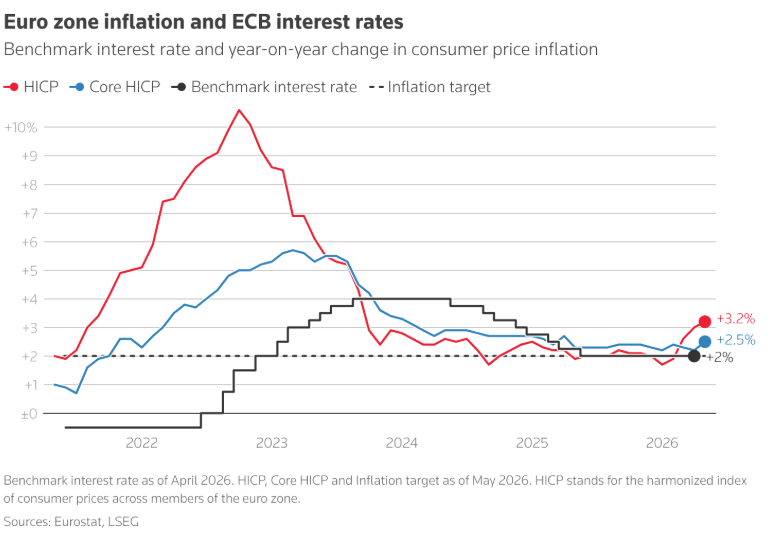
Inflation expectations are also moving higher. Surveys show that both businesses and consumers expect stronger price increases over the medium term, creating additional pressure on the ECB to act before inflation becomes more deeply embedded.
As a result, support for a rate increase appears widespread across the Governing Council. Even policymakers traditionally associated with a more accommodative stance (dovish), including Italy’s Fabio Panetta and Greece’s Yannis Stournaras, have expressed support for tighter monetary policy in response to the inflation threat.
The challenge for the ECB is that economic growth remains fragile. The eurozone economy is considerably weaker than it was during the previous energy crisis in 2022. Higher energy costs are already weighing on household spending and corporate profitability, while uncertainty surrounding the duration of the Middle East conflict continues to cloud the outlook.
ECB officials are therefore attempting to restore inflation credibility while avoiding an unnecessarily severe economic slowdown.
Markets currently expect another rate increase next week, with attention quickly shifting to what comes afterwards. Traders see September as the most likely timing for a second move, although economists remain divided on whether additional tightening will be necessary. Reuters polling suggests only around 60% expect another hike beyond June.
The ECB’s updated forecasts will be closely scrutinised. Chief Economist Philip Lane has already indicated that inflation projections are likely to be revised upward, while growth forecasts may be lowered. Investors will also pay close attention to revisions in core inflation estimates, as these could provide important clues regarding how concerned policymakers are about broader price pressures.
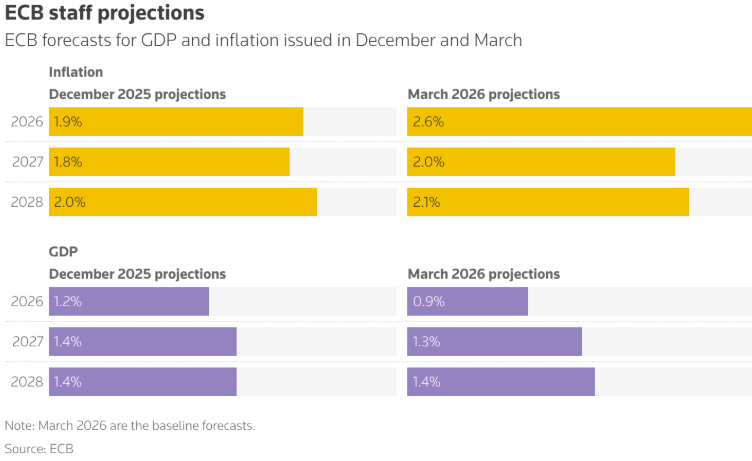
According to ECB board member Isabel Schnabel, current energy prices place the economic outlook somewhere between the central bank’s baseline and adverse scenarios. If energy markets remain disrupted and inflation expectations continue to rise, the ECB may conclude that further tightening is required despite weakening economic activity.
Conclusion
While the Bank of Canada is focused on protecting a fragile recovery and managing recession risks, the ECB is increasingly preoccupied with preventing an energy-driven inflation shock from becoming entrenched. That divergence is likely to remain a key theme for the EUR/CAD throughout the second half of 2026.
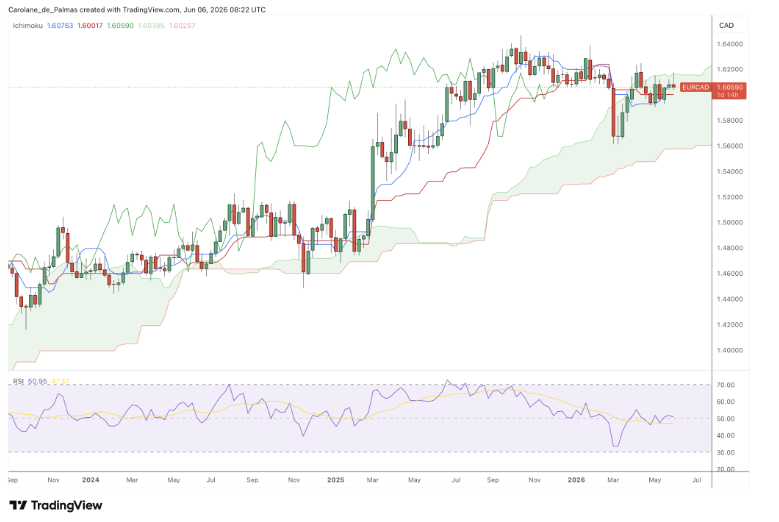
Weekly EURCAD Chart - Source: ActivTrades’ Trading Data on TradingView
Sources: Reuters, Statistics Canada, S&P Global, European Central Bank, MorningStar, The Wall Street Journal, Bank of Canada, Fitch Ratings, OECD
The information provided does not constitute investment research. The material has not been prepared in accordance with the legal requirements designed to promote the independence of investment research and as such is to be considered to be a marketing communication.
All information has been prepared by ActivTrades (“AT”). The information does not contain a record of AT’s prices, or an offer of or solicitation for a transaction in any financial instrument. No representation or warranty is given as to the accuracy or completeness of this information.
Any material provided does not have regard to the specific investment objective and financial situation of any person who may receive it. Past performance is not a reliable indicator of future performance. AT provides an execution-only service. Consequently, any person acting on the information provided does so at their own risk. Forecasts are not guarantees. Rates may change. Political risk is unpredictable. Central bank actions may vary. Platforms’ tools do not guarantee success.


Weekly Market Wrap - EURUSD, GBPUSD, EURCAD and WTI

Still in the Shallows

My Thoughts on USD, JPY & CAD

Weekly Market Recap and Forecast: AI Stocks Face Renewed Pressure as Oil Prices Surge, Gold Falls Below $4,100

EURUSD failed to break through the French barrier

Week Ahead – Central bank and earnings bonanza could roil markets

Tech selloff weighs on dollar as Treasury yields tumble