






EURUSD bounces off lows despite doubts about US-Iran talks

EURUSD is recovering from session lows, climbing towards 1.1770 after Friday’s dash to a two-month high of 1.1848 quickly ran into trouble, tumbling to 1.1728 at the start of Monday trading. Friday’s optimism that the US and Iran were close to agreeing to a peace deal didn’t last long after Iran decided to close the Strait of Hormuz again, leading the US to seize an Iranian-flagged cargo ship.
But hopes are growing again that the two sides will meet for fresh talks later today, even though this has yet to be confirmed by Tehran. EURUSD is subsequently attempting to climb out of the Ichimoku cloud and above the 50% Fibonacci retracement of the January-March downtrend at 1.1745.
However, the stochastics point to an ongoing bearish bias as they’re heading downwards, although the RSI is looking more neutral.
A continuation of today’s recovery is likely to face its next test at the 61.8% Fibonacci of 1.1825, which curtailed last week’s upswing. After that, the bulls may struggle to get past the tough obstacle at 1.1925 that successfully fended off challenges in February. The 78.6% Fibonacci lies slightly higher at 1.1937. Clearing these hurdles would open the way for January’s 4½-year high of 1.2081.
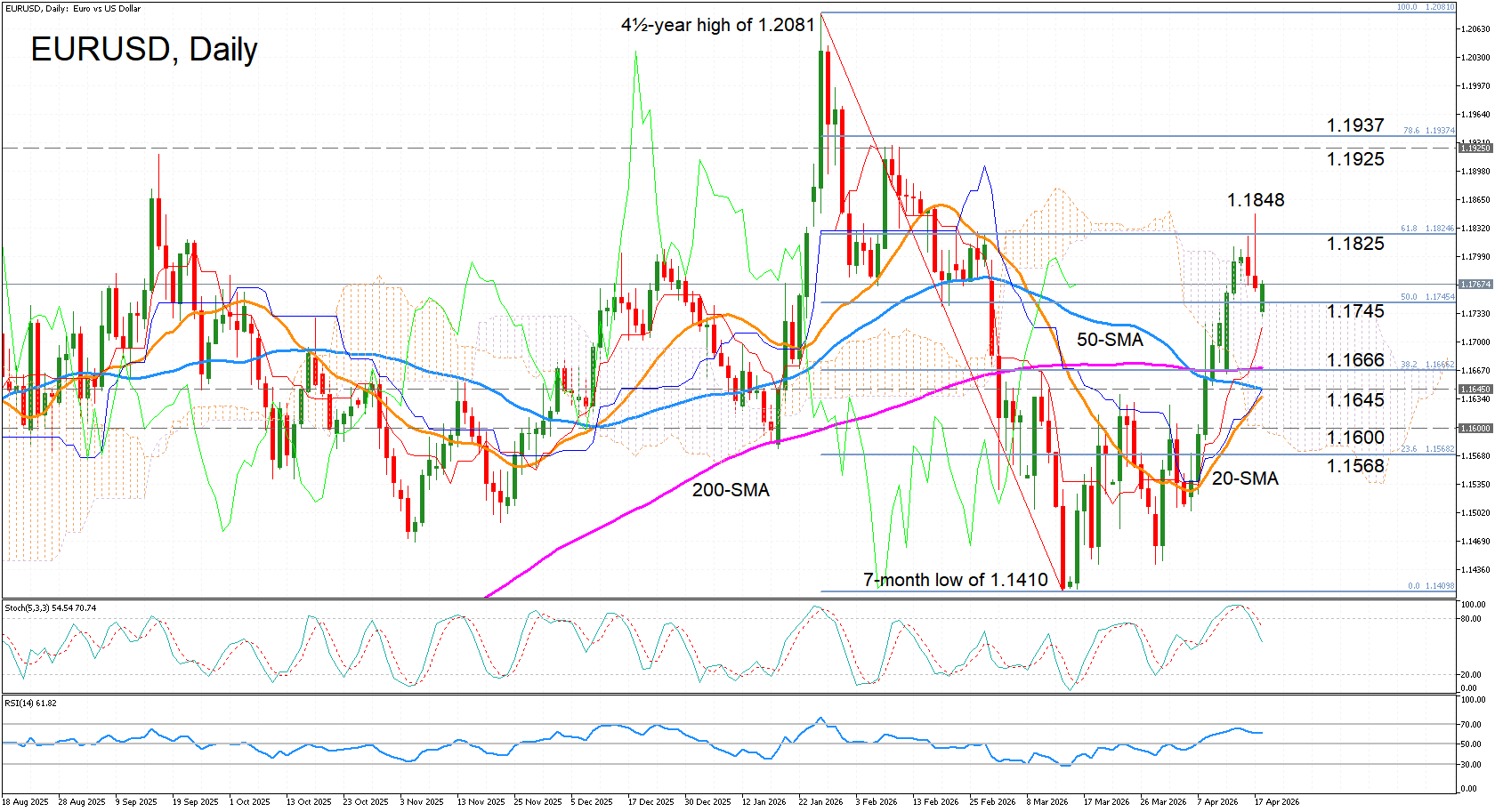
On the other hand, if today’s rebound falters, there’s likely to be strong support at the 38.2% Fibonacci of 1.1666 where the 200-day simple moving average (SMA) is converging. Slightly lower, there’s a crucial juncture forming around 1.1645 where the declining 50-day SMA is about to cross the rising Kijun-sen line and 20-day SMA. Breaking below these lines would shift the near-term bias to bearish and expose the cloud bottom at 1.1600 and the 23.6% Fibonacci of 1.1568.
All in all, EURUSD bulls are not ready to give up just yet and surpassing Friday’s peak of 1.1848 would fully restore the short-term uptrend. But with volatility still tied to developments in the Middle East, the risk of another downside reversal is far from diminished.


US Yields Rise Despite Buybacks; Eyes on ECB Hike

US Treasury Triples Long-Term Bond Buyback Size

The euro is banking on the ECB

EBC Markets Briefing | Euro eyes more gains on mounting dollar debasement risks

Yen Hits 6-Month High, Volatility Returns After North American Holiday.

EUR/USD Holds Its Rising Channel as 1.1641 Breakout Awaits ECB and U.S. CPI

Gold, EURUSD, OIL