





EUR/USD Breaks July Support as Yield Gap and Energy Shock Favor the Dollar

Summary
EUR/USD remains fundamentally tilted toward the dollar as U.S. yields stay near multi-decade highs and the Fed retains a clearer tightening path than the ECB. Europe faces a particularly uncomfortable energy shock: higher oil and gas prices raise inflation while simultaneously weakening growth and the terms of trade. Technically, EUR/USD has breached the July swing low at 1.13586, but a higher-timeframe close below it would provide stronger structural confirmation.The preferred bearish setup is not to chase price into demand, but to watch for a failed recovery into the 1.13586–1.13783 supply/retest zone.A recovery above 1.13783 would challenge immediate downside momentum; acceptance above 1.14102 would materially weaken the bearish thesis.
Fundamental Analysis
EUR/USD is increasingly becoming a contest between two different kinds of inflation problem. The Federal Reserve raised its target range to 3.75%-4.00% in September and described economic activity as expanding at a solid pace, with resilient spending, strong productivity and robust capital investment. Inflation remains elevated, leaving the Fed with an economy that appears capable of tolerating tighter monetary conditions. That combination is powerful for the dollar. The U.S. two-year Treasury yield is pressing close to 5%, while the 10-year has risen above 5.2%. High yields alone do not guarantee dollar strength, but high yields backed by comparatively resilient growth create a compelling carry advantage.
Europe’s difficulty is more awkward. The ECB also raised rates in September, taking the deposit rate to 2.50%, but President Christine Lagarde has emphasized a measured response to the latest inflation shock. The distinction is important: much of Europe’s inflation resurgence originates in oil and natural gas rather than excessive domestic demand or accelerating wages.
Central banks can suppress demand. They cannot produce natural gas. That leaves the ECB facing a worse policy trade-off. Tightening aggressively against imported energy inflation risks compounding the economic damage without solving its original cause.
The currency market has noticed. European natural-gas prices have climbed above €80 per megawatt-hour, while Brent remains around $105. Europe therefore faces a renewed deterioration in its terms of trade: more income must leave the region to pay for imported energy.
The United States experiences the same oil shock differently. It faces higher inflation, but its substantial domestic energy sector provides an economic offset. Europe mostly receives the bill. That helps explain why EUR/USD has fallen toward its lowest levels of the year even though both central banks are tightening.
Political risk adds another discount. French fiscal and political uncertainty and resistance to reforms in Germany have widened risk premia within European bond markets just as investors are being asked to absorb higher global yields.
The U.S. dollar, meanwhile, is trading near multi-month highs. DXY has moved above 101 as markets increasingly price additional Federal Reserve tightening. The next challenge will come from U.S. employment and inflation data: strong labor demand or persistent PCE inflation would reinforce the yield advantage, while genuine deterioration would give EUR/USD its clearest opportunity for a squeeze higher.
Technical Analysis
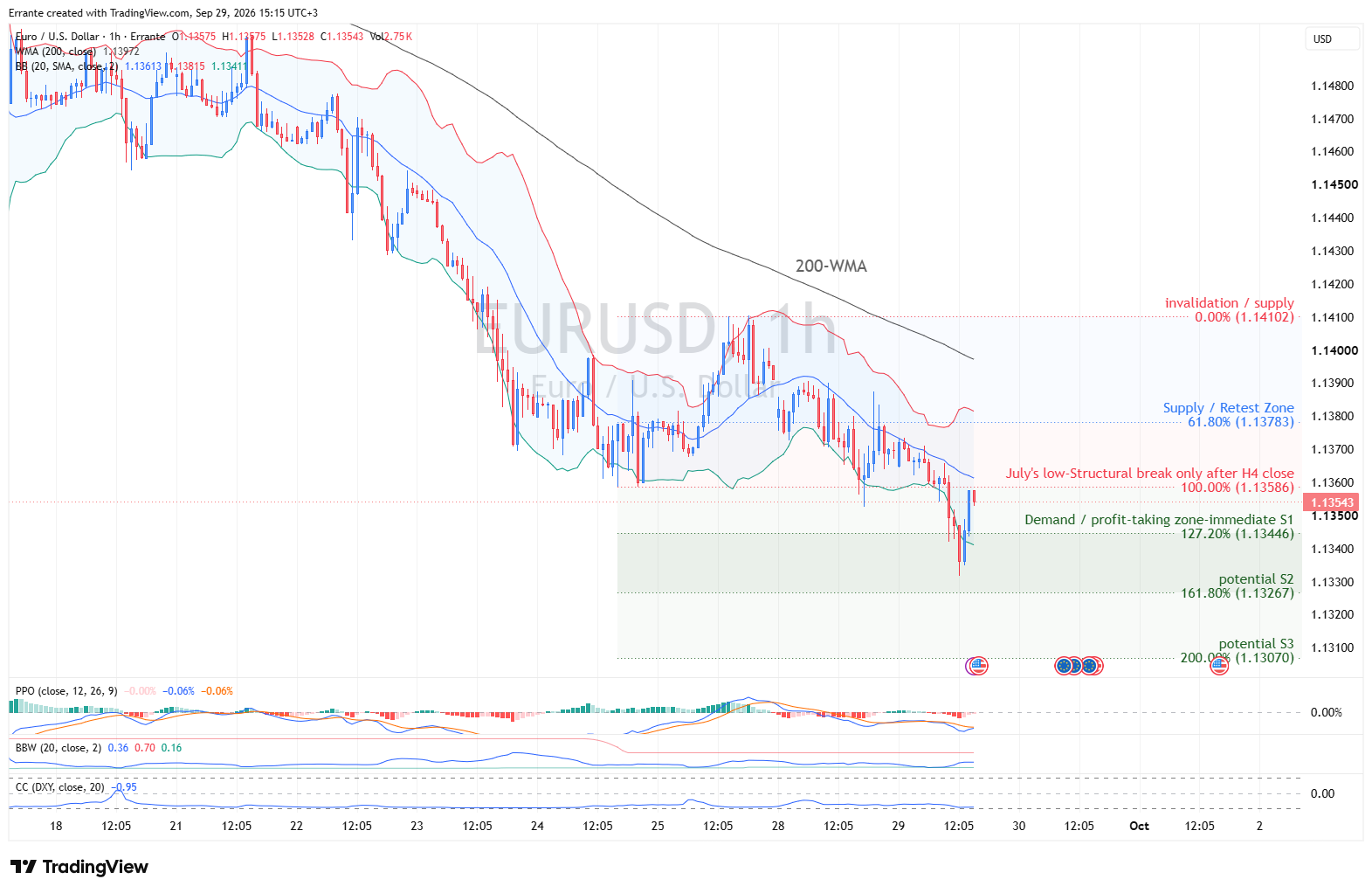
The chart agrees with the macro story, although price location argues against blindly chasing the decline. EUR/USD remains below a falling 200-period WMA near 1.1397, with the one-hour structure continuing to produce lower highs and lower lows. Price has also breached the July swing low at 1.13586. The important qualification is confirmation. Because 1.13586 is a structural level rather than an ordinary intraday pivot, a 4-hour close beneath it would provide stronger evidence that former support has genuinely failed.
The price action leading into the break is also informative. Rebounds became progressively shallower as EUR/USD repeatedly returned toward support. In order-flow terms, that suggests buyers were absorbing fewer sell orders on each test until demand finally gave way. But the market has now moved directly into another demand area. That makes the most attractive bearish location the 1.13586-1.13783 region rather than current lows. A weak recovery into this zone followed by rejection would indicate that former support has changed polarity and become supply.
Momentum supports the broader bearish regime, with PPO still below zero, but it is not accelerating aggressively. Bollinger Band Width also remains relatively compressed. A renewed decline accompanied by widening bands and deeper negative momentum would provide stronger confirmation than price alone.
The DXY correlation indicator near -0.95 adds an unusually strong intermarket filter. Continued dollar strength would reinforce a failed EUR/USD retest; weakening DXY would make the breakdown less trustworthy.
Scenario Outlook
Bearish Continuation
The cleaner bearish setup would be a confirmed break below 1.13586 followed by a weak rebound into 1.13586-1.13783. Rejection from that zone, combined with firm DXY and elevated U.S. yields, would favor 1.13446, then 1.13267 and potentially 1.13070.
Failed Breakdown
If EUR/USD quickly reclaims 1.13586 and pushes through 1.13783, the market would signal that sellers failed to gain acceptance below July support. That could trigger a corrective squeeze toward the 200-WMA.
Bullish Reversal
A rally alone is not enough. The broader bearish structure would require price to recover through the moving average and establish acceptance above 1.14102. Ideally, that would coincide with falling U.S. front-end yields and a softer dollar.
Final Conclusion
EUR/USD currently offers unusual agreement between macroeconomics and technical structure. The dollar has the stronger yield advantage, the U.S. economy is absorbing higher rates better, and Europe is carrying the heavier economic cost of the energy shock. Technically, EUR/USD remains below a falling long-term mean and has breached an important swing low.
But bearish does not automatically mean “sell here.” Price has already reached demand. The more efficient setup is to see whether the market can return toward 1.13586-1.13783 and fail there. The macro regime provides the direction. CMT identifies the bearish structure. Price-action analysis identifies the location. For now, the dollar has the advantage—but the retest may offer the better trade.


The euro has slipped out of its range

September Market Review: Fed Rate Hike, AI Momentum and October Outlook

Higher Yields Reshape Currency Markets | 1st October, 2026

The dollar has retreated from the edge

US Major Stocks Slip as Yields, Oil Lift Inflation Concerns; RBA Decision in Focus

Fed Rate Bets Pressure Major Currencies | 29th September, 2026

ATFX Market Outlook - 25th September 2026