-1162026812.png)
-1162026812.png)





Every Great Technology Boom Looked Like a Bubble

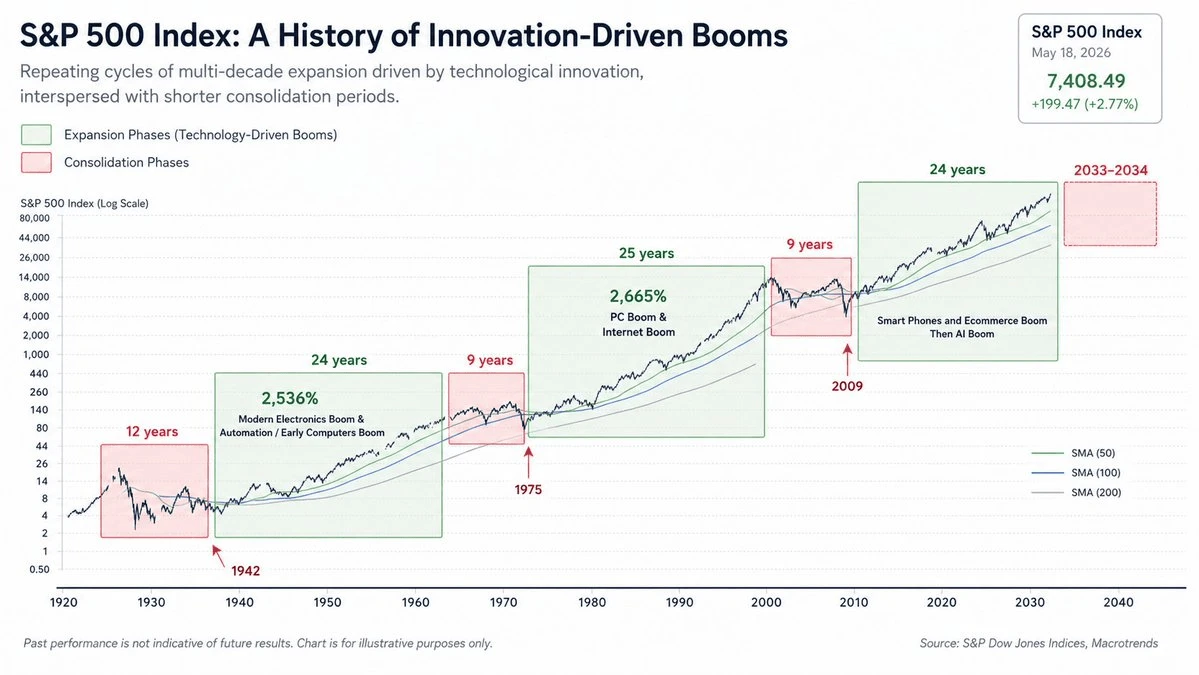
Every major technological cycle in market history has been accompanied by a remarkably familiar sequence of the investors’ reactions: initial skepticism, followed by enthusiasm, and ultimately endless discussion about excess, overvaluation, and the inevitability of a bubble. It happened during the age of electrification and industrial automation, continued within the expansion of personal computing and the internet, and it is proving no different today with artificial intelligence. At every stage, there were persuasive arguments suggesting that valuations had become detached from reality. Yet, time and again, the market continued advancing for far longer than most observers considered reasonable.
The explanation lies in the nature of genuine technological revolutions. They do not simply create a handful of successful companies; they alter the economic landscape itself. They give rise to entirely new industries, improve productivity, reshape patterns of consumption, and generate sources of profit that were previously unimaginable. As a consequence, traditional valuation frameworks often struggle to capture the scale of the opportunity during the early years of such transformations. What appears extravagantly priced today may, with the benefit of hindsight, prove to have been relatively modest. History repeatedly demonstrates that the market’s eventual winners often appear most expensive precisely when their long-term significance has yet to be fully appreciated.
That is not to suggest the journey is ever smooth. Every major technological cycle experiences setbacks, corrections, liquidity squeezes, and periods of profound doubt. Markets rarely move in a straight line. Nevertheless, when a technology genuinely changes the way economies function, the broader trend has a tendency to reassert itself over time. For that reason, many regard the present enthusiasm surrounding artificial intelligence not as a conventional speculative mania, but as the latest chapter in a succession of structural transformations that ultimately proved considerably larger, longer-lasting, and more consequential than contemporary consensus expected.Trade smart with Headway

China50 Tests 14,600 Resistance as Investors Await Inflation Data

Dollar slips, yen surges as Middle East tensions escalate

Oil Surge Pressures US Stocks as Markets Await Inflation Data

S&P 500 Stabilises Near 7,700 as Oil Prices Keep Inflation Risks in Focus

The euro is banking on the ECB

US Diesel Prices Hit Record $5.85: Why the Fuel Shock Could Keep Inflation High
EBC Markets Briefing | Yuan consolidates as domestic inflation jumped