



Oil’s safety net: How China’s demand is keeping prices afloat

Oil prices have spent months teetering on the edge of a slump, weighed down by fears of weak demand and a world bracing for an economic slowdown. In the U.S. and Europe, central banks are still fighting inflation, consumers are tightening their belts, and industrial activity remains sluggish. Traders watching these trends have been waiting for a tipping point, the moment when crude finally succumbs to downward pressure. But that moment hasn’t come.
Why? Because China isn’t letting it happen.
A steady thirst for Oil, even in uncertain times
Despite the concerns hanging over the global economy, China’s appetite for oil has remained strong. The country’s crude imports have stayed near record highs, showing that refiners aren’t just keeping up with demand-they’re betting that it will grow. Even as headlines swirl about oversupply, China has been quietly absorbing millions of barrels of crude, keeping prices from slipping too far.
February’s economic data only reinforced this trend. Manufacturing activity-the lifeblood of China’s energy consumption-returned to growth after a slow January, with the Purchasing Managers’ Index climbing to 50.2. That may not seem like a dramatic shift, but in the world of oil, momentum matters. A growing industrial sector means more fuel burned, more freight moved, and more energy needed to keep the gears of the economy turning.
Refiners are gearing up, not slowing down
Refineries in China have had every opportunity to slow things down. The global outlook remains uncertain, margins for refined products aren’t exactly soaring, and many expected demand to ease after last year’s surge in fuel consumption. But instead of hitting the brakes, Chinese refiners have been running at full speed.
This signals something important. Either demand is already stronger than expected, or refiners see a surge coming and are getting ahead of it. With domestic travel rebounding and freight movement increasing, gasoline, diesel, and jet fuel consumption have all shown resilience. At the same time, there’s another wildcard at play-government intervention. Beijing has already taken steps to boost economic activity, and if stimulus efforts accelerate, oil demand could climb even higher.
The force that’s holding the market together
Oil prices aren’t soaring, but they also aren’t collapsing. That’s because China’s demand is acting as a stabilizer, preventing crude from spiraling downward even as other markets weaken. While the West focuses on recession fears, China has been quietly propping up the global energy market, ensuring that supply gluts don’t spiral out of control.
This doesn’t mean crude is on the verge of a major rally, at least not yet. But it does mean that, for all the talk of weak demand and oversupply, oil is finding steady ground. And as long as China keeps buying, that floor is likely to hold.
Technical outlook: Will prices remain rangebound?
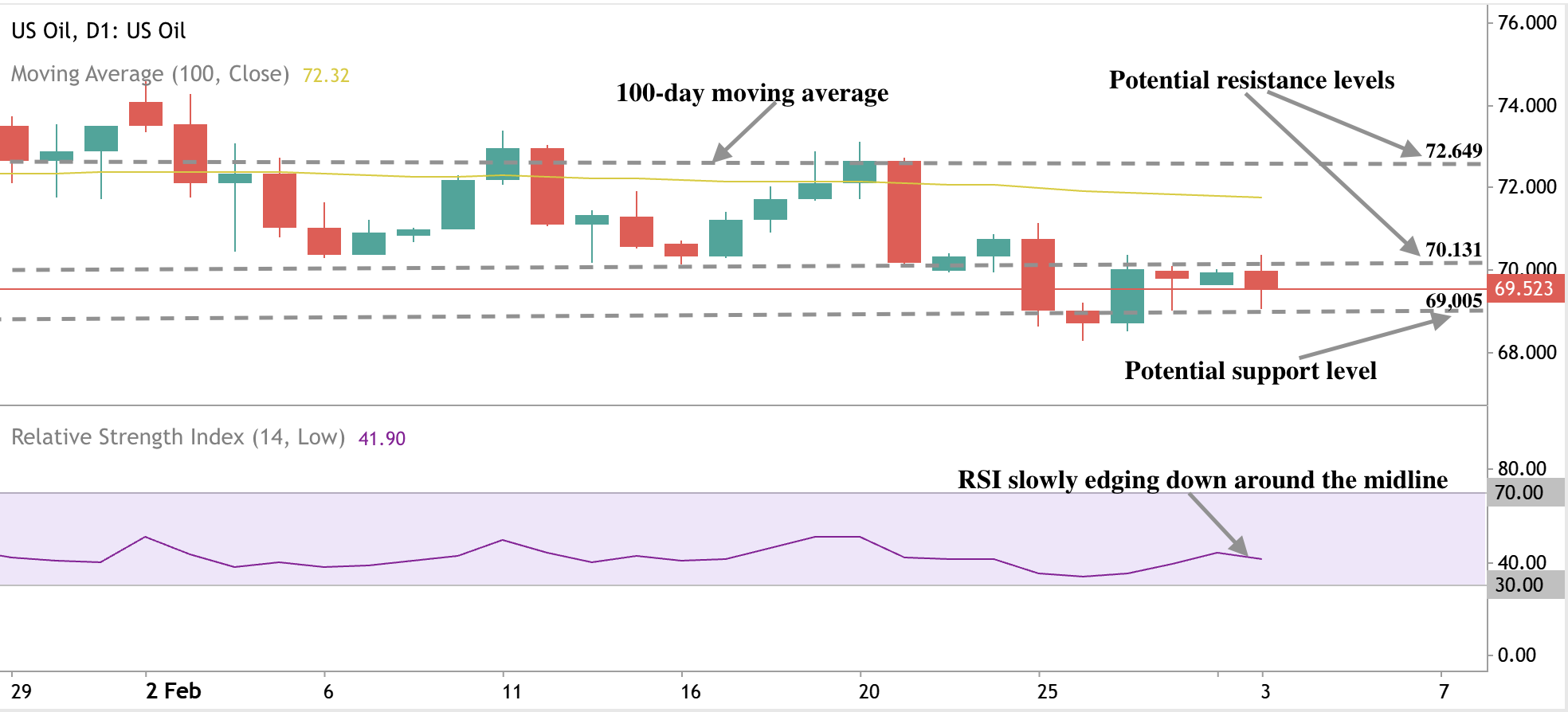
Oil has been locked in a tight price range of between $70.58 and $72.88, for the past few weeks. The daily chart paints a picture of price consolidation, though a bearish bias is evident as prices remain below the moving average. RSI pointing downwards at around 40 also builds the bearish narrative. Key level to watch should prices see a slide is $69.005 and on the upside the key levels to watch are $70.131 and $72,649.
Source: Deriv MT5
Disclaimer:
The information contained within this blog article is for educational purposes only and is not intended as financial or investment advice.
No representation or warranty is given as to the accuracy or completeness of this information.
We recommend you do your own research before making any trading decisions.
This information is considered accurate and correct at the date of publication. Changes in circumstances after the time of publication may impact the accuracy of the information.
The performance figures quoted refer to the past, and past performance is not a guarantee of future performance or a reliable guide to future performance.


EBC Markets Briefing | "Blue Wave" poised to sweep across stock markets

Stocks sink amid AI wipeout, dollar shines ahead of NFP

US Payrolls in Focus as Wall Street Rout and Falling Yields Cap the Dollar | 6th November, 2026

Week Ahead – Inflation and geopolitics in focus as US political landscape shifts

The dollar saves the day

Tech Stocks Lead US Selloff Ahead of Payrolls

Technical Analysis – USDJPY stays rangebound, pinned at support near 158.00