-1162026812.png)
-1162026812.png)





The NASDAQ's Midyear Rally Is About to Begin

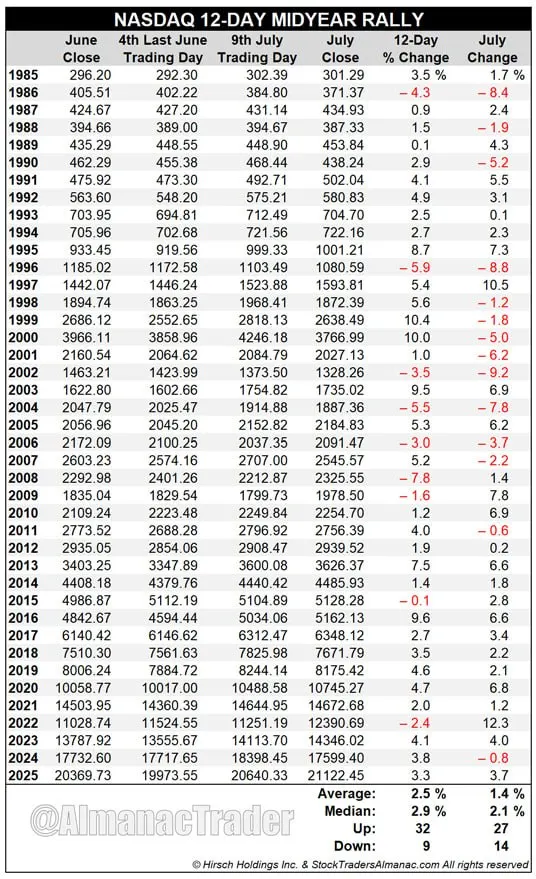
The Midyear Rally for the NASDAQ begins at the end of this week — a well-known seasonal window covering the final three trading days of June and the first nine trading days of July, says AlmanacTrader.
Since 1985, this 12-day period has delivered an average gain of 2.5% for the NASDAQ, with positive returns recorded in 32 out of 41 occurrences. The median return stands at 2.9%.
For 2026, the Midyear Rally window falls on:
- the final three trading days of June: 26, 29 and 30 June;
- the first nine trading days of July: 1, 2, 6, 7, 8, 9, 10, 13 and 14 July.
The US markets will be closed on 3 July 2026 in observance of Independence Day, as 4 July falls on a Saturday, meaning that session is excluded from the calculation.
Seasonality should never be viewed as a trading strategy in its own right, but it can offer valuable insight into how investors typically behave during particular periods of the year. The Midyear Rally has traditionally been associated with fresh capital flowing into markets at the start of the second half, institutional portfolio rebalancing and fund managers seeking to strengthen performance ahead of half-year reporting.
This year, however, the backdrop is rather more intriguing than usual. Markets enter this seasonal window after a significant repricing of interest-rate expectations, a powerful rally in the US dollar and a recent correction across the technology sector. Should the historical seasonal tendency coincide with a technical rebound and stabilizing bond yields, the NASDAQ could receive additional support precisely at a time when investor sentiment has become markedly more cautious.
The key point is that seasonality increases the probability of a particular outcome—it never guarantees one. The Midyear Rally should therefore be regarded not as a promise of higher prices, but as a period during which seasonal forces may reinforce an existing trend. If fundamental developments once again take center stage, historical patterns may easily give way to a very different outcome.


Dollar struggles to gain ahead of US inflation data, yen extends rally

EBC Markets Briefing | Crude prices on solid footing amid deep supply concerns

The yen is strengthening before our very eyes

The Inflation Measure Keeping the Fed Cautious

US Yields Rise Despite Buybacks; Eyes on ECB Hike

Bitcoin edges lower for a 4th day, capped by the 50-week MA

GBPUSD (4H) recovery holds above 1.3550, 100-SMA remains key hurdle