-1162026812.png)
-1162026812.png)





THE US BOND YIELDS SURGE AS POLICY RISKS COLLIDE💥

 D.Trump has once again intensified the pressure surrounding US monetary policy, arguing that the United States should have the lowest interest rates in the world. The statement places Federal Reserve Chair Kevin Warsh in an increasingly uncomfortable position: the White House wants cheaper money, while persistent inflation leaves the Fed with limited room to ease policy. Following Warsh’s hawkish Jackson Hole address, markets have instead moved towards pricing another rate increase, with the probability of a September move now standing at roughly 66%. This creates an awkward paradox — the greater the political pressure for lower rates, the more important it becomes for the Federal Reserve to demonstrate that its decisions are driven by economic data rather than the preferences of the administration.
The tension extends well beyond the United States. European central bankers left Jackson Hole facing even greater uncertainty over the direction of US economic and monetary policy. If the Fed does resume raising rates while inflation remains elevated, other central banks will have to consider the implications for currencies, funding costs and international capital flows. If, however, political pressure on the Fed begins to be perceived as something capable of altering its reaction function, the issue becomes considerably broader — the question will no longer concern interest rates alone, but confidence in US institutions themselves.
A particularly interesting signal is now coming from the bond market. Rising Treasury yields are no longer being accompanied by a comparable appreciation of the dollar, even though conventional market logic would often suggest precisely such a relationship. This may indicate that investors are demanding higher yields not simply because they expect stronger economic growth, but as compensation for inflation, fiscal and sovereign-debt risks. In that environment, higher yields become a less constructive signal for the USD: the market begins asking not, “How attractive are the returns on US assets?” but rather, “Why must investors be paid such a substantial premium to hold them?”
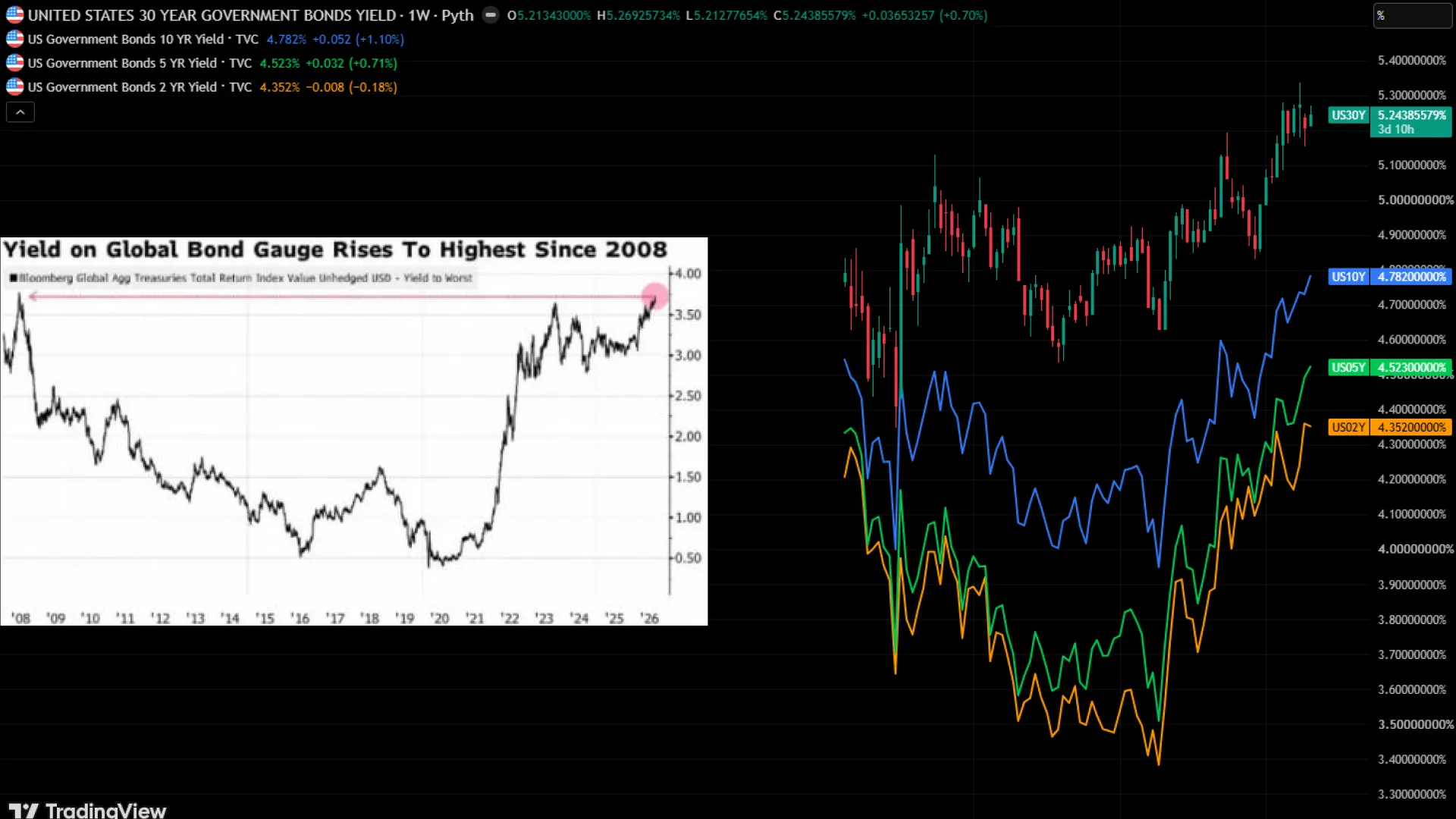
The problem is no longer confined to the United States. Long-dated government bond yields are rising across much of the developed world, with the UK and Japan already experiencing multi-year highs in borrowing costs and significant pressure also evident in the United States and the largest eurozone economies. The common denominator is increasingly clear: markets are becoming less confident in governments’ ability to control inflation, finance large fiscal deficits and stabilize their debt burdens simultaneously. An investor purchasing government debt for 20 or 30 years now demands considerably greater compensation for the possibility that future inflation and fiscal policy will prove less favorable than current forecasts suggest.
This raises the central question for the US bond market: could the 10-year Treasury yield approach 5%? Having already moved above 4.75%, such an outcome can no longer be regarded as an extreme scenario. If inflation expectations remain elevated, oil prices continue to rise and markets retain expectations of further Fed tightening, the psychologically important 5% threshold could realistically come within reach. The principal counterweight remains the US Treasury, which has already demonstrated its willingness to make greater use of buybacks of longer-dated securities to support market liquidity.
There is, however, a fundamental limitation: the Treasury can influence bond-market conditions, but buybacks cannot eliminate the underlying causes of rising yields. Larger purchases may temporarily support demand, improve liquidity and encourage some speculative sellers to reduce their positions, but they do not reduce the fiscal deficit or resolve the rising cost of servicing the national debt. This helps explain why the initial decline in longer-dated yields following the Treasury’s 19 August announcement proved relatively short-lived. If investors continue to regard the fiscal trajectory as unsustainable, pressure on the long end of the curve is likely to return.
There is also a political dimension. The expanded buyback program is operating in the run-up to November’s congressional elections, at a time when elevated mortgage and corporate borrowing costs are becoming increasingly politically sensitive. Any further action by Treasury Secretary Scott Bessent will therefore inevitably be viewed not only as technical liquidity management, but also through a political lens. Bessent himself rejects suggestions that the Treasury is manipulating yields and maintains that the program is intended to ensure the orderly functioning of the market. Nevertheless, the more actively the Treasury intervenes at the long end of the curve, the more difficult it becomes for investors to distinguish clearly between liquidity management and attempts to influence the government’s market-based cost of borrowing.
Another important conclusion is that rising yields now carry a very different message from the one associated with a conventional strong-economy cycle. When yields rise alongside the dollar and equities, the interpretation is relatively straightforward: the economy is strong, rates can remain elevated and capital continues to flow towards the United States. When yields rise while equities decline and the dollar fails to benefit sustainably, the signal becomes considerably less comfortable. Such a combination may indicate an increase in the term premium — additional compensation demanded by investors for accepting longer-term inflation, fiscal and political risks.
For gold, this creates a particularly interesting environment. Under normal circumstances, rising real yields represent a substantial headwind for XAU/USD because gold itself generates no interest income. However, if rising nominal yields increasingly reflect concerns over inflation, debt sustainability and confidence in government bonds, gold simultaneously acquires its own defensive appeal. As a result, the traditional relationship of “yields up, gold down” may become considerably less reliable than it has been in previous cycles.
The key risk for the dollar also extends beyond the direction of Federal Reserve policy. If Warsh raises rates and markets regard the move as a credible response to persistent inflation, the USD should receive fundamental support. But if longer-dated yields continue rising because of fiscal concerns while the administration simultaneously intensifies its public pressure on the Fed, some of the positive impact of higher policy rates could be offset by an increasing US risk premium. The divergence between the DXY and longer-dated Treasury yields may therefore become one of the most important market signals to watch this autumn.
Ultimately, markets are caught between three competing forces: Trump wants substantially cheaper money, the Federal Reserve needs to bring inflation under control, and the Treasury is attempting to prevent long-term funding costs from moving beyond manageable levels. These objectives are not necessarily compatible. If inflation remains elevated, the Fed could be forced to tighten monetary policy precisely when the government is seeking lower borrowing costs. And if the 10-year Treasury yield does approach 5% despite expanded buybacks, the message would be considerably more significant than another move in the bond market: investors would effectively be signaling that an increasingly high price is required to persuade them to hold US government debt.


Gold Slides Below $4,500 as Strong NFP Revives Fed Hike Bets

US Payrolls Hit 5-Month High as Markets Await CPI This Week.

The dollar is in no hurry to gain ground

Dollar Strength Meets Geopolitical Risk | 7th September, 2026

Week Ahead: US Jobs Strengthen Fed Hike Bets as CPI Looms

The Great Gold Reallocation: Central Banks Rethink Reserve Security 💥

Currency Divergence Deepens as Yen Strength Challenges Global Markets | 4th September, 2026