-1162026812.png)
-1162026812.png)





UK DEBT ALARM: 30-YEAR GILT YIELDS BREAK 6% — IS STERLING THE NEXT PRESSURE POINT?

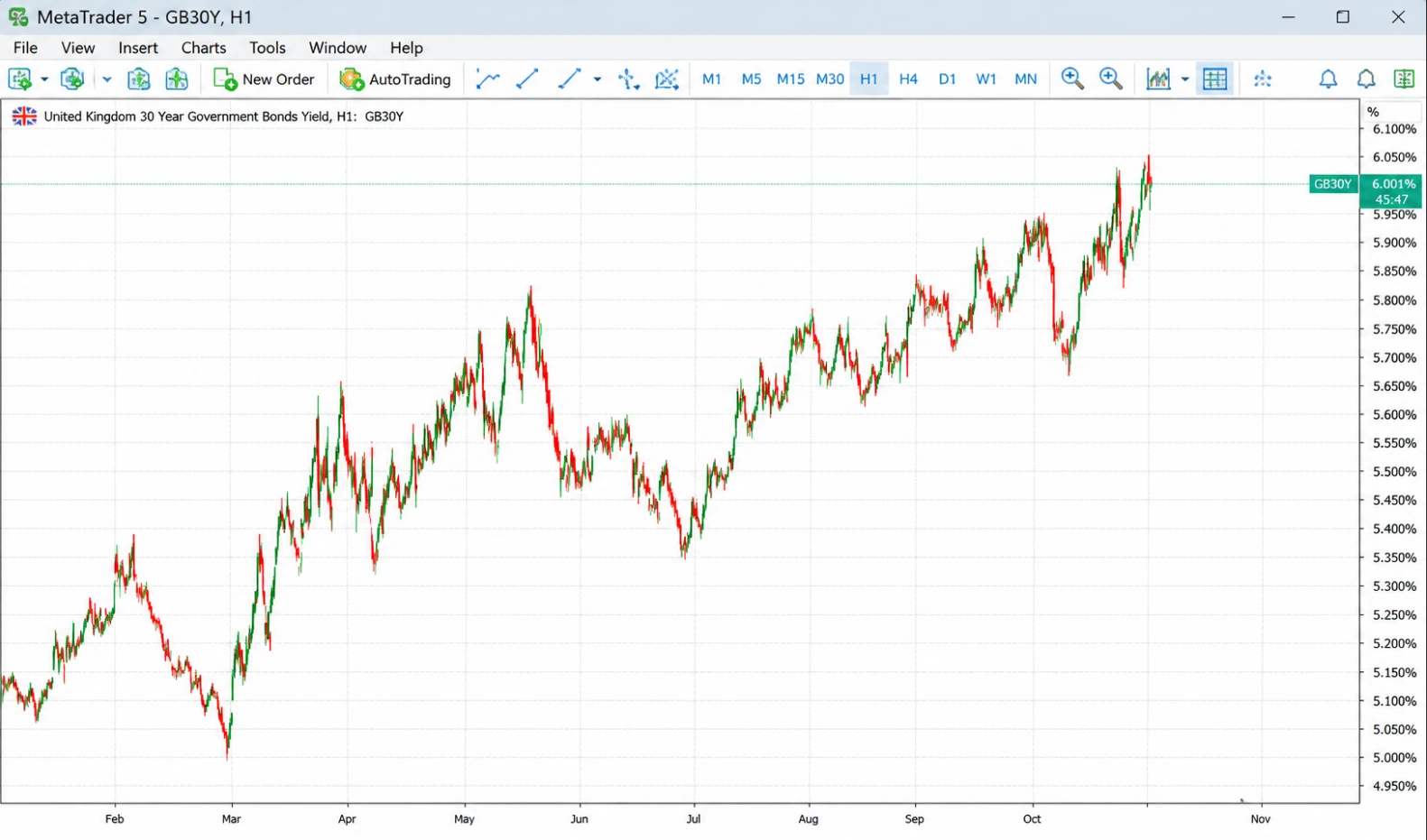 We have rather unfairly overlooked another potential candidate for Europe’s next major sovereign debt story — the United Kingdom. While France has increasingly come under scrutiny over its fiscal position, Britain has attracted rather less attention. That may now be changing, with the yield on 30-year UK government bonds touching 6.05% today.
Britain faces a broadly similar combination of structural pressures to France: a sizeable public debt burden, a persistent budget deficit and a current-account deficit. When long-term government borrowing costs rise above 6%, debt servicing becomes progressively more expensive, while the government’s room for fiscal manoeuvre narrows. It is an uncomfortable combination: the state needs substantial financing precisely when investors are demanding a higher premium to provide it.
There is, however, one fundamental difference between Britain and France — the UK has its own currency and its own central bank. France operates within the euro area and has no independent control over the issuance of euros, whereas Britain has the Bank of England and sterling. A conventional sovereign default on debt denominated in its own currency is therefore considerably less likely, as the authorities have far greater flexibility to provide liquidity and stabilise the government bond market in a crisis.
That flexibility, however, does not come without a price. If the debt burden continues to rise and investors begin to question the sustainability of the public finances, pressure could shift from gilts directly to sterling. The Bank of England could then face an increasingly difficult trade-off: keep interest rates high and intensify the pressure on debt servicing and economic growth, or ease financial conditions and risk renewed inflationary pressure and further GBP weakness.
This is why the key issue is not simply the absolute level of government debt, but investor confidence in the credibility of UK fiscal policy. Britain received a painful reminder of this in 2022, when surging gilt yields and a sharp fall in sterling forced the Bank of England to intervene in the bond market. If long-term yields remain exceptionally high, investors may once again demand a greater premium for holding UK assets, creating an uncomfortable feedback loop: higher yields → higher debt-servicing costs → a weaker fiscal outlook → still higher required yields.
The bottom line: describing Britain as the “next Greece” is more useful as a metaphor for potential sovereign debt stress than as a literal comparison — unlike Greece in 2010–2012, the UK controls its own currency. The greater risk is therefore not necessarily outright default, but the price sterling, inflation and the wider economy may have to pay to stabilise the debt market. GBPUSD parity is by no means inevitable, but if fiscal pressures intensify alongside a broader loss of confidence in UK assets, the prospect of a substantially weaker pound could move from a tail risk to a scenario markets can no longer afford to ignore.Trade smart with Headway


“Tech Tumbles, Gold Glitters

Hawkish Fed Minutes Lift the Dollar; Wall Street and Gold Slide

GBPUSD stabilizes near 1.3200, but downside risks persist

Currency Divergence Deepens as USD Holds Firm | 6th October, 2026

Nasdaq Record High, Dollar Edge 18-Month Peak; Oil and Gold Slips

Week Ahead: Weak NFP Cuts Fed Hike Bets, Putting Yields, Gold and S&P 500 in Focus

Dollar’s On Fire; NFP’s Coming—Markets Brace!