






US midterm elections in the spotlight as stock market rout persists

Stock market weakness persists
Following the biggest monthly decline since March 2025, yesterday’s abysmal session for the Nasdaq 100 index was just further confirmation that investors are in a sour mood these days. The technology-dominated index fell by 1.4% during Monday’s session, underperforming both the Dow Jones and S&P 500 indices once again.
Not even the strong earnings announcements from Apple and Palantir after the US markets closed – both easily beat EPS and revenue forecasts, with the latter also meaningfully raising its Q4 revenue guidance – appear to have improved market sentiment, with Asian stocks in the red today.
Sentiment remains weak due to persistent concerns about profitability, the implementation and the funding sources of the enormous investment plans announced, along with the borrowing costs. This is clearly depicted in reports about the upcoming Anthropic IPO, which appears to be valued near the $1.5trn mark, 25% below the pre-stock market rout valuation of $2trn.
Midterm elections in the spotlight
While there are plenty of incoming earnings announcements starting with AMD today, Arm Holdings and Qualcomm on Wednesday, market attention has largely shifted to the US midterm elections. With the Democrats forecast to achieve a solid majority in the House of Representatives, the focus is on the Senate, where the Republicans face an uphill battle to retain control.
Voting is scheduled to start as early as 06:00 local time in certain states like New York and Maine, with polls closing as early as 18:00 ET (23:00 GMT). The key states to watch are mostly Alaska, Iowa, Kansas, Maine, Michigan, Ohio and Texas, with New Hampshire and South Carolina also still undecided. The first results from Georgia, South Carolina and Virginia are expected around 00:00 GMT, with the first Senate projections made after 01:00 GMT, although it could be hours before we have a reliable projection.
Investors are preparing for all scenarios, with potentially the worst one for markets being a blue sweep, with Democrats controlling Congress for the first time since January 2023. President Trump’s leeway could narrow considerably in this case, increasing uncertainty and creating greater friction in the US administration as the likely Republican candidates for the 2028 presidential election start to make their moves.
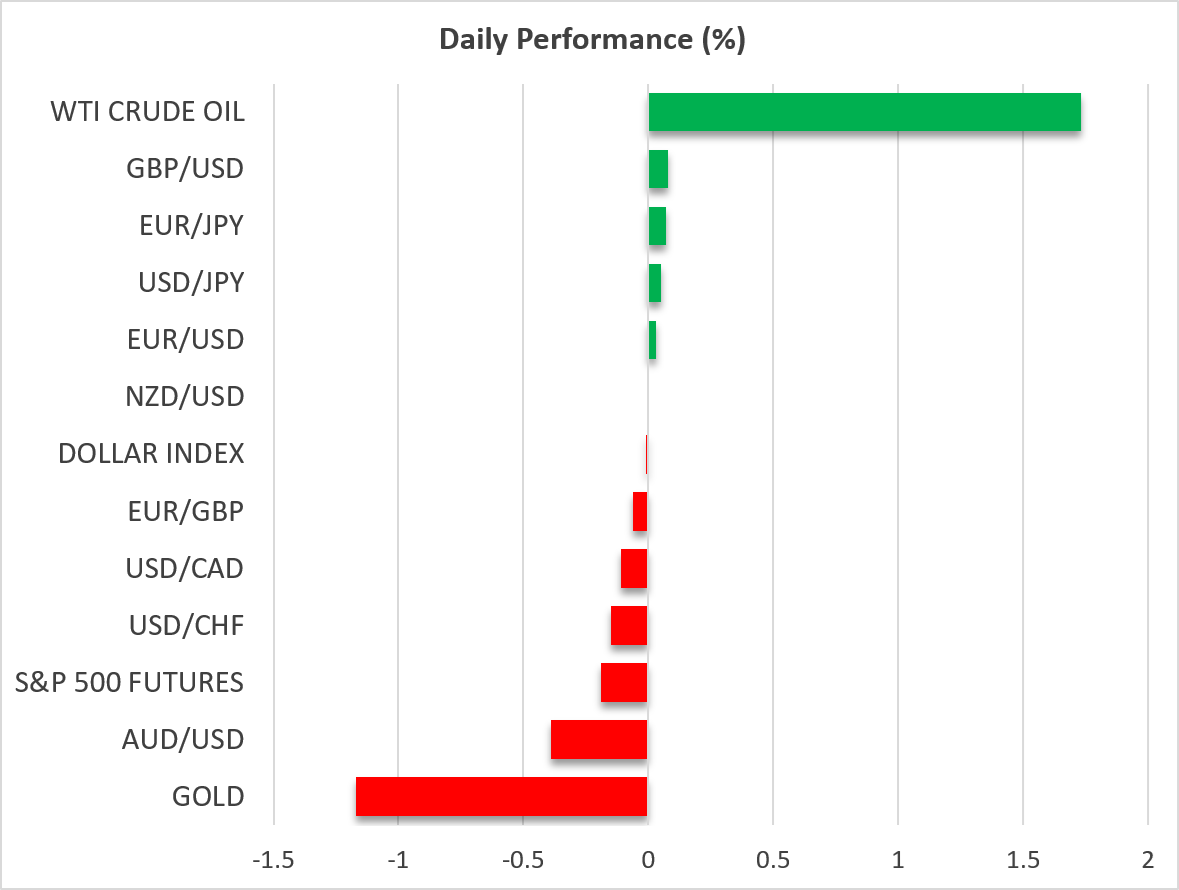
For now, Trump continues his back-and-forth regarding Iran. The news about progress made in the Iran-Qatar talks resulted in the strongest decline in WTI oil prices since late July, but, as it is usually the case in this conflict, the newsflow has been less positive overnight. US forces apparently hit Qeshm Island, a move that did not appear to catch the Iranians off-guard, especially as Trump’s warmongering ebbs and flows.
Dollar and aussie under pressure, gold retreats
WTI spot oil prices are rising at the time of writing, flirting with the $100 level again, as the US dollar is at a crossroads. A stronger-than-expected performance by the Republicans in the midterm elections, allowing for the current mix of fiscal spending and pressure on the Fed to continue, could prove damaging for the greenback down the line. However, AI angst and developments in the Middle East could limit any dollar weakness from the midterm election results.
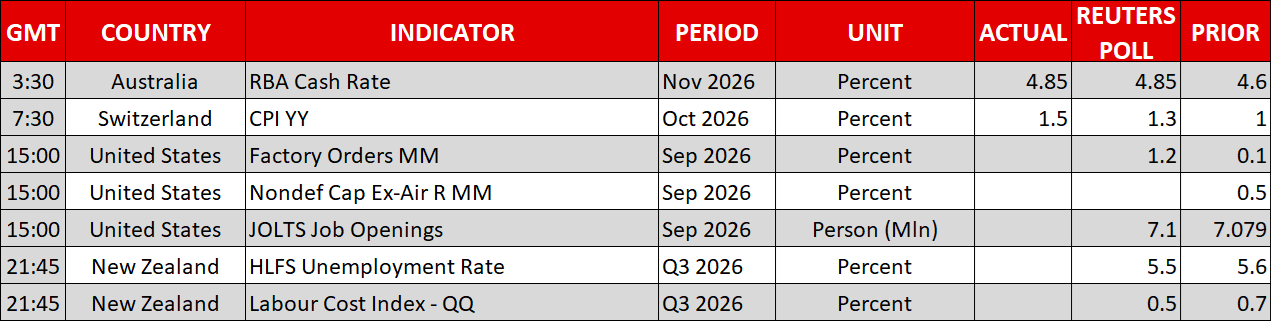
Notably, the dollar is on the back foot today, outperforming only the aussie. The RBA hiked rates, but the three dissidents and the less hawkish statement resulted in the aussie being the weakest link at the time of writing. RBA Governor Bullock’s comments about inflation limited the aussie/dollar drop, but she offered no signal for the December meeting, instead pointing to data as the key input.
Finally, gold investors appear confused by the situation, with the precious metal quickly surrendering yesterday’s gains on the positive newsflow after the Middle East talks. It remains in a critical zone, failing to take advantage of today’s weak dollar performance and potentially increasing angst about whether demand will appear at current levels.


Daily Technical Analysis: Gold Reclaims $3,900 After Hitting Its Lowest Level Since October 2025

Daily Fundamental Analysis: Wall Street Starts November on a Cautious Note Ahead of US Midterm Elections

Bitcoin tests key support as election uncertainty and tech sell-off weigh

Will gold climb back above $4,000?

Crypto turns gloomy

EBC Markets Briefing | Euro firms after oil prices fell sharply

AUDUSD bears take charge; will the 0.6980 support give way?