






USD/JPY Faces Sharp Sell-Off and Downside Gap: Could a Trend Reversal Be Coming?

USD/JPY experienced a sharp sell-off at the end of last week, printing a large bearish candle on Friday, January 23. This was followed by a significant downside gap at the start of this week, raising questions about whether the pair’s multi-month uptrend may be starting to break down.
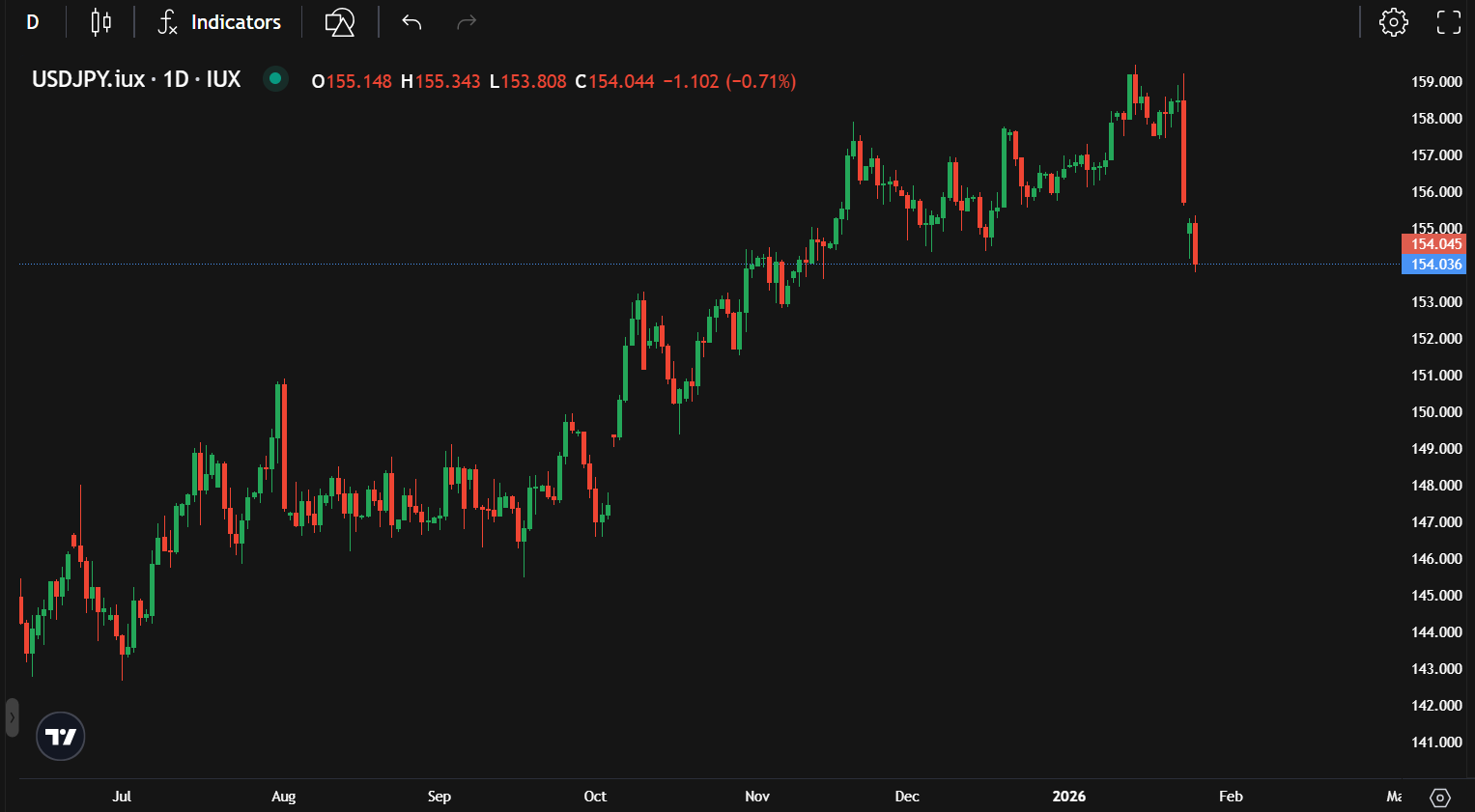
The move reflects growing stress in Japan’s bond market, rising expectations of further policy normalization by the Bank of Japan (BOJ), and renewed volatility across global markets, all of which have contributed to yen strength.
Fundamental backdrop: why the Yen is strengthening
A key structural change is occurring in Japan’s government bond market. Rapidly rising government bond yields are reshaping capital flows. As domestic investments become more attractive, Japanese investors are increasingly inclined to keep funds at home or repatriate capital, rather than seeking higher returns abroad. This creates natural demand for the yen.
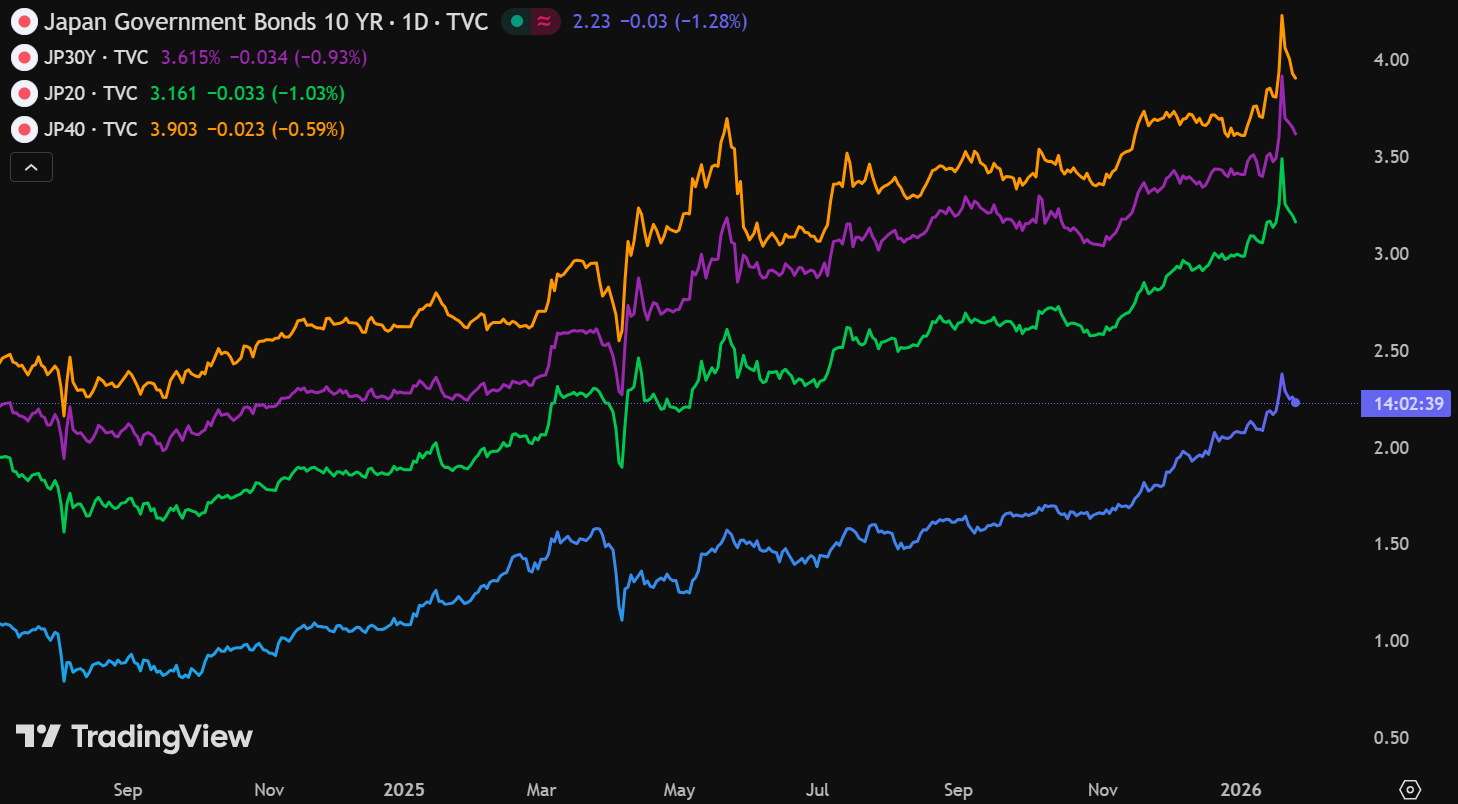
At the same time, the yen-funded carry trade, which relies on borrowing at low Japanese interest rates to invest in higher-yielding assets, is losing appeal. Rising Japanese rates and heightened FX volatility have prompted unwinding of these positions, adding further buying pressure on the yen and intensifying downside pressure on USD/JPY.
On the US side, the Federal Reserve remains cautious about cutting rates, but markets are adjusting expectations for monetary policy. Near-term US dollar weakness, combined with a narrowing US–Japan yield differential, is weakening one of the key pillars that previously supported USD/JPY’s long-term uptrend.
Technical outlook
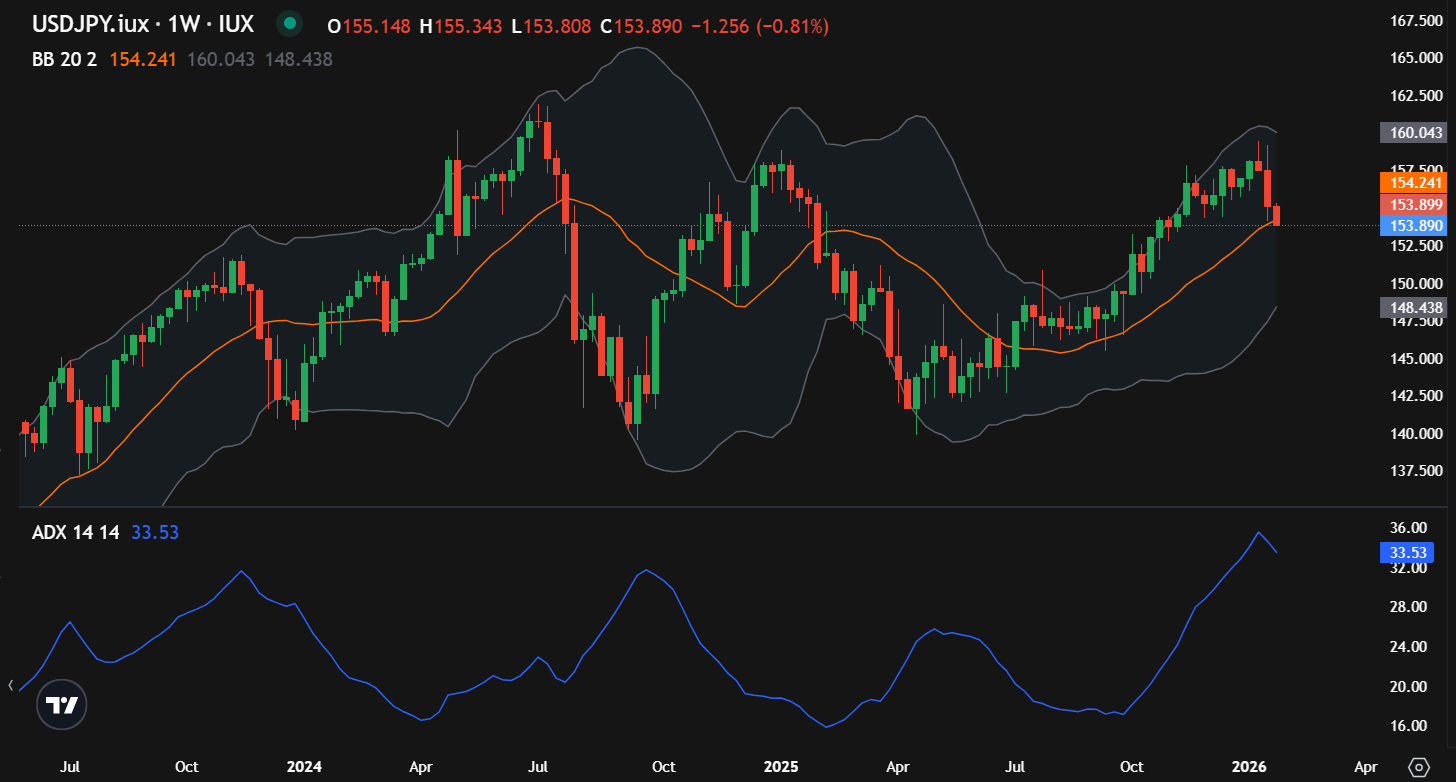
On the weekly chart: potential distribution
- While USD/JPY remains in a broader long-term uptrend, recent price action suggests a potential transition into a distribution phase. The pair has repeatedly struggled to hold above the 159.2–159.5 region, forming a possible topping structure.
- The latest weekly candle stands out as one of the most bearish in recent months, signaling potential trend exhaustion. The ADX shows rising downside momentum, consistent with a market shifting from trend continuation to deterioration. At the same time, the sharp rollover and formation of a pointed ADX peak suggest that this momentum may be fading rather than signaling renewed strength.
On the daily technical outlook: breakdown confirmed
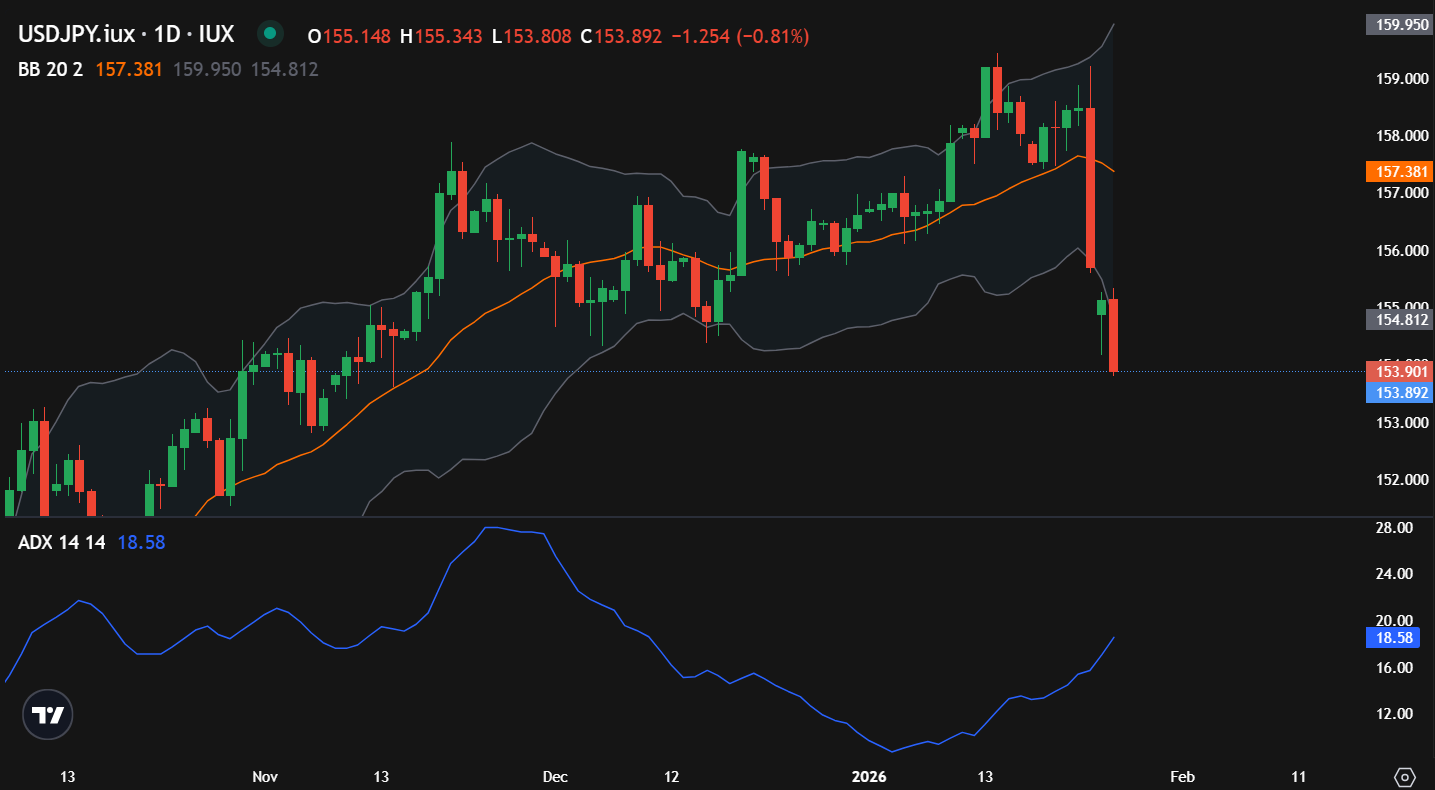
- The shift is clearer on the daily timeframe. Friday’s candle on January 23 was a sharp bearish expansion bar that broke below multiple short-term support levels. This was followed by a large downside gap at the start of the new week, a classic sign of aggressive repositioning and loss of buyer control.
- Structurally, USD/JPY has transitioned from a sequence of higher highs to lower highs and lower lows, marking the early stage of a trend reversal. Bollinger Bands indicate downside volatility expansion, while ADX confirms strengthening bearish momentum.
Key levels to watch
- 159.2–159.5: Major resistance and distribution zone
- 154.4–154.7: Broken support, now resistance
- 150.2–150.8: First downside target
Trading scenarios
Base case – Bearish continuation:
- If price holds below the 154.4–154.7 resistance zone, the breakdown is likely to extend toward the 150.2–150.8 area.
- This scenario aligns with rising Japanese yields, carry trade unwinding, and elevated FX volatility.
- It is important to note that price may retest the recently broken zone. Traders should avoid chasing shorts here and wait for confirmation signals around the retest to reduce risk before entering new positions.
Bullish invalidation:
- A sustained recovery above 155.6 that fills the downside gap would weaken the bearish structure.
Neutral or range scenario:
- If price stabilizes between 154.4–154.7, the market may enter a consolidation phase while awaiting clearer signals from BOJ policy or US macro data.
Conclusion
The sharp bearish candle on January 23, followed by a large downside gap this week, signals a potential regime shift in USD/JPY price behavior. What was previously a slow, grinding uptrend is now showing characteristics of a market under distribution and early-stage reversal.
With Japan’s bond yields rising rapidly and the structural foundations of the carry trade weakening, downside risks in USD/JPY are becoming strategic rather than merely tactical. Unless price can reclaim key resistance levels, the path of least resistance remains to the downside.


Today Fundamental Analysis: Brent Holds Around $100 Amid Fresh US-Iran Escalations

Today Technical Analysis: Japanese Yen Hits Highest Level Against the Dollar Since February

Yen Hits 6-Month High, Volatility Returns After North American Holiday.

USD/JPY Falls Below 154.000 as BOJ Rate Hike Bets Support Yen

USDJPY hits 7-month lows: recovery or bear trap?

US Payrolls Hit 5-Month High as Markets Await CPI This Week.

The dollar is in no hurry to gain ground