2276-682026843.jpg)
2216-682026843.jpg)





Yen Nears 160: Intervention Risks Rise as Market Dynamics Shift

The approach toward the 160 level in the USD/JPY currency pair has once again brought the Japanese yen into the spotlight, reviving speculation around potential government intervention. This threshold has historically carried strong psychological significance, acting as a line in the sand for policymakers concerned about excessive currency weakness.
Yet the current environment suggests that focusing solely on this level may be increasingly misleading.
The yen’s recent depreciation reflects a broader and more complex set of forces than in previous episodes. While authorities in Tokyo have stepped up their rhetoric, the underlying drivers of the move point less to speculative selling of the yen and more to persistent demand for the U.S. dollar.
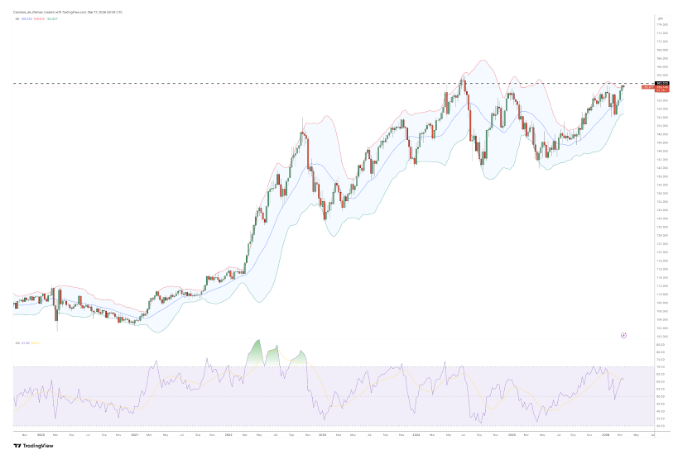
USD/JPY Weekly Chart - Source: TradingView
Why 160 Still Matters, But Less Than Before
The 160 level remains symbolically important because it has previously coincided with intervention risks. In both 2022 and 2024, Japanese authorities stepped into the market to support the currency when depreciation became disorderly and heavily driven by speculative positioning.
However, officials are now signalling a shift in focus.
Rather than defending a specific exchange rate, policymakers are emphasizing the pace and nature of currency moves. Finance Minister Satsuki Katayama reiterated that the government stands ready to act against excessive volatility, stressing a stance of heightened vigilance and readiness to take decisive action if needed. She also noted that discussions among G7 counterparts highlighted unusually high volatility across all financial markets.
This distinction is critical. Intervention is typically more effective when markets are dominated by one-sided speculative positioning. Current data suggests that this is not the case. Net short yen positions remain relatively modest compared to previous peaks, reducing the likelihood that intervention would trigger a sustained reversal.
This means that a move above 160 may not automatically provoke action. The threshold still matters, but it is no longer the sole trigger…
Dollar Strength, Not Just Yen Weakness
A key feature of the current environment is that the rise in USD/JPY is being driven primarily by dollar strength rather than yen-specific weakness and this nuance has important implications for policy effectiveness.
Strategists at JPMorgan Chase & Co. noted that the latest upward move in the pair reflects broad-based demand for the dollar. They argued that this dynamic complicates the case for intervention, even if USD/JPY moves deeper into the 160s, maintaining a medium-term forecast closer to 164.
Japanese policymakers appear to share this assessment. Internal discussions suggest that intervening in a market dominated by structural dollar demand could prove ineffective, as any yen-buying operations might be quickly offset by renewed inflows into the dollar. One official summarized the situation by emphasizing that the current move is fundamentally about dollar accumulation rather than active selling of the yen.
This represents a meaningful change from previous episodes driven by carry trades exploiting interest rate differentials. And while those dynamics still exist, they are no longer the dominant force.
The Safe-Haven Shift: Why the Dollar Is Winning
The evolving role of safe-haven currencies is another critical factor behind the yen’s weakness in 2026. Traditionally, the Japanese currency has been one of the primary beneficiaries of global risk aversion. However, the ongoing conflict involving Iran has challenged that assumption.
In the current environment, the U.S. dollar has emerged as the preferred safe haven. This reflects both its liquidity and the relative resilience of the U.S. economy. At the same time, Japan’s structural vulnerabilities are becoming more apparent.
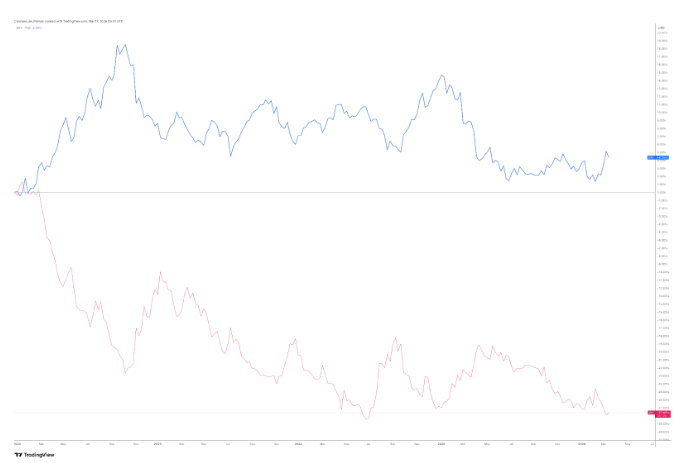
Weekly Performance of the JPY Index (pink) & the USD Index (blue) Since 2022 - Source: TradingView
The country’s heavy dependence on imported energy has turned rising oil prices into a direct headwind for the yen. With nearly all of its oil sourced from the Middle East and a significant portion transiting through the Strait of Hormuz, disruptions to supply chains have amplified concerns about Japan’s trade balance and inflation outlook.
Higher crude prices deteriorate the terms of trade, increase import costs, and weigh on growth prospects, all of which undermine the yen’s traditional safe-haven appeal, making it less attractive during periods of geopolitical stress.
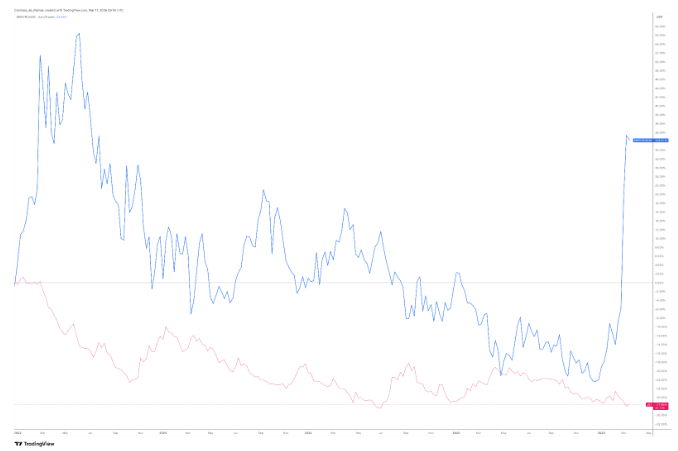
Weekly Performance of the JPY Index (pink) & Brent Prices (blue) Since 2022 - Source: TradingView
Verbal Intervention Intensifies, But Action Remains Uncertain
Japanese authorities have responded by ramping up verbal intervention. Satsuki Katayama has reiterated that the government is prepared to use all available tools to address excessive currency movements, while avoiding explicit references to specific levels.
Regional alignment is strengthening as Japan and South Korea issue a joint front against currency depreciation. Both nations have signaled a unified readiness to intervene should exchange-rate volatility turn disorderly.
Despite this stronger rhetoric, actual intervention remains uncertain.
Analysts increasingly argue that the effectiveness of such measures would be limited under current conditions. Analysts at Mitsubishi UFJ Morgan Stanley Securities suggested that any intervention could struggle to counter persistent dollar demand unless the geopolitical backdrop stabilizes. He also warned that short-term rebounds triggered by intervention might simply create opportunities for renewed yen selling.
This reflects a broader concern among policymakers that acting prematurely could prove counterproductive, especially in the absence of clear speculative excess.
BoJ Meeting in Focus: Policy Signals Over Action
Attention now turns to the upcoming meeting of the Bank of Japan, which represents the next major catalyst for the yen. While no immediate rate hike is expected, communication from Governor Kazuo Ueda will be closely scrutinized.
Ueda has indicated that underlying inflation is gradually moving toward the central bank’s 2% target, with convergence expected between the latter half of fiscal 2026 and 2027. He emphasized that sustainable inflation must be accompanied by wage growth, highlighting the importance of domestic demand dynamics.
At the same time, rising energy prices are complicating the policy outlook. Japan’s reliance on imported fuel means that the current oil shock is feeding directly into inflation, even as the central bank remains cautious about tightening too aggressively. This creates a policy dilemma: raising rates too slowly risks further yen weakness, while tightening too quickly could undermine the fragile recovery.
Market participants are therefore focusing less on immediate policy changes and more on forward guidance. Any indication that the Bank of Japan is prepared to accelerate its tightening cycle could provide support to the yen. Conversely, dovish signals would likely reinforce downward pressure, particularly if oil prices remain elevated.
The April meeting may prove more consequential, as policymakers will have access to updated economic projections and additional data on how the conflict is affecting business activity and inflation.
What Traders Should Watch Next
The trajectory of the USD/JPY pair will depend on several interrelated factors. Oil prices remain a central driver, given their impact on Japan’s trade balance and inflation dynamics. Developments in the Middle East, particularly around energy supply routes, will therefore continue to shape currency movements.
Monetary policy divergence is another element. The extent to which the Bank of Japan can normalize policy relative to its global peers will influence capital flows and exchange rates.
Finally, the nature of market positioning will determine the likelihood and effectiveness of intervention. Without a build-up of speculative excess, any government action is likely to have only a temporary impact.
In this context, the 160 level should be viewed as a reference point rather than a trigger. The more important shift lies in the underlying drivers of the move. As long as dollar demand remains dominant and Japan’s external vulnerabilities persist, the yen is likely to stay under pressure, with intervention risks rising but not necessarily materializing in a decisive way.
Sources: Reuters, The Japan Times, The Wall Street Journal, Bloomberg


Today Fundamental Analysis: Brent Holds Around $100 Amid Fresh US-Iran Escalations

Today Technical Analysis: Japanese Yen Hits Highest Level Against the Dollar Since February

Yen Hits 6-Month High, Volatility Returns After North American Holiday.

USD/JPY Falls Below 154.000 as BOJ Rate Hike Bets Support Yen

USDJPY hits 7-month lows: recovery or bear trap?

US Payrolls Hit 5-Month High as Markets Await CPI This Week.

The dollar is in no hurry to gain ground