-1162026812.png)
-1162026812.png)





🇨🇳 CHINA | TREASURIES OUT, GOLD IN💥

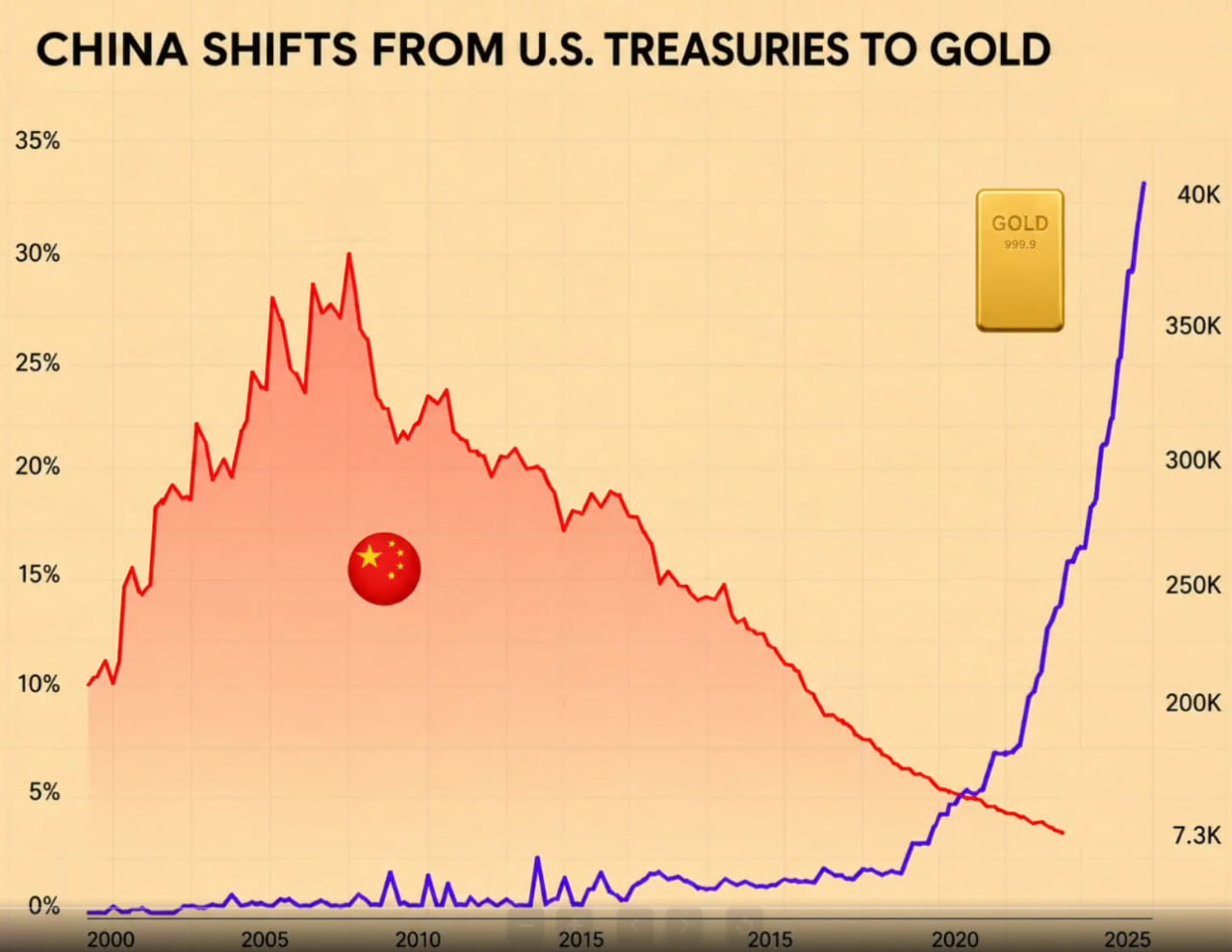
China continues to reduce its holdings of US Treasuries, with the country’s portfolio of US government debt falling to its lowest level since 2008.
China’s holdings declined from $731.4 billion in June 2025 to $633.4 billion in June 2026.
For many years, China was the largest foreign holder of US government debt. In February 2019, its holdings reached a record $1.13 trillion. By June 2019, China had lost the top position to Japan, which held $1.12 trillion compared with China’s $1.11 trillion. Japan has remained the largest foreign holder ever since.
China is now actively reducing its exposure to US government debt whilst increasing its gold holdings. Gold is arguably one of the clearest indicators of what is happening beneath the surface. Its supply cannot simply be expanded. Dollars, Treasuries and stablecoins, by contrast, can ultimately be created in significantly greater quantities through monetary expansion and QE. It is therefore hardly surprising that China continues to accumulate physical gold and draw metal eastwards. The interesting question is whether the West will eventually seek to slow this process — and, if so, how. China has considerable leverage of its own. In some respects, it has itself become part of the economic center once associated almost exclusively with the West. Much of what flowed out of China towards Europe during the nineteenth century is now moving in the opposite direction.
📊 However, this should be viewed as more than simply a sale of US government debt — it is a gradual restructuring of reserve assets. China, like a number of other central banks, is seeking to reduce its dependence on any single asset class while increasing exposure to instruments that are less directly dependent on another country’s policy decisions. In this context, gold is not merely a speculative asset; it is increasingly being treated as a strategic reserve.
🌍 The key question for markets is how far this trend can ultimately go. US Treasuries remain the world’s largest and most liquid sovereign debt market, meaning that any rapid withdrawal would create risks not only for the United States but also for major reserve holders themselves. A significant reallocation therefore takes time and must account for its impact on currencies, trade and financial stability.
🥇 Gold is increasingly becoming a barometer of confidence in the wider financial system. Demand for physical metal reflects more than expectations around inflation and interest rates; it also points to a deeper preference among major reserve managers for assets that are not another party’s liability. This is why gold is increasingly relevant when assessing the changing balance between conventional reserve assets and alternative stores of value.
🔥 Bottom line: China is not simply changing the composition of its portfolio — it is adapting to a financial system in which gold is regaining strategic importance. The United States retains considerable influence through the dollar and the depth of its Treasury market, but the gradual shift towards gold suggests that major global players are preparing for a more diversified reserve system.

Today Fundamental Analysis: Oil Breaks Above $102 as Middle East Tensions Continue to Escalate

Today Technical Analysis: Copper Approaches Record Highs on Surging Demand

Dollar struggles to gain ahead of US inflation data, yen extends rally
EBC Markets Briefing | Crude prices on solid footing amid deep supply concerns

The yen is strengthening before our very eyes

The Inflation Measure Keeping the Fed Cautious

US Yields Rise Despite Buybacks; Eyes on ECB Hike