-1162026812.png)
-1162026812.png)





Copper Signals a Potential Turning Point for Commodity Markets

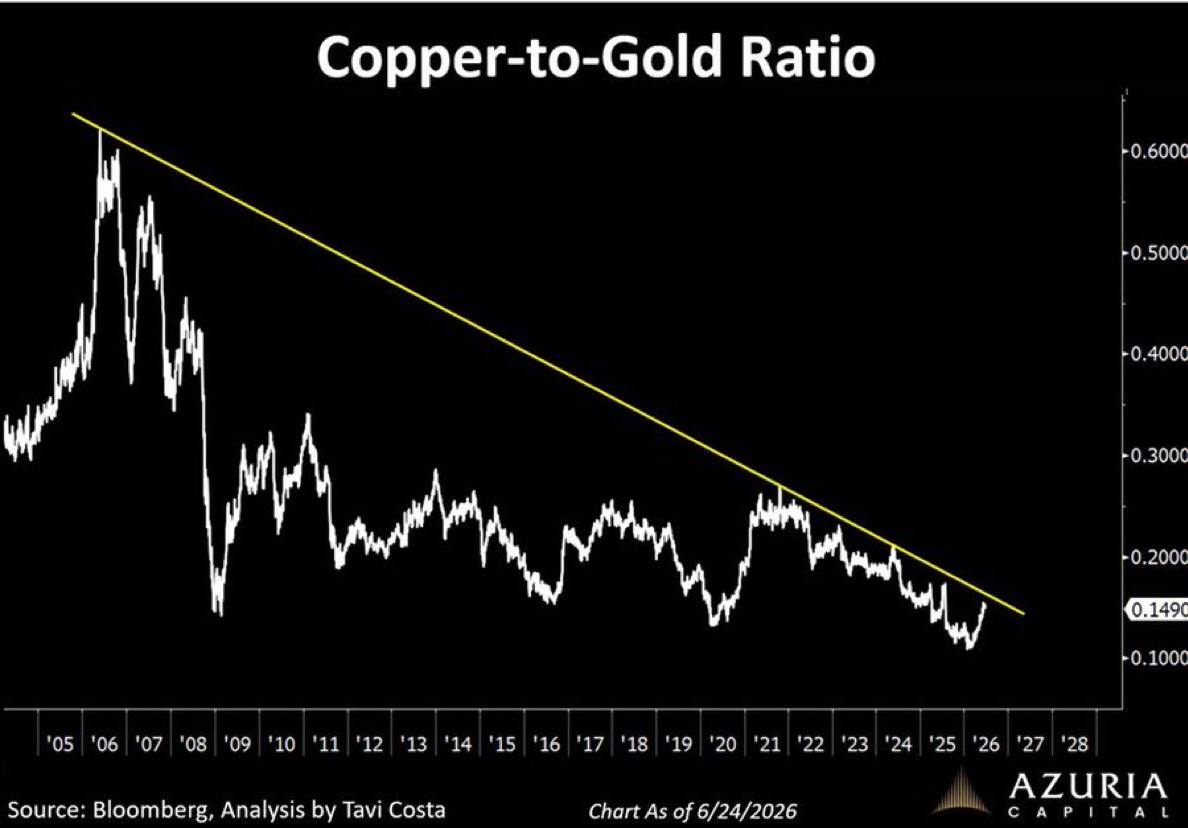
The copper-to-gold ratio is approaching the upper boundary of its long-established range. A convincing move beyond this level would be more than a chart pattern – it could indicate a broader shift in market leadership across the commodities complex.
For many investors, the copper-to-gold ratio serves as a gauge of economic sentiment rather than a simple comparison between two metals. Copper tends to thrive when industrial production, infrastructure spending and manufacturing are expanding, while gold usually outperforms during periods of economic uncertainty, weaker growth and heightened demand for defensive assets.
Supply fundamentals have steadily tightened over the past decade. Investment in new copper production has lagged, significant discoveries have remained scarce, mine development has become increasingly time-consuming, and ore quality has deteriorated. At the same time, demand continues to broaden, fueled by power grid upgrades, artificial intelligence, data centers, electric vehicles and defense-related spending. These forces are structural and likely to persist well beyond the current economic cycle.
Gold, by comparison, has already enjoyed the support of several powerful catalysts, including record buying by central banks, geopolitical tensions and sustained safe-haven demand. As a result, the copper-to-gold ratio does not require weaker gold prices to move higher. It simply requires copper to deliver stronger relative performance.
At present, the signal remains prospective rather than confirmed. Yet a sustained break above the long-term range could mark the beginning of a transition from defensive positioning towards real assets. If that scenario unfolds, industrial metals, mining companies and other cyclical sectors could emerge as the principal beneficiaries. Similar shifts have historically coincided with the start of prolonged commodity upcycles.


Brent has soared above $100. Is this just the beginning?
Today Fundamental Analysis: Brent Holds Around $100 Amid Fresh US-Iran Escalations

S&P 500 Stepped From Record Highs, but Market Breadth Is Flashing a Warning 💥

Bitcoin: the golden cross signals an uptrend, but not right away

US Inflation Data and Elevated Asset Valuations — Nasdaq, S&P 500 and Gold

China50 Tests 14,600 Resistance as Investors Await Inflation Data

Dollar slips, yen surges as Middle East tensions escalate