-1162026812.png)
-1162026812.png)





S&P 500 Stepped From Record Highs, but Market Breadth Is Flashing a Warning 💥

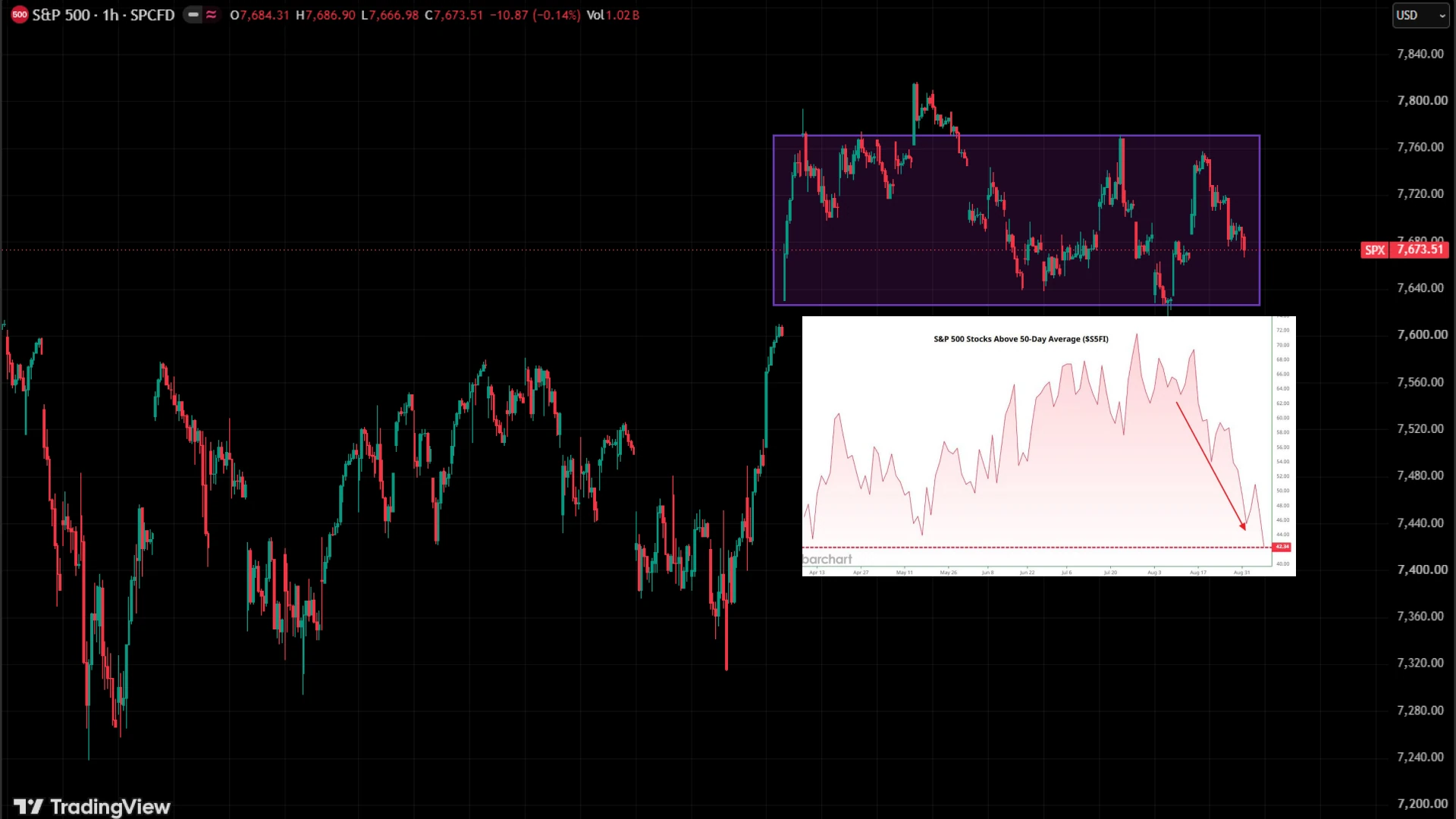 The S&P 500’s internal strength has deteriorated sharply over recent weeks. The proportion of index constituents trading above their 50-day moving average has fallen towards the low-40% area, marking one of the weakest breadth readings of the past five months, even as the headline index remains close to record territory. Recent breadth data continue to show a pronounced gap between the resilience of the capitalisation-weighted index and considerably weaker participation beneath the surface.
Historically, the more challenging period for US equities tends to begin in August and extend into the early autumn. Bank of America has highlighted that much of the S&P 500’s seasonal weakness is concentrated between August and October, before conditions have historically improved later in the year.
Despite this unfavourable seasonal backdrop, the S&P 500 has yet to enter a meaningful correction. Instead, the index has largely consolidated close to its historical highs, suggesting that deteriorating breadth has so far weakened the quality of the advance without decisively breaking the broader bullish structure.
President Trump has also continued to present a positive view of US equities. Ahead of the midterm elections, expectations that the administration will seek to maintain supportive financial conditions could provide an additional sentiment tailwind for equities and crypto assets. However, any prospective pre-election rally should be treated as a market scenario rather than a guaranteed policy-driven outcome.
Market Breadth Is the Principal WarningThe divergence between the S&P 500 and its underlying constituents deserves attention. When fewer stocks participate in an advance while the index remains near record highs, performance becomes increasingly dependent on a relatively narrow group of large-cap companies. This does not constitute a sell signal in isolation, but it reduces the market’s margin for error and increases sensitivity to negative macroeconomic catalysts.
Seasonality reinforces that caution. September has historically been a difficult period for US equities, but seasonal patterns should be treated as a risk factor rather than a standalone bearish signal. The more important confirmation would come from price itself: until the S&P 500 breaks material support and establishes a lower technical structure, consolidation near record highs remains fundamentally different from an established correction.
The principal macro risk is the combination of elevated bond yields, persistent inflation concerns and tighter Federal Reserve expectations. Strong August employment data have strengthened the case for another Fed rate increase, while forthcoming CPI figures could determine whether that hawkish repricing continues. A hotter inflation print would increase pressure on highly valued equities; benign inflation could restore risk appetite and extend the consolidation-to-rally scenario.
📌 Investment ViewThe base case remains constructive towards year-end, but increasingly cautious over the coming weeks. Weakening breadth and unfavourable September seasonality create scope for a correction, while the index itself has yet to confirm a structural bearish reversal. A stronger fourth-quarter seasonal backdrop, resilient earnings and potentially supportive pre-election positioning could subsequently restore demand for US equities and crypto assets. For now, internal weakness is a warning — not confirmation that the bull market is over.


Today Fundamental Analysis: Oil Breaks Above $102 as Middle East Tensions Continue to Escalate

Today Technical Analysis: Copper Approaches Record Highs on Surging Demand

Dollar struggles to gain ahead of US inflation data, yen extends rally

EBC Markets Briefing | Crude prices on solid footing amid deep supply concerns

The yen is strengthening before our very eyes

The Inflation Measure Keeping the Fed Cautious

US Yields Rise Despite Buybacks; Eyes on ECB Hike