-1162026812.png)
-1162026812.png)





DXY AT A CRITICAL TURNING POINT

 The market is effectively testing how far the US Treasury is prepared to go in its efforts to keep long-term borrowing costs under control. Doubling the size of buybacks in longer-dated Treasuries to at least $4 billion per operation provided only temporary relief, with yields subsequently moving higher again. This is an important signal: investors do not yet appear to regard technical measures as a sufficient response to the underlying structural challenges surrounding US government debt.
The key issue for the US dollar is no longer simply the headline level of government debt, but the cost of servicing it. US federal debt has now exceeded $40 trillion, while interest expenditure is becoming an increasingly significant burden on the federal budget. The longer long-term rates remain elevated, the more difficult it becomes to support economic activity, refinance government debt and maintain investor confidence in US assets simultaneously.
For Bessent, this is becoming an increasingly delicate balancing act. On the one hand, the Treasury has a clear interest in bringing longer-term yields down and maintaining stability in the government bond market. On the other, excessively aggressive intervention could be interpreted as a sign that conditions are more serious than the authorities are prepared to acknowledge. Bessent has already indicated that the scale of Treasury buybacks could be increased further if necessary.
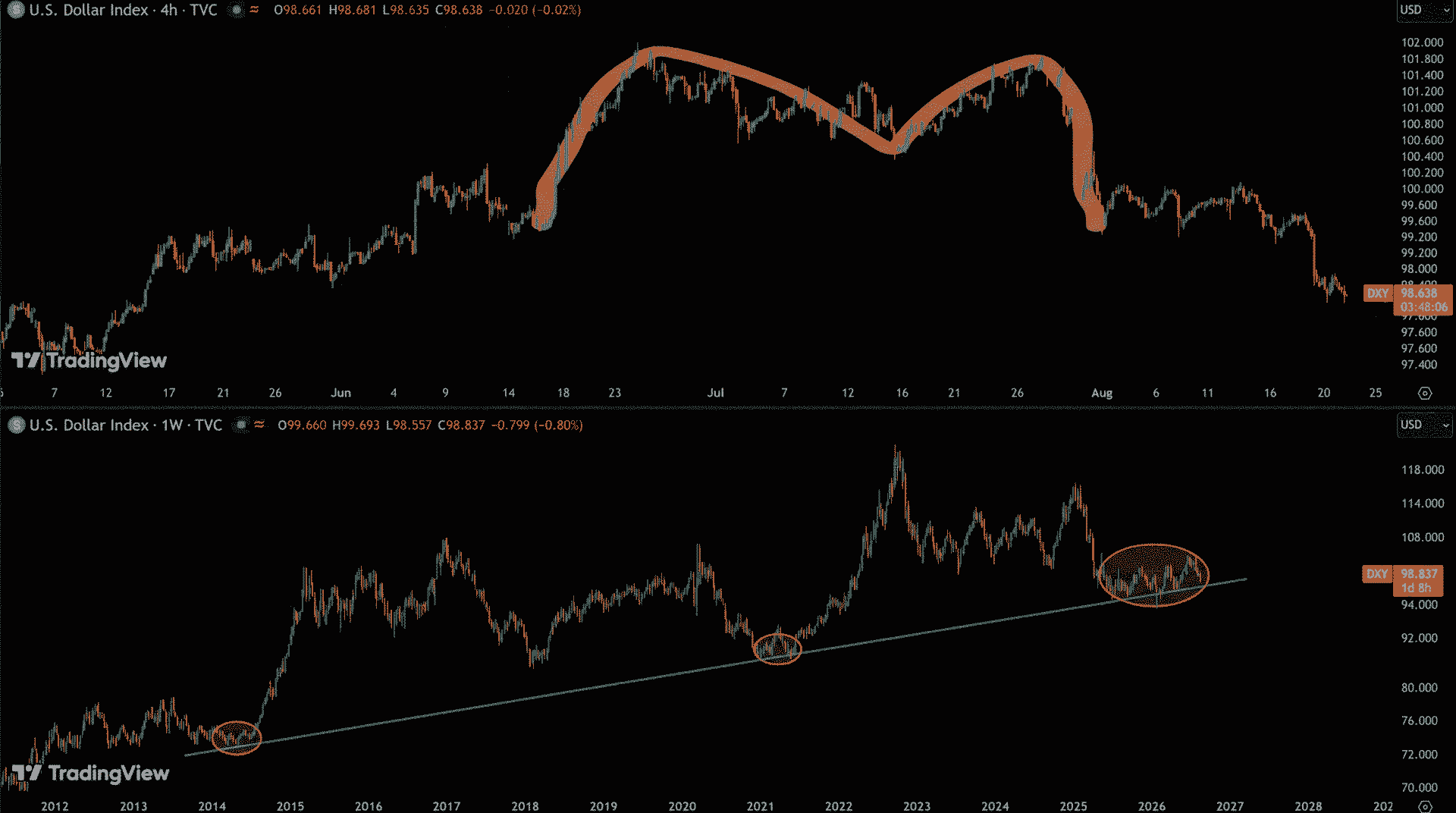
For traders, the DXY’s reaction to long-term support is now particularly important. The fact that the index is trading around a major support area does not, in itself, confirm a breakdown. However, the absence of a convincing rebound suggests that underlying pressure is continuing to build. A confirmed break below this support could therefore turn what currently appears to be a dollar correction into a considerably more significant move — particularly if gold and other assets that tend to benefit from dollar weakness continue to strengthen.
Conclusion: we are not yet looking at a confirmed collapse in the US dollar, but we may be approaching an important inflection point. Until the longer-term trend is decisively broken, dollar bears still need to prove their case. However, if the DXY loses its long-term support while the Treasury market continues to resist stabilization efforts, pressure on the dollar could intensify significantly. These are precisely the conditions from which major market trends can emerge — making confirmation, rather than anticipation, particularly important at this stage.


Brent has soared above $100. Is this just the beginning?

Today Fundamental Analysis: Brent Holds Around $100 Amid Fresh US-Iran Escalations

S&P 500 Stepped From Record Highs, but Market Breadth Is Flashing a Warning 💥

Bitcoin: the golden cross signals an uptrend, but not right away

US Inflation Data and Elevated Asset Valuations — Nasdaq, S&P 500 and Gold

China50 Tests 14,600 Resistance as Investors Await Inflation Data

Dollar slips, yen surges as Middle East tensions escalate