
-482026738.png)





EURUSD Slips Towards 1.1019 as Higher Treasury Yields and Fed Tightening Bets Support the Dollar

Key Takeaways
- EURUSD declined towards 1.1019 on Monday, approaching the psychological 1.1000 level as higher US Treasury yields supported the dollar.
- Stronger-than-expected US inflation has reinforced expectations of additional Federal Reserve tightening, widening the potential policy divergence between the Fed and the European Central Bank (ECB).
- Traders are monitoring 1.1000 as immediate psychological support, with 1.1050 and 1.1100 as potential resistance levels.
- Wednesday’s FOMC meeting minutes and upcoming eurozone inflation figures could shape the pair’s next move.

EURUSD extended its decline towards 1.1019 on Monday, pressured by rising US Treasury yields and expectations of further Federal Reserve tightening that strengthened demand for the dollar. The move has brought the pair close to the psychologically important 1.1000 level, leaving traders to assess whether selling pressure could extend or whether the pair is nearing a temporary stabilisation point.
The latest chart shows a bearish structure, with successive lower highs and lower lows indicating that sellers remain in control. The nine-period moving average continues to slope downwards, and the pair is trading below it, suggesting that upward moves have struggled to attract sustained buying interest.
Why Traders Are Watching EURUSD
The immediate focus is whether US dollar strength will continue to outweigh potential stabilisation near 1.1000. Higher Treasury yields have increased the relative appeal of dollar-denominated assets, creating additional demand for the currency. A stronger dollar generally places downward pressure on EURUSD.
Fed and ECB policy divergence also remains a key driver. Stronger US inflation has raised expectations that the Fed could maintain a more restrictive stance, and if it signals further tightening while the ECB remains cautious, the resulting interest-rate differential could continue to favour the dollar.
Key factors influencing EURUSD’s outlook include:
- US Treasury Yields: Whether yields keep rising and support dollar demand, or retreat and ease pressure on the euro.
- Federal Reserve Policy: Whether the FOMC minutes show policymakers see a need for further tightening.
- US Economic Data: Whether softer data reduces expectations of additional tightening and weakens the dollar.
- Eurozone Inflation: Whether price pressures remain persistent enough to influence future ECB decisions.
- ECB Policy Stance: Whether a cautious ECB widens the policy gap with the Fed or stronger inflation supports a firmer stance.
Key Trading Levels
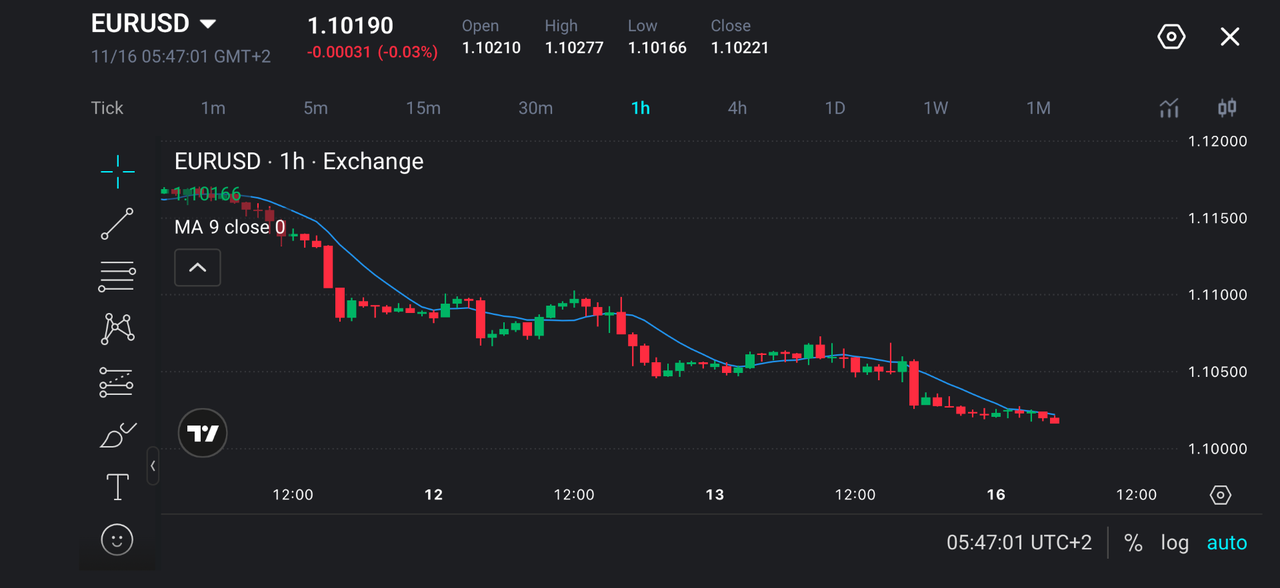
EURUSD is trading around 1.1019 and remains under bearish pressure. Immediate support sits between 1.1015 and 1.1020, near the latest hourly lows. A break below this area could expose the 1.1000 psychological level, where buyers may attempt to stabilise prices. A sustained break below 1.1000, with continued lower highs, could extend the decline towards 1.0980, followed by 1.0950 if bearish momentum persists and Treasury yields keep rising.
On the upside, 1.1025-1.1030 is the first recovery level, near the declining nine-period moving average. A move above this zone, particularly if the moving average begins to flatten or turn upwards, would suggest short-term selling pressure is easing and could bring 1.1050 into focus. Further resistance sits at 1.1080-1.1090, with 1.1100 as a major psychological level and previous consolidation area.
Bottom Line
EURUSD’s next move may depend on whether dollar strength continues to outweigh stabilisation near 1.1000. Falling Treasury yields, less hawkish Fed signals, softer US data or stronger eurozone inflation could support a recovery towards 1.1050-1.1100, while further yield gains and a break below 1.1000 could open the way to 1.0980 and 1.0950.
For a closer look at forex market developments and the factors influencing EURUSD, read this article.


A perfect storm for the dollar

Gold Tests Key Support as Fed Hike Bets Keep Dollar Firm

Week Ahead: Nvidia Earnings and Anthropic IPO Put AI Stocks and the Nasdaq in Focus

Weekly Analysis and Forecast: Gold falls to its lowest level in 2026. And Jensen Huang‘s resignation adds uncertainty to the stock market

Gold Slides as Fed Hike Bets Fuel Dollar Rally

THE FED'S DECEMBER DILEMMA: MARKETS BRACE FOR HIGHER INTEREST RATES

Dollar hits 19-month high as USDJPY nears 160 and Japan hints at intervention