-1162026812.png)
-1162026812.png)





GOLD’S GREAT RESET: IS THE WORST NOW OVER?

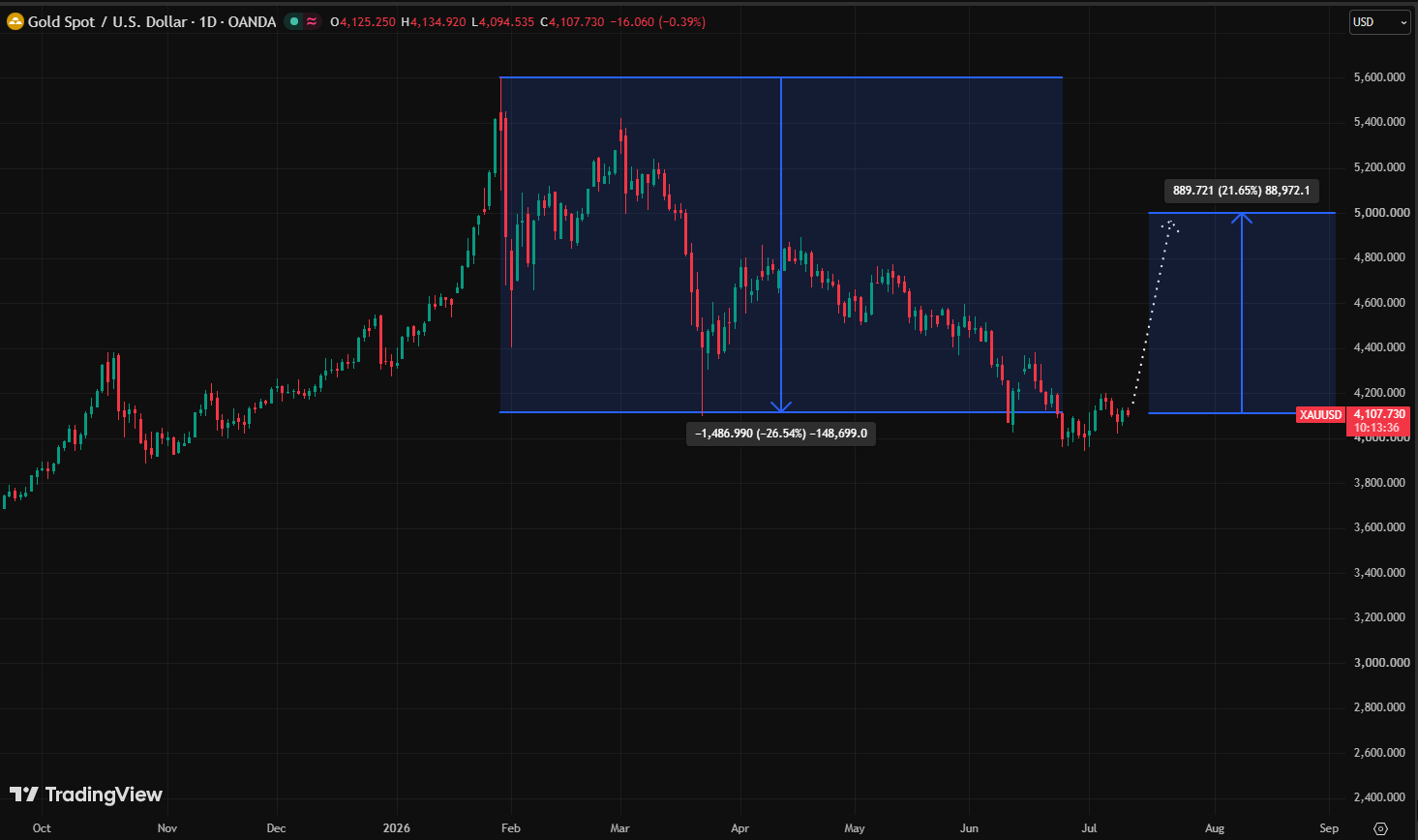
June marked the fourth consecutive month of losses for gold. For the first time in eight months, the metal slipped below the psychologically important $4,000-an-ounce level. Over the past four months, gold has shed roughly a quarter of its value, making it one of the weakest-performing assets across global markets.
From its all-time high of around $5,600 an ounce, reached on 30 January, gold has fallen by 26.5%. However, sellers failed to keep the price below $4,000 for long, and by the end of June the metal had recovered to $4,010 an ounce. Even so, gold finished the month 11.7% below its May closing level.
The decline has now extended to four consecutive months, leaving gold down more than 7% since the start of the year. As a result, the metal has fallen to the bottom of the investment performance rankings for the first time since 2021.
At the same time, the factors driving the sell-off have gradually shifted. In the spring, the war in the Middle East was the main source of pressure on precious metals. By the start of the summer, however, attention had turned to a more hawkish Federal Reserve under its new chair.
Following such a sharp decline, banks no longer expect gold to make a swift return to the $6,000-an-ounce level. However, a considerable amount of bad news may already be priced in, and revised forecasts now suggest that gold could recover by 10–20% by the end of the year.
From a market perspective, the current situation looks like a shift from euphoria to a substantial reset in expectations. Only a few months ago, investors were pricing in an almost uninterrupted rise in gold, but the combination of a hawkish Fed, a strong US dollar and growing investor disappointment has forced the market to search for a new equilibrium. At the same time, the failure of sellers to keep gold below $4,000 for long may suggest that demand is beginning to emerge at current levels, although a more meaningful change in the macroeconomic backdrop will be needed to confirm a sustained reversal.
The key takeaway is that the most painful part of the decline may already be behind us, but a sharp sell-off alone is not enough to trigger a new bull market. In the short term, gold remains highly dependent on Fed policy, the direction of the US dollar and interest rates. If these pressures begin to ease, however, a 10–20% recovery looks entirely plausible. For now, the current environment looks more like the formation of a long-term accumulation zone than a return to the previous phase of rapid gains.

Today Fundamental Analysis: Oil Breaks Above $102 as Middle East Tensions Continue to Escalate
Today Technical Analysis: Copper Approaches Record Highs on Surging Demand

Dollar struggles to gain ahead of US inflation data, yen extends rally
EBC Markets Briefing | Crude prices on solid footing amid deep supply concerns

The yen is strengthening before our very eyes

The Inflation Measure Keeping the Fed Cautious

US Yields Rise Despite Buybacks; Eyes on ECB Hike