-1162026812.png)
-1162026812.png)





Has Crypto Lost the Capital… or Has The S&P500 Stolen the Spotlight?

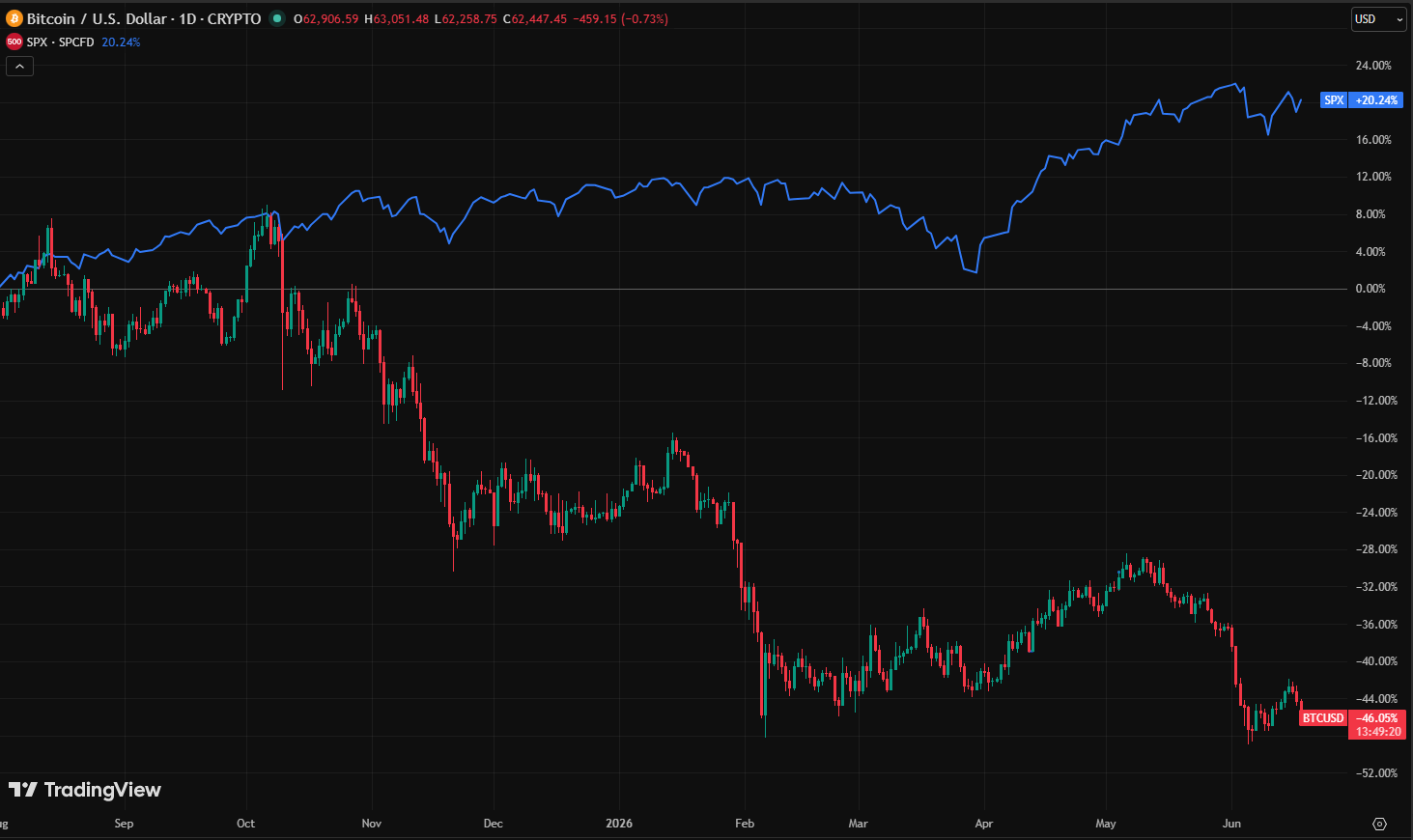
Currently, bitcoin retreats, altcoins look even more fragile, and it almost appears as though billions have quietly evaporated from the crypto market. For real, the money has not disappeared at all. Capital rarely leaves the system—it simply migrates from one corner of the market to another.
Whilst digital assets struggle for momentum, American equities continue to march towards fresh record highs. The S&P 500 is once again rewriting history, and Wall Street has become almost entirely consumed by one narrative: the AI. It bears all the hallmarks of a classic capital rotation. Whenever a single theme promises to attract tens of billions of dollars, institutional investors inevitably begin raising liquidity. The quickest way to do so is by trimming exposure to higher-risk assets—and cryptocurrencies are often first in the firing line.
Take the recent SpaceX IPO, one of the largest listings ever brought to market. Investors were not simply buying a space exploration company; they were buying a vision of tomorrow—satellite communications, artificial intelligence, next-generation infrastructure and technologies that have yet to reach maturity. Markets have always been remarkably fond of compelling stories, particularly when innovation sits at the center of the narrative.
There is, of course, nothing wrong with investing in businesses capable of reshaping entire industries. Nevertheless, experienced investors know that enthusiasm alone is never an investment thesis. The structure of the offering, the deployment of fresh capital, debt levels and underlying financial performance deserve just as much attention as the futuristic headlines. History has a rather consistent habit of reminding us that the louder the excitement surrounding an IPO, the more carefully one ought to examine the small print.
Federal Reserve policy adds another important dimension. The central bank has adopted a distinctly hawkish tone, and part of the optimism that fueled risk assets only weeks ago has already begun to fade. Should the Fed remain committed to higher rates for longer, speculative assets may continue to face headwinds. Equally, the first credible signs of future monetary easing could rapidly revive demand for cryptocurrencies and other growth-oriented investments.
That is why the key indicator is not Bitcoin's price, but the direction of liquidity itself. If capital returns to crypto once the latest IPO frenzy subsides and markets fully digest the Fed's message, we will simply have witnessed another textbook rotation between asset classes. If, however, liquidity continues flowing almost exclusively into US equities and AI-related opportunities, it may suggest that a new investment cycle is already under way.
Markets have always chased the next great story. The only question is whether today's capital is merely taking a temporary detour—or quietly laying the foundations for the next decade's winners.
Trade smart with Headway


Today Fundamental Analysis: Oil Breaks Above $102 as Middle East Tensions Continue to Escalate

Today Technical Analysis: Copper Approaches Record Highs on Surging Demand

Dollar struggles to gain ahead of US inflation data, yen extends rally

EBC Markets Briefing | Crude prices on solid footing amid deep supply concerns

The yen is strengthening before our very eyes

The Inflation Measure Keeping the Fed Cautious

US Yields Rise Despite Buybacks; Eyes on ECB Hike