2276-682026843.jpg)
2216-682026843.jpg)





How Can the Iran War Derail Bovespa’s Trajectory

Brazil’s Economic Backdrop and the Fragile Foundations of a Rally
Brazil entered 2025 on uncertain footing. After a robust 3.4% expansion in 2024, Latin America’s largest economy slowed sharply to 2.3% growth last year — its weakest showing since the pandemic-era contraction of 3.3% in 2020. The deceleration was not incidental. It was the deliberate consequence of one of the most aggressive monetary tightening cycles the country has seen in decades, as the Banco Central do Brasil held its benchmark Selic rate steady at 15% from July onward, the highest level in nearly two decades, in a determined effort to bring persistent inflation to heel.
The toll of elevated borrowing costs showed up clearly in the fourth quarter, when GDP expanded just 0.1% from the previous three months, even as the annual reading came in at 1.8%. Consumer spending retreated under the weight of expensive credit, while business investment stalled with financing costs at generational highs. The central bank itself projected that the slowdown would deepen further, forecasting growth of only 1.6% in 2026 — a figure that was already sobering before new geopolitical shocks entered the equation.
Yet against this backdrop of slowing growth, Brazilian equities staged a remarkable rally. The Ibovespa, Brazil’s benchmark stock index, rose 17% in dollar terms in the year to March 12, while the S&P 500 slipped 2% over the same stretch. The rally was driven largely by foreign capital flowing into Brazilian assets, propelled by two complementary forces: the expectation that the central bank was finally poised to begin cutting rates, and a broader global search for diversification away from U.S. dollar assets amid a pre-war weakening of the greenback. Both of those tailwinds are now at risk.
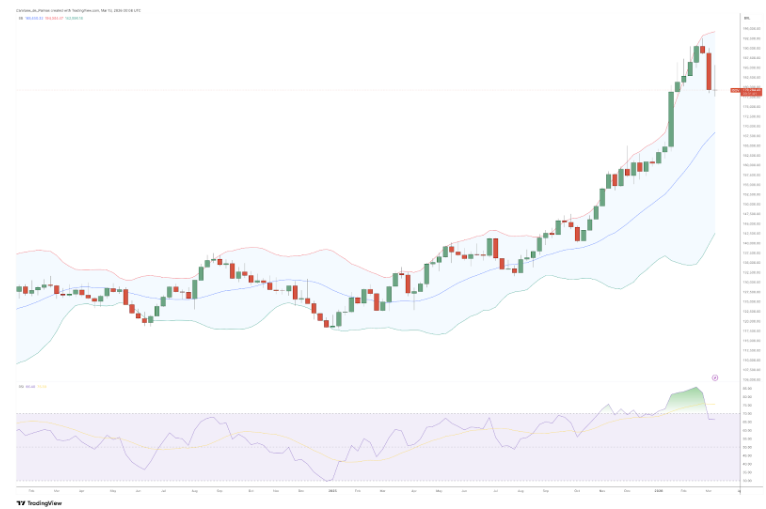
Bovespa Weekly Chart - Source: TradingView
Inflation, the Selic Rate, and the Rate Cut That May Not Come
February brought a rare piece of good news on the inflation front. Brazil’s 12-month consumer price index eased to 3.81%, down from 4.44% in January and the lowest reading since April 2024, according to statistics agency IBGE. The figure brought annual inflation close to the central bank’s target of 3%, within the allowed tolerance band of plus or minus 1.5 percentage points. With the Selic rate sitting at 15% and the economy losing momentum, the case for monetary easing appeared, until very recently, almost airtight.
Board members had signaled as early as January that they intended to begin cutting rates at the March 17-18 monetary policy meeting, and markets had priced in the move with considerable confidence. The question debated among analysts was not whether cuts were coming, but how aggressive the first move would be — 25 basis points or a bolder 50. The inflation data, released just ahead of the meeting, appeared to tilt the balance toward the more accommodative option.
Then oil crossed $100 a barrel.
The catalyst was a statement from Iran’s new supreme leader Mojtaba Khamenei, who declared that the Strait of Hormuz must remain closed as leverage against the United States. The announcement sent energy markets into a sharp upward move, injecting a new and deeply uncomfortable variable into the Banco Central’s deliberations. Oil price surges have a well-documented pass-through effect on consumer prices globally, and in an emerging economy like Brazil — where energy costs feed directly into transportation, manufacturing and food production — the inflationary implications are difficult to dismiss.
Markets responded by rapidly repricing the rate cut expectations. From a broad consensus around a 50 basis point reduction, sentiment fractured, with investors now split between 25 and 50 basis points. Some economists went further, arguing that the start of the easing cycle itself could be postponed. The central bank, which had spent months carefully preparing the ground for a pivot, now finds itself navigating an external shock that was entirely absent from its December projections.
The War Premium and What It Means for the Bovespa in 2026
The intersection of geopolitics, monetary policy and fiscal dynamics creates a particularly complex picture for Brazilian equities. On the surface, higher oil prices should be straightforwardly positive for Brazil. The country is a major crude exporter, and elevated prices increase royalty revenues for the federal government while boosting dividends from Petrobras, the state-controlled oil giant that carries enormous weight in the Ibovespa’s composition. But the surface reading obscures a more troubling structural dynamic.
Nearly half of Brazil’s substantial public debt is tied directly to the Selic rate. Every quarter-point that the central bank is forced to delay cutting — or worse, every scenario in which rates must stay higher for longer to contain an oil-driven inflation resurgence — translates directly into higher debt service costs for the federal government. A prolonged conflict in the Middle East would therefore simultaneously inflate the revenue side and balloon the expenditure side of Brazil’s fiscal ledger, with the net effect almost certainly negative over time, as several economic analysts have acknowledged.
The fiscal picture was already strained before the war escalated. Brazil’s government spends significantly more than it collects, at a pace many economists consider inconsistent with a stable emerging market trajectory. With general elections scheduled for October 2026, the political incentive to increase spending will intensify rather than ease — potentially widening the deficit at precisely the moment when the central bank needs fiscal policy to work alongside monetary policy in containing inflationary pressures. A looser fiscal stance risks stoking domestic consumption, putting upward pressure on prices, weakening the Brazilian real, and ultimately making the path to lower interest rates even narrower.
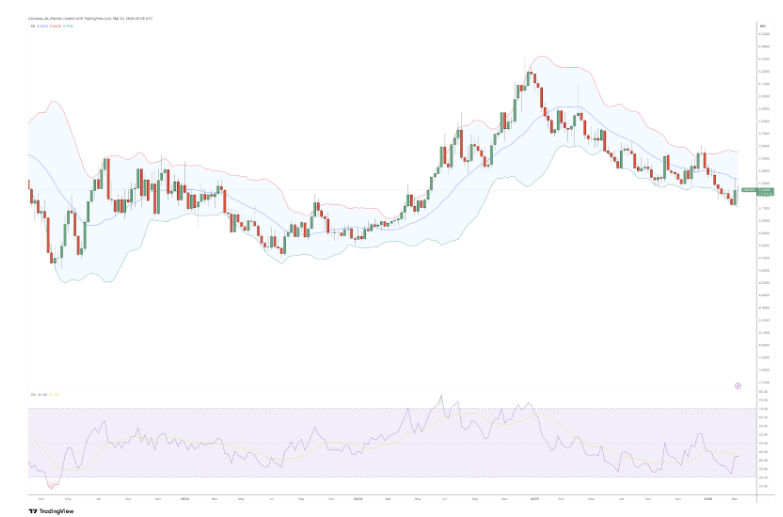
Weekly USD/BRL Chart - Source: TradingView
The rally of the Bovespa index of the past year was built on two pillars: the prospect of cheaper borrowing costs unlocking consumption, corporate investment and equity valuations, and a global rotation into non-dollar assets. If the Iran war keeps the Selic elevated, or forces the central bank to cut more gradually than anticipated, the re-rating of Brazilian equities loses its primary engine. And if the dollar strengthens again as a safe-haven response to escalating tensions in Iran, the diversification trade that brought foreign capital into Brazilian markets could quietly reverse.
The index’s impressive run in 2025 has priced in a future that the war is now placing in doubt. Whether Bovespa can sustain its trajectory through 2026 will depend, in no small part, on decisions being made far beyond Brazil’s borders.
Sources: Reuters, The Wall Street Journal, CNBC, IBGE, Banco Central do Brasil
The information provided does not constitute investment research. The material has not been prepared in accordance with the legal requirements designed to promote the independence of investment research and as such is to be considered to be a marketing communication.
All information has been prepared by ActivTrades (“AT”). The information does not contain a record of AT’s prices, or an offer of or solicitation for a transaction in any financial instrument. No representation or warranty is given as to the accuracy or completeness of this information.
Any material provided does not have regard to the specific investment objective and financial situation of any person who may receive it. Past performance is not a reliable indicator of future performance. AT provides an execution-only service. Consequently, any person acting on the information provided does so at their own risk. Forecasts are not guarantees. Rates may change. Political risk is unpredictable. Central bank actions may vary. Platforms’ tools do not guarantee success.

Today Fundamental Analysis: Oil Breaks Above $102 as Middle East Tensions Continue to Escalate

Today Technical Analysis: Copper Approaches Record Highs on Surging Demand

Dollar struggles to gain ahead of US inflation data, yen extends rally
EBC Markets Briefing | Crude prices on solid footing amid deep supply concerns

The yen is strengthening before our very eyes

The Inflation Measure Keeping the Fed Cautious

US Yields Rise Despite Buybacks; Eyes on ECB Hike