2276-682026843.jpg)
2216-682026843.jpg)





How to Invest Like Warren Buffett in 2026 (Part 1)

Warren Buffett, the Oracle of Omaha, stands as one of the most extraordinary success stories in financial history. At age 95, with a net worth of approximately $148 billion, he has transformed what was once a struggling textile mill into Berkshire Hathaway, now a $1.2 trillion conglomerate that owns everything from Apple to Mitsubishi. Since taking control of Berkshire in 1965, Buffett has delivered a staggering compound annual return of 19.9% by the end of 2024, nearly double the S&P 500’s 10.4% over the same period according to the company’s 2024 annual report. Berkshire shares have skyrocketed 5,502,284 %, compared to the S&P 500’s 39,054 % gain with dividends over the same period.
As we enter 2026, major global indices are trading at or near record highs, prompting both excitement and caution among investors. The Dow Jones pushed past 49,000 for the first time last week, while the S&P 500 reached a new milestone above 6,944. This rally isn't confined to U.S. markets—fresh records have also been set in Japan, Singapore, and South Korea, among others.
Major investment banks have issued bullish forecasts for the year ahead. Deutsche Bank leads with the most optimistic projection, expecting the S&P 500 to reach 8,000 points by year-end 2026—a potential 15% gain from the record high. Morgan Stanley and Wells Fargo both forecast 7,800, while Citigroup, UBS, and Goldman Sachs converge at 7,700. These targets suggest Wall Street believes the bull market has further room to run.

S&P 500 Daily Chart - Source : ActivTrader
However, with such elevated valuations and after years of impressive returns—the S&P 500 has surged 93% since the bull market began in October 2022, investors face a legitimate question: is this still the right time to invest? When stock prices sit at historic highs and economic uncertainty looms around trade policy, Federal Reserve decisions, and geopolitical tensions, how should investors approach the markets?
Having just stepped down as Berkshire Hathaway's CEO after six decades at the helm, Buffett leaves behind principles that have worked through bull markets and bear markets, recessions and booms, technological revolutions and financial crises. His philosophy doesn't depend on predicting whether markets will rise or fall in the short term—it focuses on buying quality businesses at reasonable prices and holding them through inevitable volatility.
Whether 2026 delivers the bullish scenario most banks predict or experiences the corrections, Buffett's approach provides a framework for navigating both outcomes. Here’s how you can apply some of his wisdom to your own portfolio in 2026, even when markets feel expensive and the future uncertain.
Invest in What You Understand
"Never invest in a business you cannot understand," Buffett famously advised. This principle, often called staying within your "circle of competence," is perhaps his most fundamental rule when you decide to invest your savings into the financial markets.
Understanding what you own is the foundation of intelligent investing. When you truly comprehend a business, you can make rational decisions during market turbulence instead of reacting emotionally to price swings. You’ll recognize whether a stock decline represents a temporary setback or a fundamental problem. You’ll know if management is making smart strategic moves or squandering shareholder capital. Most importantly, you can distinguish between genuine value and clever marketing hype.
Buffett himself has walked away from countless investment opportunities simply because they fell outside his circle of competence. He famously avoided technology stocks during the dot-com bubble of the late 1990s, not because he thought technology was unimportant, but because he didn’t feel he could reliably predict which companies would succeed.
Understanding also protects you from one of investing’s greatest dangers: buying something solely because its price is rising. When you lack genuine comprehension of a business, you have no anchor to assess whether a stock at $100 is cheap or expensive. You’re flying blind, dependent on the market’s mood rather than business fundamentals. And this is speculation, not investing.
How Can You Apply This Rule in Your Investment Strategy?Start by considering your professional expertise and personal interests.
If you work in healthcare, you likely understand pharmaceutical companies better than most—you might know the drug approval process, the importance of patent cliffs, and how reimbursement dynamics affect profitability. If you’re passionate about consumer goods, you might be better equipped to evaluate retail brands—you understand consumer behavior, brand loyalty, and the economics of distribution. If you’ve worked in manufacturing, you are likely to grasp supply chain complexities, margin pressures, and operational efficiency in ways that most investors don’t.
This doesn’t mean you can only invest in your exact field, but rather that you should be able to explain how a company makes money, what its competitive advantages are, and what risks it faces. You can expand your circle of competence over time through dedicated study, but you must be honest about its current boundaries.
Before investing in any company, test your understanding by asking yourself probing questions:
- Can I explain this business model to a friend in simple terms without using jargon?
- Do I understand where the company’s revenues come from and whether those revenue streams are stable or volatile?
- Can I identify the company’s main competitors and explain why customers choose this company over alternatives?
- What are the company’s key competitive advantages, and are they sustainable or easily replicated?
- How does the company make money—through high volume and thin margins, or low volume and high margins?
- What could disrupt this business in the next five to ten years?
- Do I understand the major costs involved in running this business?
- Can I explain what drives profitability in this industry?
- Would I understand the company’s quarterly earnings report if I read it?
- If this were a private business I was buying entirely, would I feel comfortable taking over management tomorrow?If your answers to these questions are vague, filled with uncertainty, or rely on hoping that management or "smart investors" have it figured out, that’s your signal to either do more research or move on to something you genuinely understand.
What Should You Avoid Doing?
The temptation to chase hot stocks in sectors you don’t comprehend simply because others are profiting can be overwhelming, especially when friends and social media are buzzing about spectacular gains. Resist this urge.
Making money on an investment you don’t understand is often more dangerous than losing money on one you do, because it encourages you to take more uninformed risks. Investing in companies with overly complicated business models or obscure revenue streams might sound sophisticated, but complexity is often where problems hide. If you can’t clearly articulate how a company generates cash, you can’t possibly know if it’s worth owning.
Don’t let FOMO (Fear Of Missing Out) push you beyond your knowledge boundaries. The fear of missing out sentiment has destroyed more wealth than perhaps any other emotion in investing. There will always be another opportunity, but there’s no recovering from catastrophic losses in businesses you never understood. Similarly, avoid assuming that because a company is popular, innovative, or frequently mentioned in the news, it’s automatically a good opportunity.
Popularity and innovation are wonderful traits, but they don’t determine whether a stock is undervalued, fairly valued, or wildly overpriced. Some of history’s most innovative companies have been terrible investments because investors paid too much at a given time, while some boring, well-understood businesses have generated exceptional returns simply because they were purchased at sensible prices.
Sources: Investopedia, Yahoo Finance, Bloomberg, CNN, CNBC, Finance Charts, Berkshire Hathaway, Business Insider
The information provided does not constitute investment research. The material has not been prepared in accordance with the legal requirements designed to promote the independence of investment research and as such is to be considered to be a marketing communication.
All information has been prepared by ActivTrades (“AT”). The information does not contain a record of AT’s prices, or an offer of or solicitation for a transaction in any financial instrument. No representation or warranty is given as to the accuracy or completeness of this information.
Any material provided does not have regard to the specific investment objective and financial situation of any person who may receive it. Past performance is not a reliable indicator of future performance. AT provides an execution-only service. Consequently, any person acting on the information provided does so at their own risk. Forecasts are not guarantees. Rates may change. Political risk is unpredictable. Central bank actions may vary. Platforms’ tools do not guarantee success.

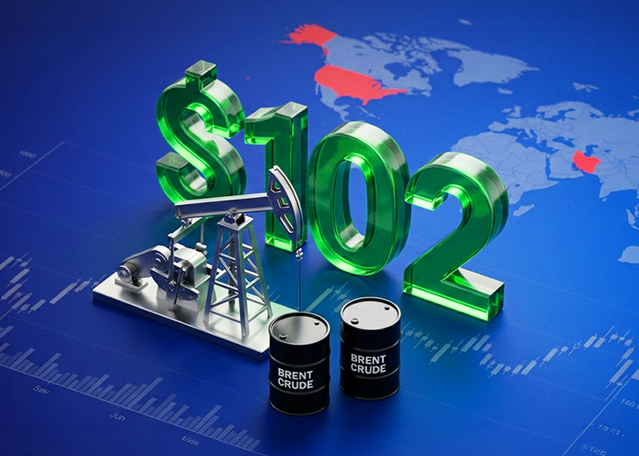
Today Fundamental Analysis: Oil Breaks Above $102 as Middle East Tensions Continue to Escalate

Today Technical Analysis: Copper Approaches Record Highs on Surging Demand

Dollar struggles to gain ahead of US inflation data, yen extends rally
EBC Markets Briefing | Crude prices on solid footing amid deep supply concerns

The yen is strengthening before our very eyes

The Inflation Measure Keeping the Fed Cautious

US Yields Rise Despite Buybacks; Eyes on ECB Hike