-1162026812.png)
-1162026812.png)





Market Concentration Peaks: Is the S&P 500 Losing Its Core Drivers?

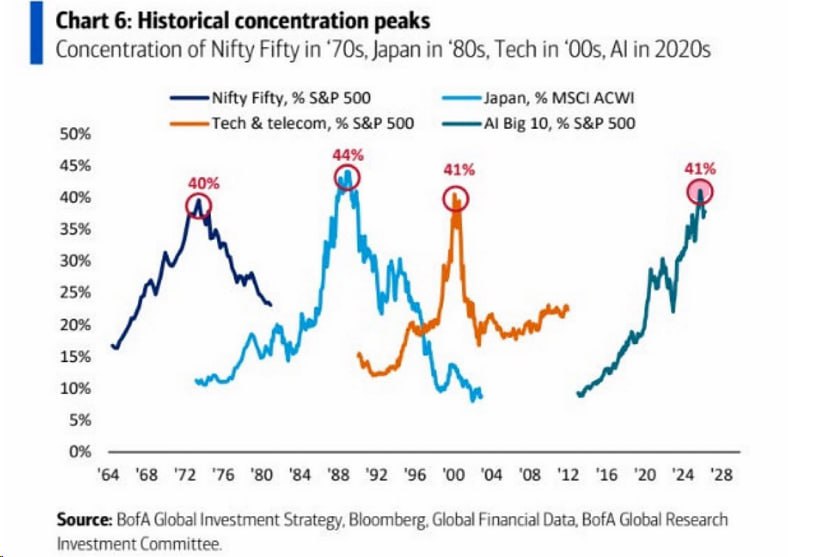
The concentration of a particular group of stocks within the S&P 500 (alongside a comparable measure for Japanese equities within the MSCI ACWI) is becoming an increasing point of concern.
Historically, market bubbles have tended to burst once such concentration exceeds roughly 41%.
In the current cycle, the weight of the largest 10% of US stocks in the S&P 500 — the so-called “Magnificent Seven” — reached that same 41% threshold. The trend has since begun to ease, with these stocks, previously the main drivers of the index, underperforming the broader market for some time.
There is a growing sense that the peak of this cycle may already be behind us.
Concerns are also mounting over the scale and justification of corporate spending on AI, as well as uncertainties surrounding the so-called “Operation Epic Rage”.
Should the AI narrative — which has been the principal driver of S&P 500 gains over the past year — prove overstated, and if “Operation Epic Rage” were to unravel with wider repercussions, it could act as a significant catalyst for a sharp market correction.
What makes the current situation particularly notable is not merely the level of concentration, but the change in leadership. When a narrow group of stocks drives the bulk of index performance, the market becomes increasingly fragile. Once that leadership begins to falter, the broader index often struggles to maintain momentum, even if the rest of the market remains relatively stable.
At the same time, the scale of investment into AI has introduced an additional layer of uncertainty. While the long-term potential is widely acknowledged, the near-term return on such spending remains unclear. Should expectations prove overly ambitious, a reassessment of valuations could follow — particularly among the largest names that have driven the rally.
Taken together, these factors suggest that markets may be entering a more delicate phase — one characterized less by broad-based expansion and more by selectivity, dispersion, and sensitivity to disappointment.


Today Fundamental Analysis: Oil Breaks Above $102 as Middle East Tensions Continue to Escalate

Today Technical Analysis: Copper Approaches Record Highs on Surging Demand

Dollar struggles to gain ahead of US inflation data, yen extends rally

EBC Markets Briefing | Crude prices on solid footing amid deep supply concerns

The yen is strengthening before our very eyes

The Inflation Measure Keeping the Fed Cautious

US Yields Rise Despite Buybacks; Eyes on ECB Hike