-1162026812.png)
-1162026812.png)





Oil Enters July on a Knife Edge

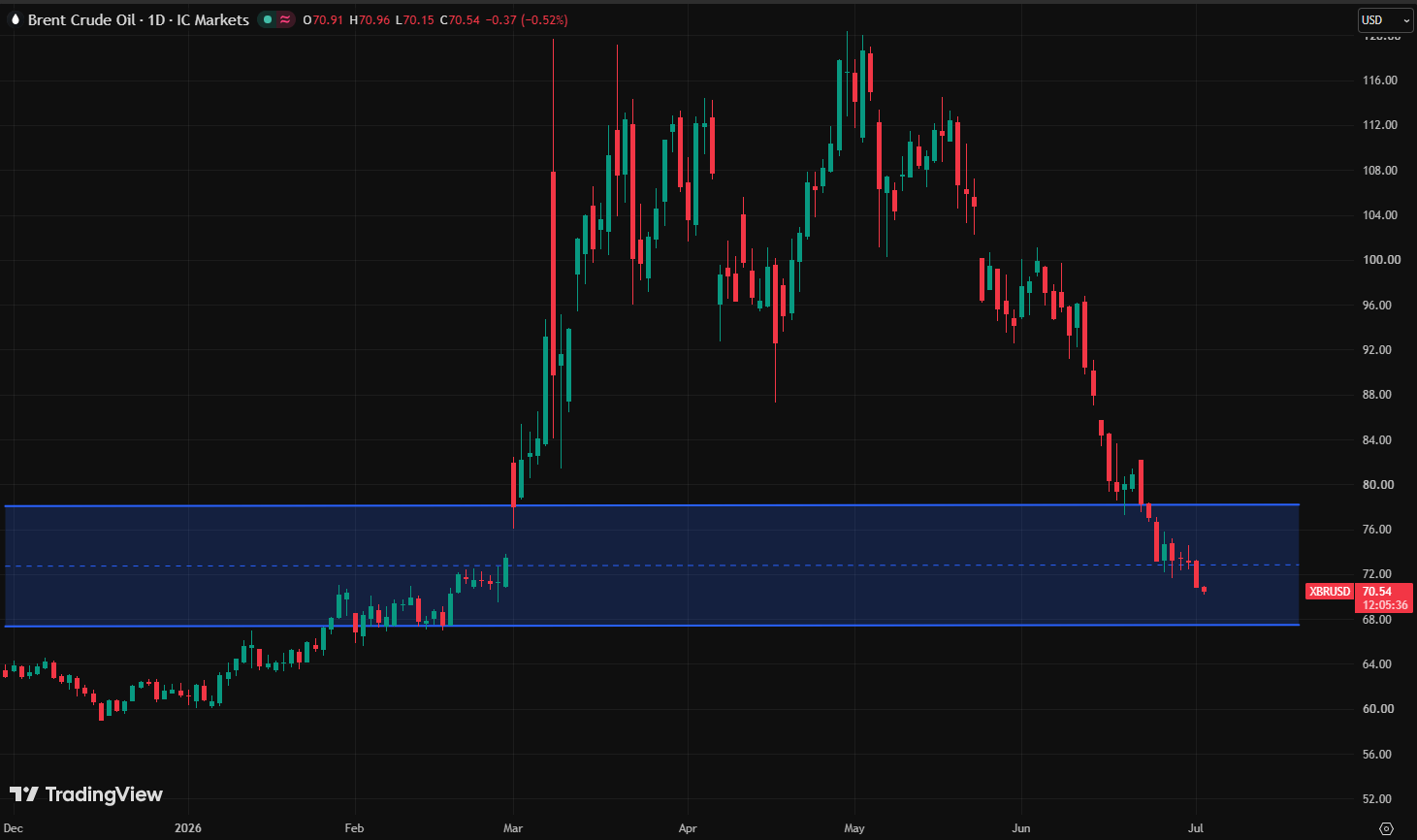
The oil market underwent a marked reversal in June. The conflict in the Persian Gulf was no longer being priced as a prolonged supply shock, and by month-end both Brent and WTI had retreated and erased “Iranian spikes”. As a result, the market enters July with technically weakened price charts, depleted inventories and a fragile "peace" narrative that could unravel at any moment.
Throughout June, traders stopped viewing the Gulf conflict as a source of sustained supply disruption and instead began pricing in a gradual recovery in Middle Eastern exports. Futures markets moved ahead of physical fundamentals, anticipating a potential US–Iran memorandum, partial sanctions relief and the escorted passage of tankers through the Gulf. By the end of the month, Brent had eased back to around $74 per barrel and WTI to approximately $71, even though traffic through the Strait of Hormuz and crude exports from the Gulf remained well below pre-conflict levels.
The IEA now expects global oil demand to decline by 1.1 million barrels per day in 2026, whilst refinery throughput is projected to contract by 2 million barrels per day. Elevated fuel prices and ongoing disruption to refined-product supplies have already eroded a meaningful share of end-user demand. At the same time, non-OPEC+ producers—particularly the United States and Latin America—have expanded exports to Asia, partially offsetting the shortfall in Middle Eastern shipments. Meanwhile, combined crude imports by China and Japan have fallen by almost 6 million barrels per day, underlining softer regional demand.
Despite weaker consumption, global oil inventories declined by 143 million barrels in May alone. In the United States, total crude oil and petroleum product stocks have fallen to their lowest level in 27 months. The Strategic Petroleum Reserve continues to be drawn down at a rapid pace, whilst commercial inventories remain only marginally above historical averages. This leaves the market exceptionally vulnerable to any fresh disruption to global supply chains.
The base-case scenario for July is for Brent to trade within a volatile $68–80 per barrel range, favoring a 'sell the rally' approach. At present, markets appear more inclined to reward signs of improving logistics and smoother transit through the Strait of Hormuz than to react aggressively to renewed geopolitical tensions. However, should diplomatic efforts in Doha falter, attacks intensify once again, or insurers withdraw cover for voyages through the Gulf, prices could readily climb back above $80–85 per barrel. Conversely, if shipping through Hormuz continues to normalize and Asian demand remains subdued, Brent could feasibly retreat towards the $65–68 range.


Today Fundamental Analysis: Oil Breaks Above $102 as Middle East Tensions Continue to Escalate

Today Technical Analysis: Copper Approaches Record Highs on Surging Demand

Dollar struggles to gain ahead of US inflation data, yen extends rally
EBC Markets Briefing | Crude prices on solid footing amid deep supply concerns

The yen is strengthening before our very eyes

The Inflation Measure Keeping the Fed Cautious

US Yields Rise Despite Buybacks; Eyes on ECB Hike