-1162026812.png)
-1162026812.png)





🛢️📉OIL STAYS BEARISH — BUT SUPPLY RISKS ARE BUILDING💥

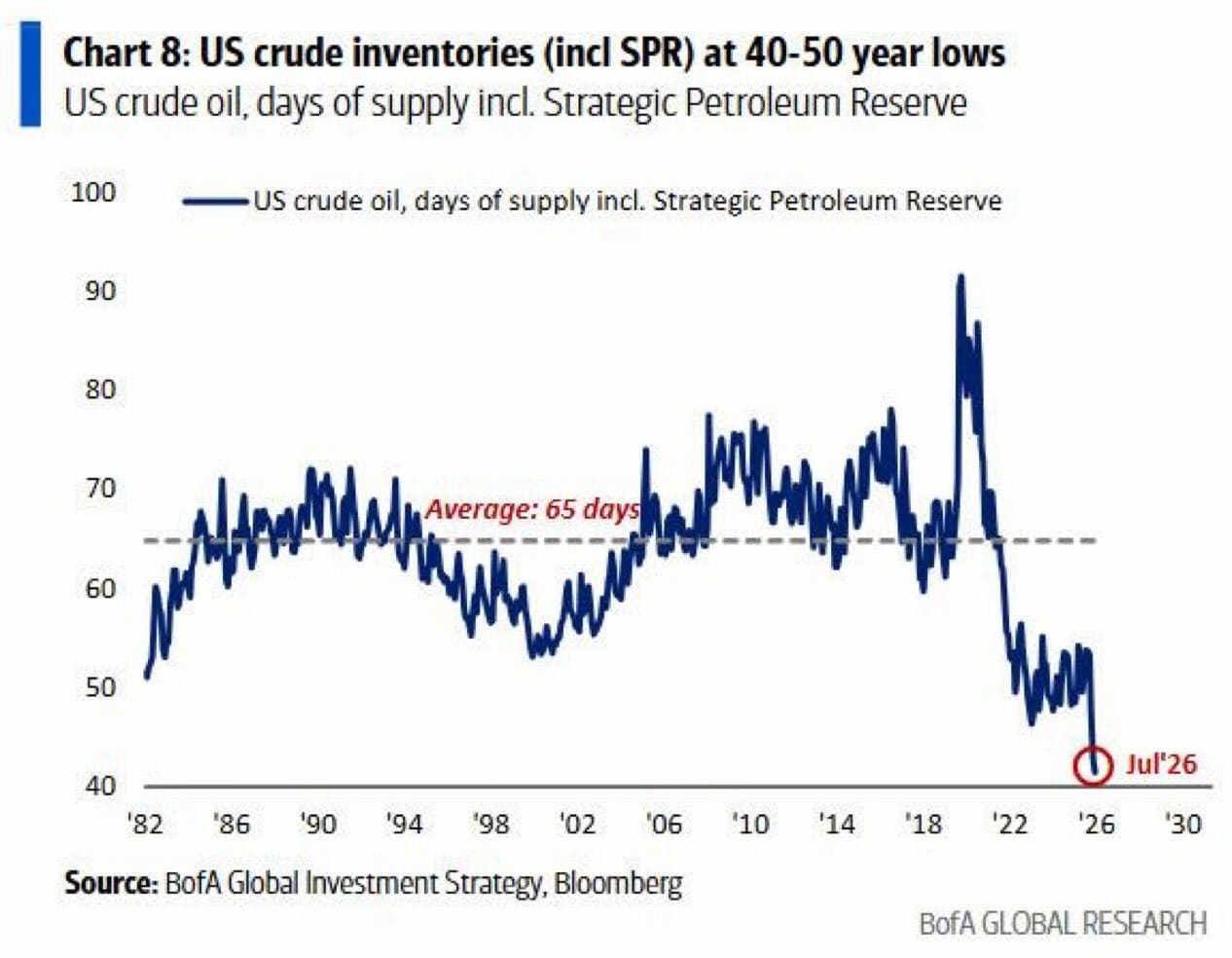
The situation surrounding the US Strategic Petroleum Reserve is becoming increasingly sensitive. Over the past week, the volume of crude held in the Strategic Petroleum Reserve (SPR) fell by a further 3.7 million barrels to 289.7 million barrels — its lowest level since 1982. The decline forms part of the previously agreed US release of 172 million barrels from the reserve.
Measured against total US oil consumption, the current 289.7 million barrels represent approximately two weeks of overall demand rather than 41 days. The “41 days of consumption” figure should therefore not be used without clarifying the methodology behind the calculation. Nevertheless, the broader conclusion remains unchanged: America’s strategic reserve is at its lowest level in more than four decades, while the scope for further large-scale intervention is gradually narrowing.
At the same time, the IEA is not currently considering a second release of oil from strategic reserves. IEA Executive Director Fatih Birol said that, following the decision taken in March, member countries had already released approximately 400 million barrels onto the market, while around 80% of their original reserves remain in storage. In other words, additional capacity is available, but the agency is not currently prepared to deploy it.
Against this backdrop, the behavior of oil itself is particularly noteworthy. Despite geopolitical tensions and restricted flows through the Strait of Hormuz, market sentiment remains predominantly bearish. On 25 August, Brent fell by around 3% to approximately $89.42 per barrel, while WTI declined to around $82.34. Investors currently appear to view additional US sanctions against Iran as less of a threat to physical supply than the prospect of renewed military escalation.
However, the geopolitical risk has not disappeared. Senior Iranian official Mohsen Rezaei warned that, if US economic pressure continues, no oil would be exported through the Strait of Hormuz or the Persian Gulf. He also warned of consequences for countries that join Washington’s economic pressure on Tehran.
This creates the market’s central contradiction. Oil prices are displaying bearish sentiment, while the physical side of the market remains potentially vulnerable. According to the IEA, global oil supply could decline by an average of 4.3 million barrels per day in 2026, with disruptions in the Middle East continuing to restrict the recovery in production. At the same time, the agency expects global demand to decline by 1.6 million barrels per day — and it is precisely this weakness in demand that is currently helping to offset the geopolitical risk premium.
The second important conclusion is that a low SPR level is not, in itself, a signal to buy oil. As long as the market remains confident that a physical shortage can be avoided and global demand remains weak, traders may continue to sell geopolitical price spikes. This is why strong statements from Tehran are currently generating a considerably smaller market reaction than might be expected under different conditions.
However, the lower strategic reserves fall, the more costly the next mistake becomes. In March, IEA member countries carried out a record intervention of 400 million barrels, of which the United States contributed 172 million. If another major supply shock requires further intervention, Washington will have considerably less flexibility to use the SPR without reducing inventories that are already at their lowest level since 1982.
Conclusion: oil remains bearish in terms of actual price behavior, but the fundamental risk is becoming increasingly asymmetric. As long as the Strait of Hormuz remains at least partially operational and the conflict does not cause another major disruption to physical supply, sellers retain the advantage. However, the combination of a low SPR, no new IEA release, Iranian threats and continuing difficulties around Hormuz means that any serious supply shock could change market sentiment very quickly — and today’s weakness in oil could prove to be merely the calm before a considerably sharper move.

Today Fundamental Analysis: Oil Breaks Above $102 as Middle East Tensions Continue to Escalate

Today Technical Analysis: Copper Approaches Record Highs on Surging Demand

Dollar struggles to gain ahead of US inflation data, yen extends rally
EBC Markets Briefing | Crude prices on solid footing amid deep supply concerns

The yen is strengthening before our very eyes

The Inflation Measure Keeping the Fed Cautious

US Yields Rise Despite Buybacks; Eyes on ECB Hike