-1162026812.png)
-1162026812.png)





SpaceX IPO: Great Company, Greater Expectations

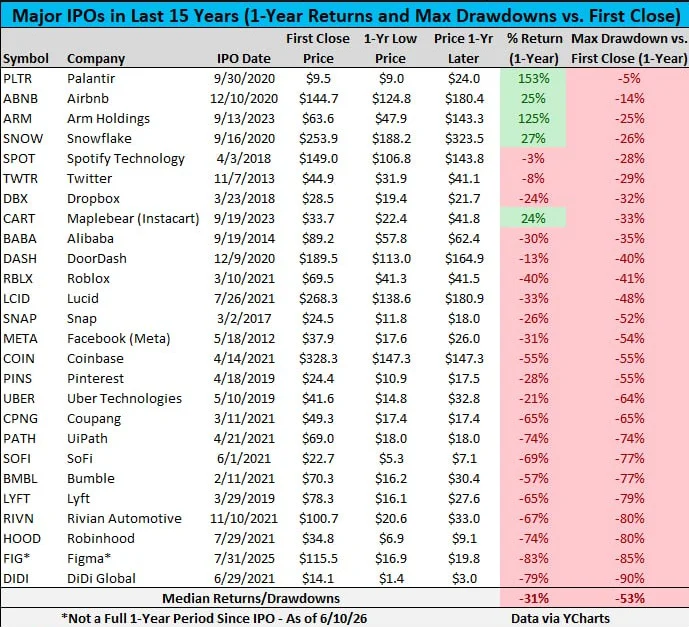
The excitement around the SpaceX IPO is overwhelming, yet the history of landmark market debuts offers a rather sobering lesson.
Even the most admired and innovative companies seldom provide investors with a smooth passage immediately after listing. Looking at the largest initial public offerings of the past fifteen years, the median first-year return stands at -31%, whilst the MDD (Median Maximum Drawdown) reaches 53%.
Palantir, Airbnb and ARM proved to be notable exceptions, but most headline-grabbing listings first demanded a considerable degree of patience from shareholders. More often than not, investors were buying excitement rather than earnings.
The crucial consideration is valuation. On the proposed terms, the market is prepared to pay approximately $95 for every dollar of SpaceX's annual revenue. By that measure, SpaceX would command a richer valuation than any constituent of the S&P 500. Even the likes of Nvidia, Palantir and Tesla appear comparatively restrained.
That is not to suggest that SpaceX is anything other than an exceptional business. Quite the contrary. The market is already valuing it as a future strategic infrastructure champion, spanning launch services, satellite communications, Starlink, defense contracts and orbital logistics. At such levels, however, investors are paying handsomely for what the company may become, rather than for what it is today.
This is precisely why the first principle of participating in a major flotation is to distinguish between a first-rate company and a first-rate investment. The two are by no means the same. When demand becomes overwhelming, the most optimistic assumptions are frequently reflected in the valuation before the opening bell has even rung, leaving the early weeks as a contest between momentum-driven enthusiasm and long-term conviction.
SpaceX may well prove to be one of the defining flotations of a generation, much as Apple was in 1980. Yet history suggests that the greatest opportunities often emerge after the initial excitement has subsided rather than at its height. For traders, heightened volatility offers opportunity; for long-term investors, patience has far more often proved the most valuable asset. In the City, there is an old saying: price is what you pay, value is what you eventually receive.

Today Fundamental Analysis: Oil Breaks Above $102 as Middle East Tensions Continue to Escalate
Today Technical Analysis: Copper Approaches Record Highs on Surging Demand
Dollar struggles to gain ahead of US inflation data, yen extends rally
EBC Markets Briefing | Crude prices on solid footing amid deep supply concerns

The yen is strengthening before our very eyes

The Inflation Measure Keeping the Fed Cautious
US Yields Rise Despite Buybacks; Eyes on ECB Hike