2276-682026843.jpg)
2216-682026843.jpg)





The Best Start in 23 Years: Dow Rockets into 2026

Wall Street’s 2026 debut has delivered a statement opening act. The Dow Jones Industrial Average surged 2.9% through the first three trading days of the year—its strongest start since 2003, when it gained 5.2% over the same period. On Tuesday, the blue-chip index closed above 49,000 for the first time on record, advancing 485 points to 49,462, while the S&P 500 also reached a fresh all-time high of 6,944. Trading volume was heavy in the U.S. markets yesterday, with 19.1 billion shares changing hands—exceeding the 20-session average of 15.9 billion. As American indices have delivered double-digit gains for three consecutive years, the question now is whether this explosive start signals sustainable strength or represents euphoria that could prove difficult to maintain for the rest of 2026.
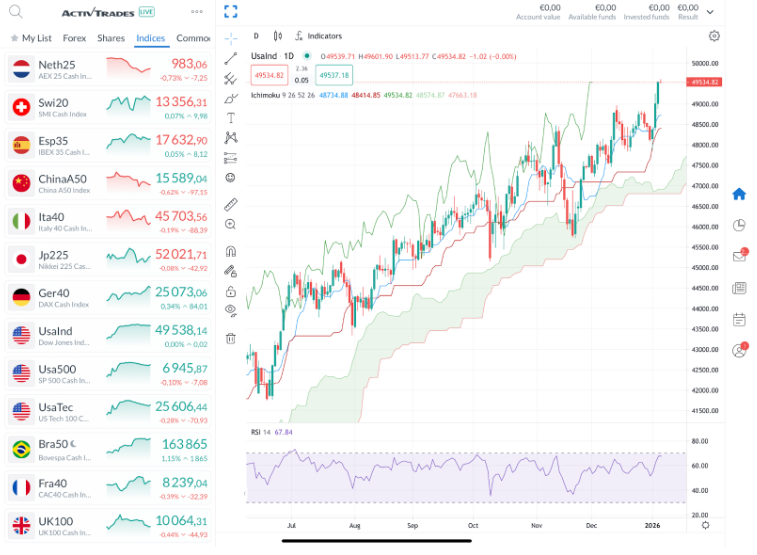
Daily Dow Jones Chart - Source: ActivTrader
What Could Be Fueling the Record-Breaking Rally of the U.S. Market?
The January Effect in Action
Seasonal patterns may be playing a supporting role. Since 1928, equities have finished January with gains more than 60% of the time, according to historical data from Dow Jones. The so-called "January effect" stems from several factors: investors completing tax-loss harvesting in December and repurchasing stocks in the new year, year-end bonuses being deployed into markets, and psychological factors as individuals follow through on New Year’s resolutions to begin investing programs.
Recent Geopolitical Developments Create Winners
The U.S. military intervention that removed Venezuelan leader Nicolás Maduro from power triggered gains in energy equities, as major oil producers positioned themselves for potential access to Venezuela’s considerable petroleum assets. President Trump pledged to unlock the country’s vast crude reserves—a significant opportunity given that Venezuela controls approximately 17% of global oil reserves according to the U.S. Energy Information Administration, despite currently producing only about 1% of worldwide output following years of underinvestment, sanctions, and naval blockade.
Defense contractors similarly benefited as market participants recalibrated expectations around geopolitical risk and government spending priorities. The decisive military action reinforced perceptions of an evolving global order that may necessitate expanded defense budgets and increased procurement activity.
What stands out is the market’s interpretation of these developments. Rather than triggering risk-aversion or volatility—typical responses to geopolitical upheaval—investors identified specific opportunities within affected sectors. This constructive reading of geopolitical events reflects the confidence characterizing current market psychology, a sentiment that might have seemed improbable during more cautious market environments.
AI Enthusiasm Reignites Technology Leadership
Some technology giants provided crucial support, with Amazon climbing more than 3% yesterday, while semiconductor stocks Micron and Palantir Technologies also posted strong gains, up 10% and 3% respectively. The CES 2026 technology conference in Las Vegas acted as a key catalyst, highlighted by Nvidia CEO Jensen Huang’s introduction of the company’s next-generation Vera Rubin AI superchip platform, followed by AMD CEO Lisa Su’s unveiling of the competing Helios system, alongside several other major announcements.
These announcements reinforced investor conviction that artificial intelligence remains in early stages of commercial deployment rather than approaching maturity. The AI infrastructure buildout continues at extraordinary scale, with estimates from Barclays suggesting that approximately 1% of U.S. economic growth in 2025 stemmed directly from spending on data centers, chips, power grids, and related AI capital expenditure. This represents one of the largest capital spending cycles in decades, even surpassing the telecom boom of the 1990s.
Broadening Participation Beyond Mega-Cap Tech
One particularly encouraging sign for market sustainability is the broadening of leadership beyond the technology giants that dominated recent years. Healthcare and materials stocks ranked among the top performers yesterday, while several members of the "Magnificent Seven" technology companies actually underperformed the broader market. The small-cap Russell 2000 index posted especially strong gains, up almost 3% in the first 2 days of this week after 3 weeks down, suggesting investors could be rotating into segments beyond the mega-caps. Narrow market leadership concentrated in a handful of stocks eventually becomes fragile. Broader participation across sectors and market capitalizations typically characterizes more durable bull markets.
3 Factors That Could Sustain the Rally Through 2026
1. Robust Corporate Earnings Growth Momentum
Corporate profit growth remains the fundamental engine supporting equity valuations. FactSet projects the S&P 500 will deliver 15.0% year-over-year earnings growth in 2026—marking the third consecutive year of double-digit expansion and the sixth straight year of positive earnings growth.
This 15% forecast significantly exceeds the 10-year average annual growth rate of 8.6% from 2015 to 2024. Interestingly, only two of the top five contributors to projected 2026 earnings growth are among the "Magnificent Seven" companies: NVIDIA and Meta Platforms. This diversification suggests the earnings story extends well beyond mega-cap technology, reducing concentration risk that has characterized recent market gains.
2. Potential for Accommodative Monetary Policy
After lowering rates three times in 2025 to a range of 3.5%–3.75%, the Federal Reserve has signaled caution about further cuts, with officials currently penciling in just one reduction for 2026. However, market participants believe that continued inflation deceleration combined with labor market softening could prompt more aggressive easing later in the year.
Leadership transition at the Fed adds another layer of complexity and opportunity. Fed Chair Jerome Powell’s term as central bank chief ends in May, and his successor could adopt a more accommodative stance. Additionally, divergence among Fed officials suggests policy could shift more dovish or more hawkish than current guidance indicates. For instance, Federal Reserve Governor Stephen Miran stated this week that aggressive rate cuts might be needed this year to sustain economic momentum.
3. AI’s Expanding Economic Footprint
Artificial intelligence has evolved from a speculative theme into a tangible economic driver with measurable impact across sectors. The infrastructure buildout surrounding AI is generating substantial spillover effects: construction workers erecting data centers, power industry employees installing grid capacity, and equipment manufacturers supplying specialized components all participate in this investment wave.
Estimates suggest AI-related capital expenditure contributed approximately 1% to U.S. GDP growth in 2025, representing one of the largest investment cycles in decades. Beyond direct spending, AI-linked equity gains have created wealth effects for investors, helping consumers navigate trade uncertainty, elevated interest rates, and housing market stagnation. Vanguard specifically highlights AI as standing apart from other megatrends due to its capacity to fundamentally transform labor markets and drive productivity improvements—effects that could push GDP growth above consensus forecasts.
The technology itself is also maturing in economically significant ways. We appear to be transitioning from the "Generative AI" era of 2023-2024—focused on content creation and chatbots—into what analysts term the "Agentic and Physical AI" phase. These next-generation systems don’t merely generate text, images or other content; they can actively manage supply chains, optimize power distribution, control autonomous vehicles, and execute complex operational tasks. This evolution from novelty to mission-critical infrastructure provides fresh justification for technology sector valuations and suggests the AI investment cycle has substantial runway remaining.
Risks That Could Derail the Momentum in 2026
Despite the optimistic opening, prudent investors should remain attentive to potential headwinds. The market’s strong performance has set expectations exceptionally high, leaving little margin for disappointment. Unexpected weakness in employment data, less impressive corporate earnings than anticipated, or signs that AI momentum is decelerating could quickly shift sentiment. Additionally, valuation levels across many segments appear stretched. Three consecutive years of double-digit gains have left stocks priced for near-perfection. If economic growth proves less resilient than expected, or if geopolitical tensions escalate, corrections could prove sharp.
The early success of 2026 demonstrates that investor appetite for risk remains robust, supported by genuine economic and technological developments rather than mere speculation. Whether this translates into sustained gains throughout the year will depend on whether corporate fundamentals can justify elevated valuations—and whether the economic backdrop remains supportive as monetary and fiscal conditions evolve. For now, momentum clearly favors the bulls, but the historic start also raises the bar for what comes next.
Sources: CNBC, Wall Street Journal, Reuters, Bloomberg, Yahoo Finance, Barclays, Euronews, PBS, CNN, Vanguard
The information provided does not constitute investment research. The material has not been prepared in accordance with the legal requirements designed to promote the independence of investment research and as such is to be considered to be a marketing communication.
All information has been prepared by ActivTrades (“AT”). The information does not contain a record of AT’s prices, or an offer of or solicitation for a transaction in any financial instrument. No representation or warranty is given as to the accuracy or completeness of this information.
Any material provided does not have regard to the specific investment objective and financial situation of any person who may receive it. Past performance is not a reliable indicator of future performance. AT provides an execution-only service. Consequently, any person acting on the information provided does so at their own risk. Forecasts are not guarantees. Rates may change. Political risk is unpredictable. Central bank actions may vary. Platforms’ tools do not guarantee success.

Today Fundamental Analysis: Oil Breaks Above $102 as Middle East Tensions Continue to Escalate

Today Technical Analysis: Copper Approaches Record Highs on Surging Demand

Dollar struggles to gain ahead of US inflation data, yen extends rally

EBC Markets Briefing | Crude prices on solid footing amid deep supply concerns

The yen is strengthening before our very eyes

The Inflation Measure Keeping the Fed Cautious

US Yields Rise Despite Buybacks; Eyes on ECB Hike