-1162026812.png)
-1162026812.png)





The S&P 500: Is the Next Leg Higher Already Taking Shape? 🚀

The S&P 500 may still be firmly within a long-term bull market.
The reasoning is straightforward: prolonged periods of consolidation have historically been followed by fresh multi-year advances. If the current cycle proves comparable to previous ones, the trajectory could still allow the S&P 500 to reach 10,000 by the end of the decade.
Back in 2013, when the S&P 500 was trading at around 1,500, the prospect of 4,000 seemed just as far-fetched.
Historically, the period from May to October during US midterm election years has been one of the weakest stretches for the index. Since 1962, it has finished this period lower in 15 out of 16 cycles. In several cases, those declines developed into full-blown bear markets. The only notable exception came in 1982, when it rallied 17% following the Fed's policy pivot and the beginning of a new long-term bull market.
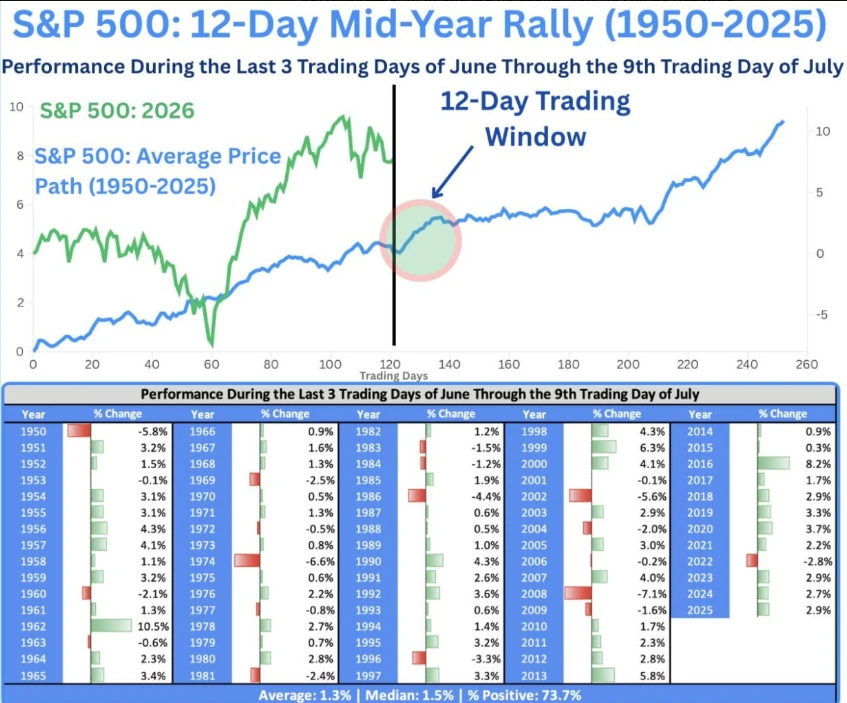
Meanwhile, last Friday marked the start of a 12-day seasonal window for the S&P 500, covering the final three trading days of June through to the ninth trading day of July.
Since 1950, the index has delivered positive returns during this period 73.7% of the time, with a median gain of 1.5%. Since 2010, this seasonal window has ended in negative territory only once.
Seasonality alone does not guarantee stronger markets, but the historical record suggests this has consistently been one of the most favorable periods for US equities.
That said, the market now finds itself at an important crossroads, where supportive seasonal trends are colliding with significant macroeconomic risks. Investors are looking ahead to key economic releases and central bank developments, either of which could quickly reshape market sentiment.
The coming weeks may therefore prove pivotal for the direction of markets in the second half of the year. If economic data continue to point to resilience and corporate earnings remain supportive, the broader uptrend could stay firmly intact despite the historically weaker backdrop associated with midterm election years.
Ultimately, seasonality should be viewed as a useful guide rather than a forecasting tool. History often rhymes, but it is the interaction between economic fundamentals, Federal Reserve policy and investor sentiment that will determine whether the current consolidation becomes the foundation for the next leg higher.

Today Fundamental Analysis: Oil Breaks Above $102 as Middle East Tensions Continue to Escalate

Today Technical Analysis: Copper Approaches Record Highs on Surging Demand

Dollar struggles to gain ahead of US inflation data, yen extends rally

EBC Markets Briefing | Crude prices on solid footing amid deep supply concerns

The yen is strengthening before our very eyes

The Inflation Measure Keeping the Fed Cautious

US Yields Rise Despite Buybacks; Eyes on ECB Hike