





U.S. 2-Year Yield Holds Key Level Before Payrolls

Executive Summary
- The U.S. 2-year yield is trading near 4.18%, holding above the 61.8% retracement at 4.173%.
- Fed Chair Kevin Warsh avoided giving direct rate guidance, briefly reducing aggressive hike pricing.
- Today’s NFP report is the main catalyst for the front end of the Treasury curve.
- A break above 4.20% would revive upside pressure, while a move below 4.153% would weaken the bullish yield setup.
Market Overview
The U.S. 2-year yield enters July 2 in a holding pattern before the June payrolls report. This part of the curve is the market’s cleanest proxy for Federal Reserve expectations, so today’s jobs data can quickly reset pricing for July, September, and year-end policy risk.
The latest macro setup is finely balanced. Strong May payrolls revived the Fed-hike debate, and markets have been pricing at least one rate increase by autumn, with some probability of a second move by year-end. However, Warsh’s latest communication reduced the sense of urgency. He avoided giving a policy promise and emphasized that decisions will be made when policymakers meet behind closed doors. That matters because the market had been leaning into a hawkish Fed repricing, and his refusal to validate near-term hike timing allowed yields to pull back from the 4.20% area.
The transmission channel is direct; payrolls shape Fed expectations, Fed expectations drive the 2-year yield, and the 2-year yield transmits into the dollar, gold, equity valuations, and high-beta assets.
Fundamental Outlook
The front end of the Treasury curve has shifted away from recession hedging toward pricing policy uncertainty. As a result, the 2-year yield now reacts sharply to data that signals persistent demand, firm wages, or limited labor market cooling.
June payrolls are expected to rise by around 110,000 following May’s 172,000 increase, with unemployment near 4.3%. While that suggests moderation, the Fed’s focus extends beyond the headline. Wage growth, participation, and the composition of hiring - especially in cyclical or service-driven sectors - will shape the policy interpretation.
A stronger-than-expected report, particularly with wage growth near or above 3.5% year-on-year, would reinforce expectations that policy must remain restrictive. In that case, the 2-year yield could revisit 4.20% and potentially extend toward 4.236%, reflecting sustained income growth and ongoing inflation pressure. This outcome would likely support the dollar while weighing on gold and rate-sensitive equities.
On the other hand, a weaker payrolls figure would only drive yields lower if accompanied by broader signs of cooling, such as softer wages or rising unemployment. A simple miss in job creation without easing wage pressure would limit downside in yields, as inflation concerns would persist. A more decisive decline in yields would require job growth well below 100,000 alongside clear signs of reduced labor demand.
Recent data offer a mixed picture. ADP payrolls slowed to 98,000, hinting at softer hiring momentum, while JOLTS showed elevated job openings and low layoffs. This suggests a labor market that is stable but not expanding aggressively, leaving the Fed without clear evidence of slack.
The June FOMC statement maintained that economic activity remains solid and inflation elevated, reinforcing a cautious stance. This creates an asymmetric response: strong data can quickly revive tightening expectations, while modest weakness may not be enough to shift policy outlooks.
Market implications follow this dynamic. Firm payrolls and wages would keep the 2-year yield above 4.173%, with scope toward 4.20%-4.236%, supporting the dollar and pressuring risk assets. Conversely, softer data could push yields toward 4.153% and 4.133%, with a move to 4.109% requiring broader disinflation signals.
Overall, the outlook remains conditional. The 2-year yield is anchored by stable labor conditions and persistent inflation, with direction hinging on whether incoming data confirms resilience or signals a more meaningful slowdown.
Technical Analysis
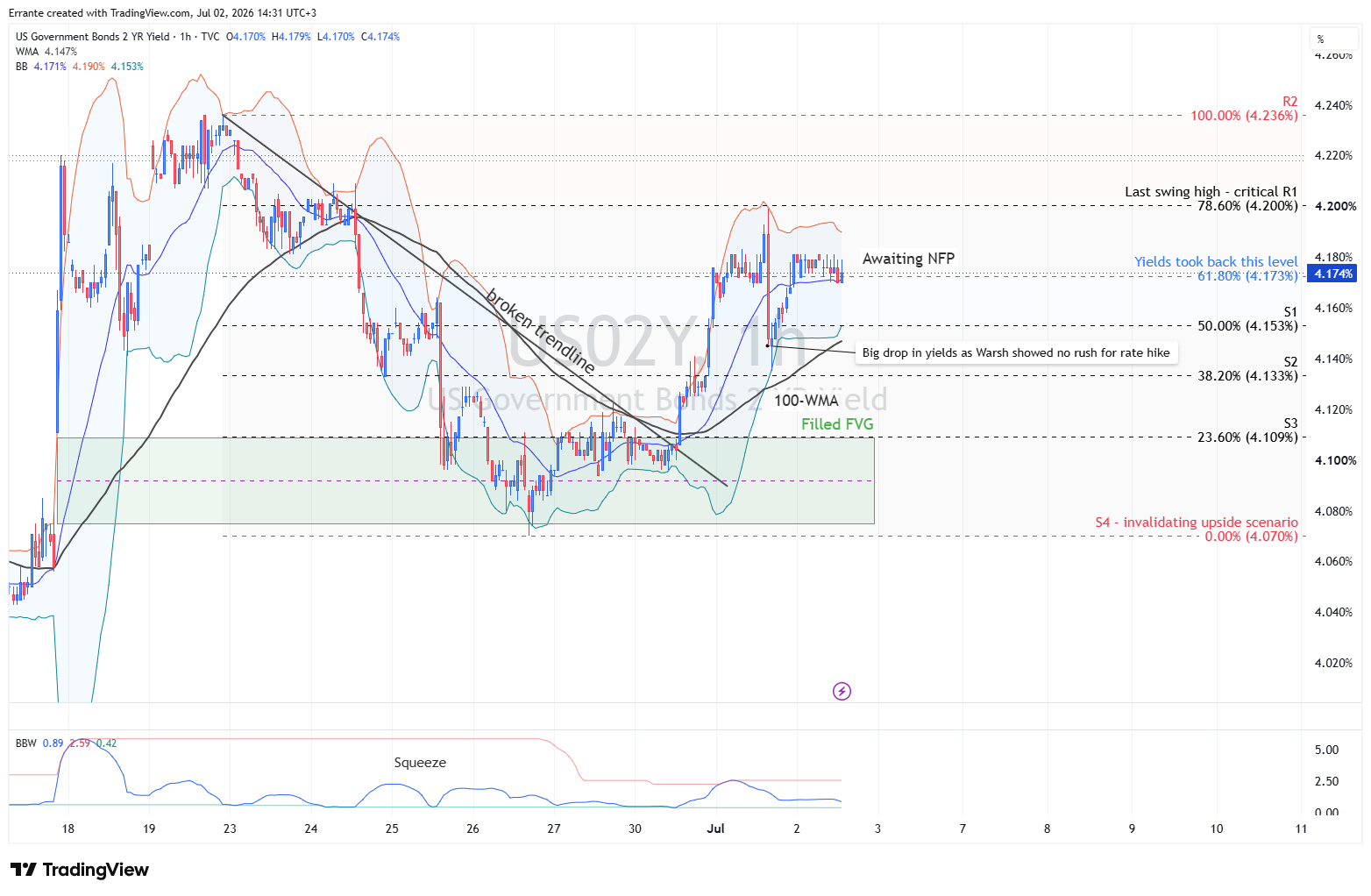
The 1-hour chart shows that the U.S. 2-year yield has broken above the prior descending trendline and reclaimed the 61.8% retracement at 4.173%. That is the most important short-term technical point. After a sharp drop linked to Warsh’s less hawkish tone, yields recovered this level and are now consolidating around 4.179%.
The structure is constructive but not confirmed as a new impulse leg. The recovery from the 4.07% area created a higher-low sequence, and price is holding above the 100-WMA, which now acts as dynamic support. However, yields are still below the last swing high near 4.20%, which remains the critical resistance.
The Fibonacci map defines the trade zone clearly. Immediate support sits at 4.173%, followed by 4.153%, 4.133%, and 4.109%. The deeper invalidation level is 4.070%. On the upside, the first major resistance is 4.20%, the 78.6% retracement and last swing high. A break above that level would expose 4.236%, the 100% extension.
Bollinger Bands show compression, and the BBW panel confirms a squeeze. This means the market is waiting for a catalyst rather than trending cleanly. Payrolls are the obvious trigger for the next volatility expansion.
Momentum is neutral-to-constructive. The yield has recovered from the Warsh-driven pullback, but it has not yet broken the 4.20% ceiling. That makes the current setup conditional: bullish above 4.173%, but confirmed only above 4.20%.
Key Levels
- Immediate support: 4.173%
- Next support: 4.153%
- Deeper supports: 4.133% and 4.109%
- Invalidation support: 4.070%
- Immediate resistance: 4.20%
- Breakout resistance: 4.236%
Main Scenario:
The 2-year yield remains constructive while holding above 4.173%. A strong payrolls report could drive a retest of 4.20%. A sustained break above 4.20% would confirm upside continuation toward 4.236%.
Alternative Scenario:If payrolls disappoint or wage growth softens, yields may lose 4.173% and rotate toward 4.153%. A break below 4.153% would shift the market back into a defensive consolidation phase.
Invalidation Signal:The upside yield scenario would be invalidated by a sustained move below 4.070%. That would erase the post-breakout recovery and signal that markets are no longer pricing a credible near-term Fed tightening path.
Trading TakeawaysThe 2-year yield is at a clean pre-NFP decision point. The chart is constructive above 4.173%, but the real confirmation is 4.20%.
Traders should avoid overreacting to the first payrolls candle. The better signal is whether yields hold above or below 4.173% after the initial volatility. Above 4.20%, the dollar-rate trade strengthens. Below 4.153%, the market starts pricing a less hawkish Fed path.
ConclusionThe U.S. 2-year yield has recovered from Warsh’s less hawkish tone, but it still needs payroll confirmation. Above 4.20%, the front end can reprice toward tighter Fed policy. Below 4.153%, the rally in yields begins to lose conviction.


USD/JPY: The Dollar Still Owns the Carry, but Japan Is Starting to Push Back

Gold: Oversold rebound before bears strike again?

Fragile risk appetite as investors prepare for a crucial week

The crypto market is drifting down

The US Midterms Are the Next Test for Gold, the Dollar and Stocks

Five Central Banks Set to Shape Market Sentiment This Week

Week Ahead: Fed Decision, GDP and PCE Inflation Put Dollar, Gold and S&P 500 in Focus