



US NFP Sparks Hawkish December Fed Expectations

The Federal Reserve’s policy stance has become more hawkish following the release of the latest delayed Nonfarm Payroll (NFP) data. Global markets reacted sharply, with U.S. equities declining, especially in the tech sector, which saw the biggest sell-off. Cryptocurrencies also plummeted, reflecting rising risk aversion amid concerns over tighter monetary policy.
Investor sentiment is tense as markets reassess the potential for further Fed rate cuts and their impact on growth-sensitive assets. The NFP data has increased uncertainty, forcing traders to weigh slowing growth against ongoing inflation pressures.
In this analysis, we break down the latest FOMC meeting, explore how the NFP data has shifted market expectations, and discuss what it means for global markets in the coming weeks.
Insights from the Latest FOMC Minutes
The October FOMC meeting minutes revealed that the Committee lowered the federal funds rate target range by 25 basis points to 4.00%–4.25%, signalling a slight shift toward a more accommodative stance. However, the accompanying commentary and forward guidance remained cautiously hawkish.
Key Highlights
- Rate Cut: A 25 bps reduction, framed as a “risk-management” move, not due to economic weakness.
- Economic Activity: Growth has slowed in the first half of the year, with job gains moderating.
- Labour Market: The Fed noted higher downside risks to employment.
- Inflation: Price pressures remain elevated, with signs of re-acceleration.
- Forward Guidance: Policy will remain data-dependent, with no preset path of cuts.
The Fed's actions reflect a delicate balancing act: easing financial conditions to support a softening labour market while staying vigilant against persistent inflation. Some officials have expressed concerns that inflation progress has stalled, even though hiring demand has eased but not collapsed.
In short, the Fed faces a tricky dilemma: rate cuts might offer limited support to a moderately soft labour market, while also risking a rebound in inflation.
NFP Deepens Hawkish Tone in Fed Policy Outlook
Before the NFP release, markets had already been dialling back expectations for a December rate cut. Following the FOMC minutes and hawkish remarks from several Fed officials, investor sentiment shifted toward caution.
CME FedWatch tools showed that the probability of a December rate cut had dropped to 40%, down from 98.8% a month ago. After the NFP report, these odds decreased further to 35.4%, reflecting the strong labour market data.
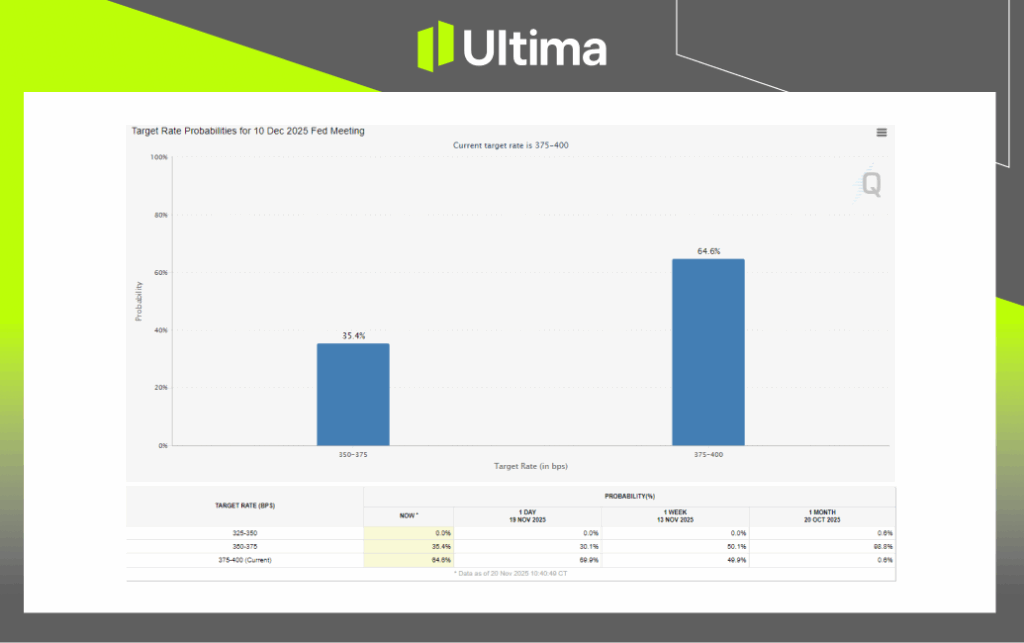
December Rate Probabilities | Source: CME Group
Nonfarm Payrolls Data Highlights
- Jobs Added: The US economy added 119,000 jobs in September, far surpassing the consensus forecast of 50,000, highlighting ongoing labour market strength.
- Unemployment Rate: Unexpectedly rose to 4.4%, indicating some softening in labour force participation.
- Revisions: Previous months' figures were revised downward, reinforcing the gradual cooling trend highlighted by the Fed.
Despite the slight uptick in unemployment, the strong payroll growth, along with the Fed’s hawkish stance, has significantly lowered expectations for a rate cut before Christmas. The data suggests the Fed has little immediate reason to speed up easing, leaving markets uncertain about the policy direction as the year ends.
Market Response: Dollar Rises, Equities Fall
Following the NFP release, the US dollar surged as markets adjusted their expectations for the Fed, reducing the chances of a December rate cut. Equities dropped, with major indexes falling and technology stocks underperforming due to their sensitivity to interest rate expectations.
Meanwhile, cryptocurrencies saw significant losses as investors moved away from high-risk assets toward safer positions.
The overall impact underscores a market increasingly sensitive to Fed signals and economic data, with traders closely tracking labour and inflation indicators for hints on the central bank’s next policy move.
What’s Next for the US Stock Market?
With interest rates expected to remain "higher-for-longer," equities are under pressure. But what’s driving this now, despite prolonged high rates? The added strain comes from concerns over AI and tech sector overvaluation.
Recent market sentiment has been focused on the AI/tech sector, with the US stock market seeing a strong rally since the March sell-off during the trade war escalation. However, with elevated rate expectations, growing concerns about AI/tech valuations, and a broad risk-asset sell-off, selling pressure has intensified. This points to one conclusion: US equities may be entering a corrective phase.
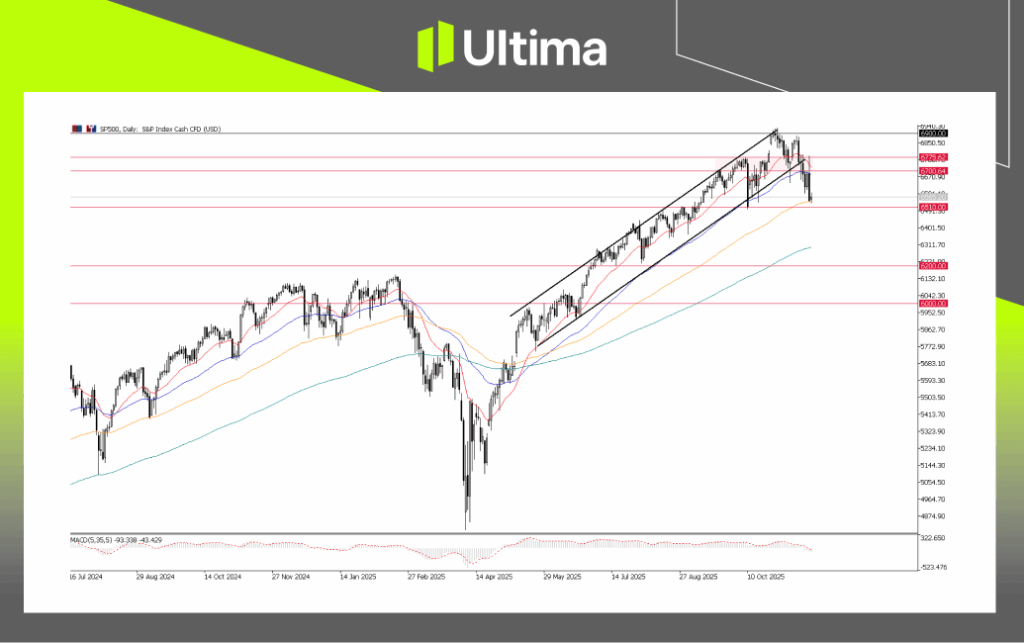
S&P500, Daily Chart | Source: Ultima Market MT5
This is reflected in the S&P 500’s technical outlook, where the near seven-month uptrend channel seems to have broken, signalling a potential correction. Given the current market environment and technical analysis, the S&P 500 and broader US stock market are likely in a corrective phase.
Is this a bearish market? Not yet. But further uncertainty or worsening data in the coming weeks could continue to weigh on risk assets.
Increased Uncertainty Surrounding the Fed, US Economy, and Equities
The latest FOMC minutes, combined with the strong NFP report, have heightened concerns about the Fed’s policy outlook, adding hawkish pressure and diminishing the chances of a pre-Christmas rate cut. The data point to a US economy with a resilient labour market, yet showing signs of gradual cooling, creating a tricky balancing act for policymakers.
Meanwhile, the US stock market faces increasing pressure, with high interest rate expectations, AI/tech valuation concerns, and a broader risk-off sentiment suggesting a potential corrective phase.
Market participants remain on edge, closely monitoring upcoming economic data to determine if the Fed will stay on its current path or adopt a more aggressive stance.
Key Market Implications for End of 2025:
- US Dollar: Likely to maintain bullish momentum as reduced expectations for immediate Fed cuts support the currency.
- Gold: While safe-haven demand remains due to heightened risk sentiment, higher yield expectations may prevent gold from being the go-to choice for capital inflows.
- Cryptocurrency: As a highly sensitive risk asset, crypto could continue to face pressure. Historically, recoveries after sharp sell-offs take time, indicating that crypto markets may remain under strain before fully rebounding from the current bear phase.
Conclusion
To stay ahead in a market shaped by shifting Fed expectations, evolving economic signals, and fast-moving risk sentiment, traders need clarity and consistent learning. Join Ultima Markets to explore deeper insights on global market trends, and visit our UM Academy to sharpen your trading knowledge with practical, easy-to-understand resources.
Disclaimer
Comments, news, research, analysis, price, and all information contained in the article only serve as general information for readers and do not suggest any advice. Ultima Markets has taken reasonable measures to provide up-to-date information, but cannot guarantee accuracy, and may modify without notice. Ultima Markets will not be responsible for any loss incurred due to the application of the information provided.


Brent has soared above $100. Is this just the beginning?
Today Fundamental Analysis: Brent Holds Around $100 Amid Fresh US-Iran Escalations

S&P 500 Stepped From Record Highs, but Market Breadth Is Flashing a Warning 💥

Bitcoin: the golden cross signals an uptrend, but not right away

US Inflation Data and Elevated Asset Valuations — Nasdaq, S&P 500 and Gold

China50 Tests 14,600 Resistance as Investors Await Inflation Data

Dollar slips, yen surges as Middle East tensions escalate