-1162026812.png)
-1162026812.png)





WALL STREET'S LEVERAGE BOOM: HOW MUCH LONGER CAN IT LAST?

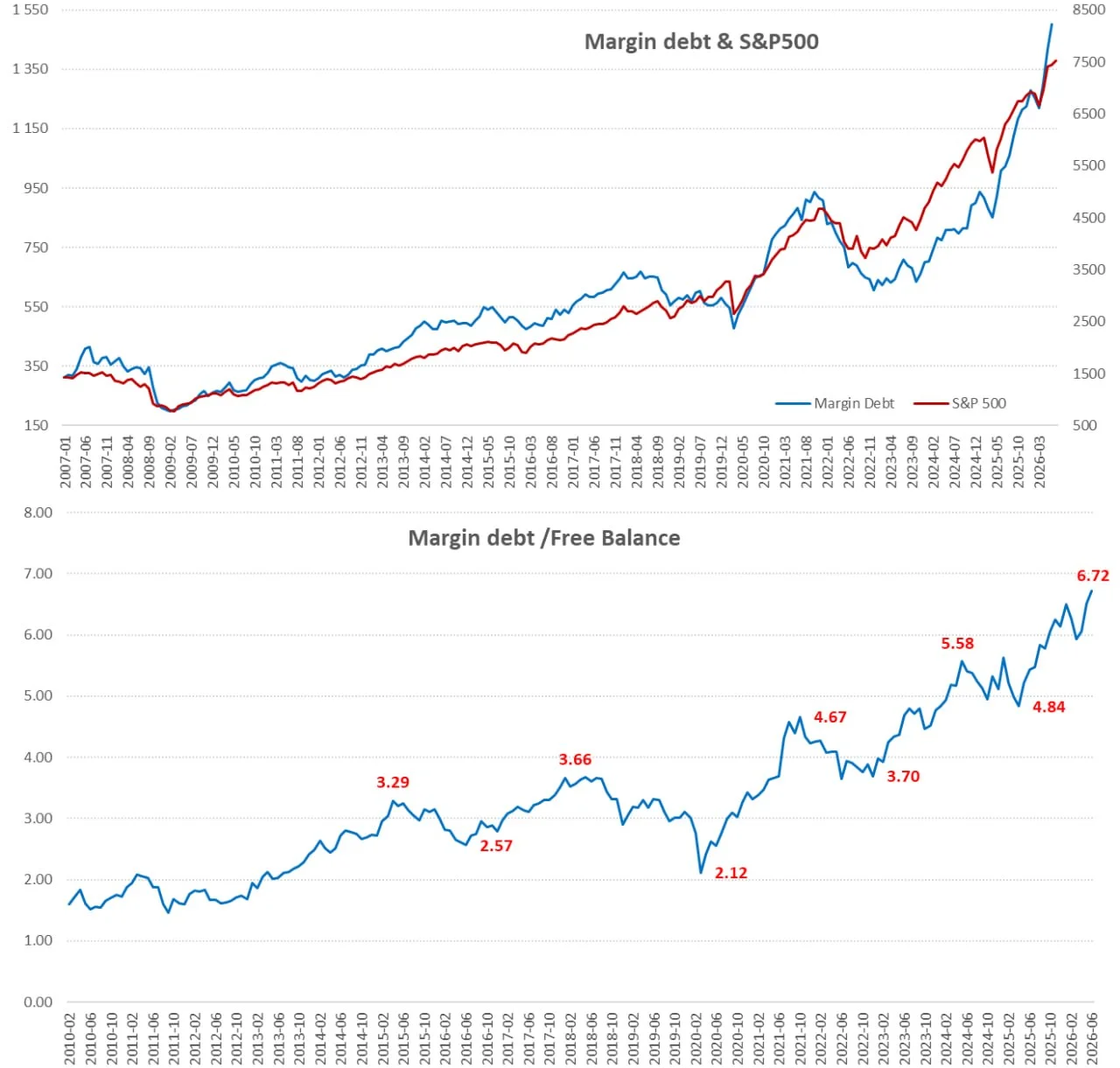
US investors are increasing their exposure to equities at an unprecedented pace through the use of leverage. Margin debt rose to a fresh record of $1.5 trillion in June, up $87 billion over the month, extending an already aggressive build-up in speculative positioning. The latest leg higher was helped by the highly anticipated SpaceX IPO, which fueled risk appetite and encouraged investors to add further exposure despite already elevated valuations.
More importantly, cash balances held in margin accounts increased only marginally over the same period. As a result, the ratio of margin debt to available cash climbed to a record 6.72, indicating that investors are operating with the highest level of leverage ever recorded. In practical terms, this means that a growing share of market exposure is being financed with borrowed money rather than fresh capital, leaving investors increasingly sensitive to any deterioration in market conditions.
The backdrop in May was considerably more supportive. Alongside rising margin debt, US equities benefited from almost $135 billion of foreign inflows, while corporate buyback programs continued to provide a powerful source of demand. Those factors created a favorable liquidity environment and helped absorb higher levels of leverage without placing excessive strain on market valuations.
June, however, tells a rather different story. Although margin debt continued to rise sharply, US equity indices failed to deliver a comparable advance. That divergence deserves close attention. If leverage continues to increase while prices struggle to move materially higher, it may suggest that the market is becoming increasingly crowded and that incremental buying power is generating progressively weaker returns. In other words, more capital is required simply to maintain existing valuations.
This is often one of the defining characteristics of mature bull markets. During the earlier stages of a rally, fresh liquidity tends to translate into broad-based gains across risk assets. Later in the cycle, however, market participants are forced to deploy increasingly larger amounts of capital merely to sustain momentum. The marginal efficiency of new money begins to decline, while valuations become more dependent on continued inflows than on improving fundamentals.
Should investor sentiment deteriorate, margin calls may force leveraged participants to reduce exposure rapidly, creating a self-reinforcing cycle of selling pressure. History has repeatedly demonstrated that periods of exceptionally high leverage rarely cause market declines on their own, but they often amplify corrections once they begin.
Several potential catalysts are already emerging. The renewed escalation in the Middle East has increased geopolitical uncertainty, while expectations that Kevin Warsh could maintain a firmer monetary policy stance have prompted investors to reassess the outlook for interest rates. Higher yields, tighter financial conditions or weaker-than-expected macroeconomic data would all represent additional headwinds for an equity market that is already heavily reliant on leverage.
At the same time, the bullish case should not be dismissed. Corporate earnings remain broadly resilient, share buyback programs continue to provide structural demand, and enthusiasm surrounding artificial intelligence has yet to fade. These factors continue to underpin market confidence and help explain why investors remain willing to increase risk exposure despite increasingly stretched positioning.
The key issue is therefore not whether the market is fundamentally weak, but whether the balance between risk and reward is becoming less favorable. The combination of record leverage, slowing marginal returns from borrowed capital, softer liquidity support and rising geopolitical uncertainty suggests that the market is entering a phase in which volatility is likely to increase. Investors may continue to push indices higher in the near term, but doing so will require progressively stronger catalysts and an uninterrupted flow of positive news.
For now, Wall Street remains supported by liquidity, corporate fundamentals and investor optimism. However, history suggests that when leverage reaches unprecedented levels, the market's tolerance for disappointment declines sharply. The coming weeks are therefore likely to provide an important test of whether this bull market still has sufficient underlying strength—or whether the growing weight of leverage is beginning to outweigh the forces that have driven equities higher over the past year.

Today Fundamental Analysis: Oil Breaks Above $102 as Middle East Tensions Continue to Escalate

Today Technical Analysis: Copper Approaches Record Highs on Surging Demand

Dollar struggles to gain ahead of US inflation data, yen extends rally

EBC Markets Briefing | Crude prices on solid footing amid deep supply concerns

The yen is strengthening before our very eyes

The Inflation Measure Keeping the Fed Cautious

US Yields Rise Despite Buybacks; Eyes on ECB Hike