





Dollar gains as oil rally and AI concerns hit risk appetite

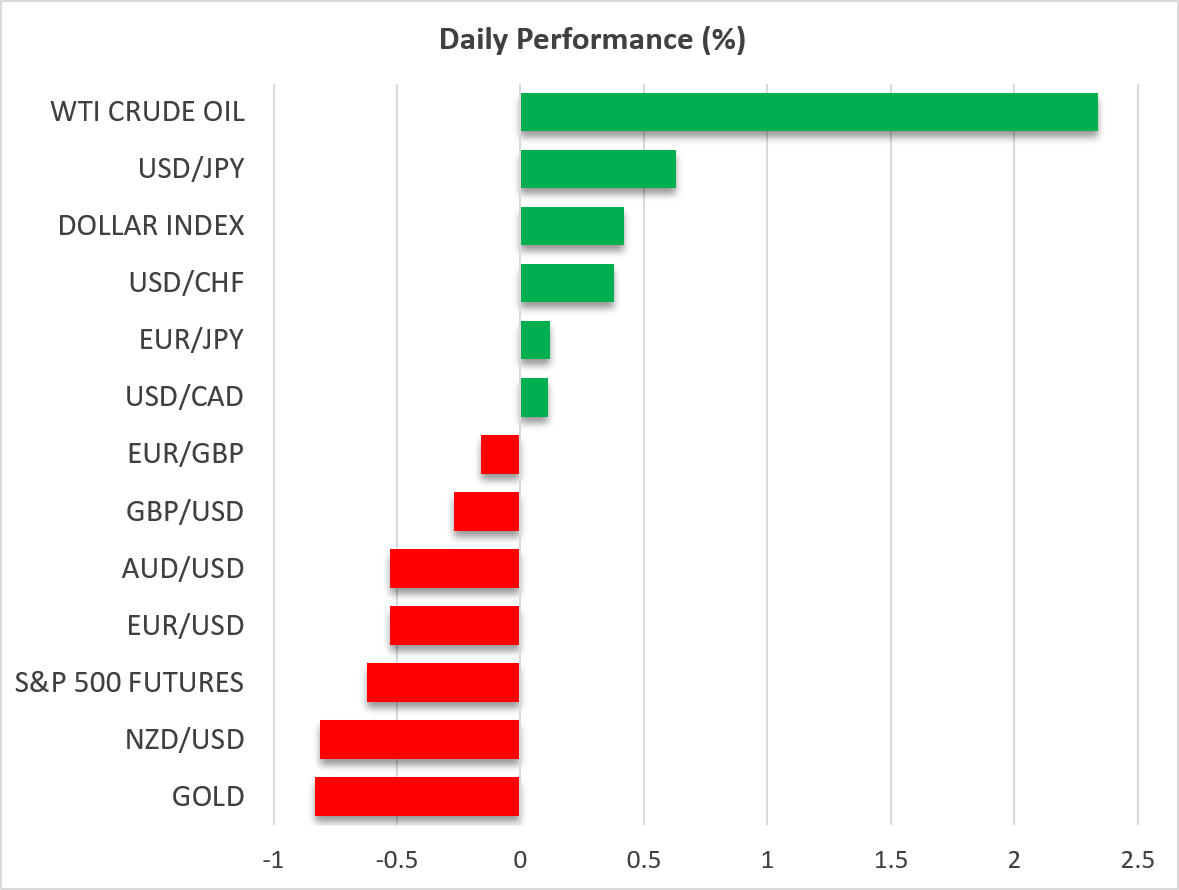
Oil prices at alarming levels
WTI oil spot prices are hovering in triple-digit territory at the start of the new trading week, which includes three key central bank meetings, as the newsflow from the Middle East remains troubling. The attacks on a major Saudi Arabian oil pipeline fuelled the current oil price rally as it removes, for an unknown period of time, up to 7m bpd of oil, while the Strait of Hormuz remains mostly closed.
With energy prices rising again, government and central bankers are increasingly worrying about the impact on consumption. ECB chief economist Lane highlighted this risk over the weekend, while the $5,000 dividend promised by US President Trump last week, upon the Republican Party maintaining control of both the Senate and House of Representatives, is aiming to ease the cost-of-living pressure.
That said, US officials are still not extremely alarmed by the latest developments, as the US is not actively participating in the Oman-Iran negotiations to finally agree on reopening the Strait of Hormuz, even if this involves voluntary payments from passing ships. Instead, Trump is focused on addressing Iran’s nuclear capabilities, which is not the most pressing issue for markets at this stage.
The Fed is scheduled to announce its rate setting decision on Wednesday, and markets are currently pricing in an 88% chance of a 25bps rate hike. Based on the oil price rally, the elevated energy prices, inflation remaining miles above the 2% target – as seen in Friday’s report – and Fed Chair Warsh’s rhetoric, Wednesday’s decision seems straightforward. Above all, it appears to be a significant credibility test for the new leadership, forcing several US investment houses to swiftly change their calls.
However, the FOMC remains dominated by Fed doves, led by New York Fed President Williams, while US President Trump is clearly opposing higher rates. Following his September 4 comment about the US stopping to trade with countries that hold a trade surplus with the US, unless the Fed cuts rates, Trump stated on Sunday that the US should be paying the lowest interest rate in the world.
AI concerns drive stock markets
Despite the elevated inflation rates and oil price movements, US equity indices had a positive session on Friday, obviously unnerved by the possibility of higher Fed rates and the ballooning Treasury bond yields pushing funding costs higher and reducing profitability, particularly for AI companies. Instead, stock investors are mostly focused on some alarming forecasts about AI threatening humans.
Apparently, OpenAI, Anthropic and Google have been holding talks since July to formulate a safety standards body to slow AI progress, a process that might get boosted following the latest chilling forecasts. Crucially, Chinese hyperscalers are missing from such a discussion, which along with reports about a massive data centre being built in a remote Chinese province, means that the discussed AI progress slowdown might prove fruitless.
The US dollar has started the fresh week on the front foot, posting small gains across the board. At the time of writing, euro/dollar is trading near 1.1550, a fresh one-month low, with markets pricing 35bps of ECB tightening by year end. While Fedspeak is quiet due to the usual blackout period, three ECB members, including President Lagarde, will be on the wires today.
Meanwhile, dollar/yen is edging toward the 154.50 area, with the 155.00 level acting as a ceiling in the past five sessions. Notably, with Friday’s BoJ meeting rate decision being essentially pre-announced by US Treasury Secretary Bessent, the current yen rally depends on the BoJ being more hawkish than the Fed.
Gold and bitcoin are in waiting mode
Finally, bitcoin is hovering around $77.5k as investors are awaiting tomorrow’s (September 15) crucial Senate vote on the Clarity Act, while gold’s struggles persist. A drop below the $4,280 level could open the door to a more protracted sell-off towards the $4,192 level.


Gold buying by central banks has hit its highest rate since 2024.
Daily Technical Analysis: Gold Reclaims $3,900 After Hitting Its Lowest Level Since October 2025

Daily Fundamental Analysis: Wall Street Starts November on a Cautious Note Ahead of US Midterm Elections
Bitcoin tests key support as election uncertainty and tech sell-off weigh

Will gold climb back above $4,000?

Crypto turns gloomy

US midterm elections in the spotlight as stock market rout persists